Posted in Life & Happiness

Yellow Ball

If I was to put a yellow ball in front of you and ask what colour the ball is, you would confidently say “yellow”. As you say, the ball appears yellow, but the answer is technically wrong. Strictly speaking, the ball itself is not yellow – it is merely reflecting the colour yellow. The ball only appears yellow because we see the yellow part of the natural light spectrum bouncing off the ball. We cannot say that the essence of the ball is “yellow”. For example, if you were to look at the ball through a red lens, the yellow light would be filtered and you would see a black ball. A person with a certain kind of colour blindness would say the ball has a bluish hue. A butterfly, which sees the ultraviolet spectrum as well, would see a colour we cannot even name.

Human beings judge objects using the vision. We describe an object as we see it and store that information in our brain to define the object. For this purpose, the fact that a colour blind person or a butterfly sees the ball a different colour is irrelevant to us. All we need to know is that object appears yellow to us. But this is only the case for objects. Let us imagine the ball is a person. If everyone in the world sees you as a yellow ball, would that make you a yellow ball? Of course not. However, people worry too much about how others see them. Although other people’s perception does not change our true nature in the slightest, we even go as far as erasing or abandoning our nature to look good in front of another person. Thus, whether our essence is white, black, red, blue or technicolour, when others see us as yellow, we have a tendency to try desperately to become yellow. 

If the world says you are a yellow ball, act crazy and be a red ball. There is not a single reason you should have to hide your true nature. Have confidence in your essence. There is nothing wrong with that.

image

Posted in Science & Nature

Niven’s Laws

Larry Niven is a science fiction author. Like many other science fiction authors, he is responsible for citing many rules regarding the world, humorous or not. Niven took to this another level by publishing a series of laws on “how the universe works” as far as he can tell. The following is the revised list as of January 29, 2002.

  1. Never throw shit at an armed man.
  2. Corollary to #1: Never stand next to someone throwing shit at an armed man. 
  3. Never fire a laser at a mirror.
  4. Mother Nature doesn’t care if you’re having fun.
  5. Giving up freedom for security is beginning to look naive. (or “F x S = k”, meaning that the product of freedom and security is a constant.)
  6. Psi and/or magical powers, if real, are nearly useless.
  7. It is easier to destroy than to create.
  8. Any damn fool can predict the past.
  9. History never repeats itself.
  10. Ethics change with technology.
  11. Anarchy is the least stable of political structures.
  12. There is a time and a place for tact.
  13. The ways of being human are bounded but infinite.
  14. When your life starts to look like a soap opera, it’s time to change the channel.
  15. The only universal message in science fiction: There exist minds that think as well as you do, but differently.
  16. Corollary to #15: The gene-tampered turkey you’re talking to isn’t necessarily one of them.
  17. Never waste calories.
  18. There is no cause so right that one cannot find a fool following it.
  19. No technique works if it isn’t used.
  20. Not responsible for advice not taken.
  21. Think before you make the coward’s choice. Old age is not for sissies.
  22. Never let a waiter escape.

Posted in Philosophy

Oil And Water

It is said that oil and water do not mix. This phrase is also used to describe two people who do not get along and cannot even stay near each other. But technically speaking, oil and water can be mixed. When you mix oil and water, you will find that droplets of oil float in the water. If you add an emulsifier (something that helps emulsion – the mixing of oil and water – such as soap or egg white), the oil droplets break down into very fine droplets that spreads through the water to make a stable emulsion fluid. Thus, even something like oil and water that appear to never mix can be mixed using science. Not only that, but some foods that we enjoy so much such as mayonnaise, milk and vinaigrette are all emulsions. Two fluids with different densities and properties, never wanting to be together, can combine to form such a great mixture.

If two people who never get along and refuse to mix were to congeal like mayonnaise, they may form a surprising combination, producing synergy.

1 + 1 = 3

Posted in Science & Nature

Three Little Pigs

The story of the Three Little Pigs is a timeless tale of how important good planning and doing things right is. Also, it serves to remind us that good architecture and engineering is key to one’s survival. A key aspect of the story is how the wolf “huffs and puffs” to blow the straw house and the stick house away. However, he cannot blow the brick house away as it is too well-built. Out of scientific curiosity, how hard does the wolf have to blow to destroy the Little Pigs’ three houses?

An experiment was performed to scientifically test this tale. The researchers built a house out of straw, a house out of sticks and a house out of bricks, then set up a fan to test at what wind speed the house was destroyed. The straw house blew away when the wind speed was 11m/s. The stick house lasted a little longer, up to a wind speed of 21m/s. Then what about the brick house? The brick house withstood winds of 35m/s, whereupon the researchers had to stop as the strong wind nearly blew the people away.

Posted in History & Literature

Mary Celeste

In 1872, a ship by the name of Mary Celeste was spotted off the Azores in the Atlantic Ocean – completely intact and undisturbed aside from its missing crew. Not a single person, alive or dead, could be found, despite everyone’s personal belongings still sitting undisturbed where they had been left. Even little things such as valuables and piano music were right where they should have been. It was as if its crew had simply evaporated. There were no signs of a struggle and no cargo was missing. To this day, the case of the disappearing crew of the merchant ship Mary Celeste is one of the most famous maritime mysteries in history.

So what happened to the ship’s crew? Historians have been trying to figure out their fate for decades, but the question was finally solved by scientists. One fact that is known about the Mary Celeste is that of its cargo of 1701 barrels of alcohol, 9 were empty. Although an obvious answer is that the sailors went overboard with a party, the truth is even more spectacular. In 2006, Dr. Andrea Sella, a professor of chemistry at University College London, created a replica of the Mary Celeste’s hold to find out how to create an explosion without leaving a trace of fire. He simulated a leak of the ship’s nine barrels of alcohol and found that once the vapour was ignited, say by a pipe or a spark, it created a pressure-wave type of explosion. There was a spectacular wave of flame but, behind it was relatively cool air. No soot was left behind and there was no burning or scorching.

Ergo, the mystery of the Mary Celeste is most likely as follows: there was a leak of the alcohol, the vapour of which fuelled a massive ghost explosion that swept through the ship. The sailors, completely unscathed but utterly horrified, would have piled into the ship’s lifeboat without any useful things like food or water, eventually sinking or dying of thirst and exposure. The Mary Celeste would have still looked perfectly fine as it drifted the vast ocean, all by itself.

Posted in Psychology & Medicine

Left-handedness

Phones, golf clubs, scissors, forks and knives, the order of writing… Almost everything in this world is made for the convenience of right-handed people. Because of this, there is a hypothesis that left-handed people have a relatively shorter life expectancy compared to right-handed people.

Dr. Diane F. Halpern of California State University conducted a research comparing the life expectancy of right-handed people versus left-handed people. The results were astounding; the mean life expectancy of right-handed people was 75, while left-handed people only lived 66 years on average. Dr. Halpern posited that this was due to left-handed people becoming stressed living in a right-handed world, shortening their life expectancy. Of course, there were debates about whether the results were reliable or not and there was heavy opposition from the left-handed community. But if the left-handed people are enraged about being discriminated against by society, this would stress them out and actually shorten their life, so it might not be best not to debate about the issue.

Left-handedness has historically been associated with evil. The word right also means “good”, while left-handedness is formally known as sinistrality, which shares its etymological origin with sinister. The word for right is associated with good things throughout the world, while left is associated with bad things. In Korea, 오른 (oreun, right) has the same pronunciation as 옳은 (orlheun, true)“. The Chinese character for left (左) is also used to mean “improper”. In medieval Europe, left-handed people were thought to be associated with the devil or witches and were often executed. Left-handed people have been unjustly hated throughout time and space.

Posted in Science & Nature

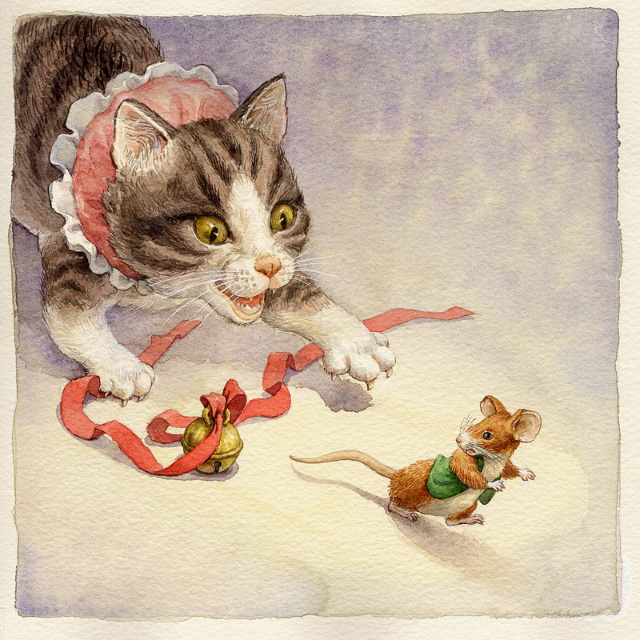
Belling The Cat

There once lived a community of mice in the attic of a house. The mice would sneak into kitchens, gnaw holes in the walls and run about freely. The owners were so fed up that they brought in a cat, causing the mice to all hide in fear. The terrified mice eventually held a meeting to discuss how they would sneak around the house without getting caught by the cat. One mouse suggested: “What if we put a bell around the neck of the cat? Then we can hear it coming and run away.”. The mice unanimously agreed that it was a brilliant idea. However, when they came to decide who would bell the cat, no mouse was brave enough to step forward and the plan was never carried out.

What would actually happen if a cat was belled? Without a doubt, the cat would take it as a cruel, cruel punishment. Not because it cannot catch mice, but because the sound of the bell ringing every time it moves will be extremely loud for the cat. A cat’s hearing is six times better than a human’s. With this excellent hearing, the constant sound of bells attacking its eardrums would be physical torture for the cat.

Furthermore, a cat can hear frequencies as high as 40,000Hz. A person can only hear up to 20,000Hz, meaning a cat hears over twice the range of sounds we can. This combined with the boosted volume results in the cat living in a very noisy world. Ergo, putting a bell around a cat’s neck is an extremely atrocious thing to do.

Posted in Science & Nature

Cattle Mutilation

For decades, there have been case reports by farmers who found mysteriously dead cattle with strange, surgically precise wounds. Strangely, these corpses were split open and most of their soft organs (e.g. eyes, tongues, intestine, genitals) had been removed. Even stranger, the corpses were completely drained of blood.

The mysterious, mutilated cattle corpses set off a diverse range of conspiracies of what could have caused such a bizarre phenomena. The most popular theories included: alien experimentation (explaining the surgical precision and lack of blood and organs), sacrifice by cults, vampires and the El Chupacabra (a mythological vampiric beast).

Cattle mutilation became so well-known that during the 70’s, it was properly investigated by the FBI. Of course, no evidence was found of aliens and vampires. As with most supernatural phenomena, cattle mutilation could be logically explained by science.

It was found that the cattle had simply died of natural causes, with no foul play involved (other than the occasional psychopaths attacking cattle). But how could natural death cause the surgical wounds, the missing organs and lack of blood? The answer is obvious when one thinks of what happens to animals after they die.

Scavengers such as foxes and buzzards often feast on decomposing corpses, cleanly removing the soft organs before they rot away (organs are the first to spoil). As scavengers usually bite into the corpses, this does not explain the clean wounds. This phenomena is due to insects also feasting on the corpse – a key part in putrefaction. Insects prefer softer tissue such as organs and ragged wounds, so after the insects are finished, wounds often look extremely clean. Also, putrefaction of tissue leads to massive gas production, causing bloating. Once this reaches a peak, the cattle corpse bursts like a balloon, causing clean tears in the abdomen. Lastly, the flies that were involved in cleaning away organs lay eggs, which hatch into maggots. Maggots immediately eat away the dead flesh and organs, even sucking up the blood that pooled at the bottom of the corpse. All of these factors combined results in what appears to be a mysterious alien bovine autopsy.

Although this may sound crazier than Chupacabras, the theory was actually tested in 1979 by a sheriff who kept receiving complaints about cattle mutilation. He took a dead cow, left it on a field and filmed it for 48 hours. The video clearly showed each step described above, proving that cattle mutilation was simply Mother Nature’s cruel, vicious way of returning a corpse back to the soil.

Posted in Science & Nature

Clarke’s Three Laws Of Prediction

The following are three laws conjectured by acclaimed science fiction author, Arthur C. Clarke, regarding predicting the future.

  1. When a distinguished but elderly scientist states that something is possible, he is almost certainly right. When he states that something is impossible, he is very probably wrong.
  2. The only way of discovering the limits of the possible is to venture a little way past them into the impossible.
  3. Any sufficiently advanced technology is indistinguishable from magic.

Posted in Science & Nature

Cryptography: Book Cipher

So far, the three ciphers introduced could all easily be cracked using frequency analysis and the Kasiski examination. Is there a cipher that is easy to implement yet difficult to break for a beginner cryptanalyst? An extremely popular and surprisingly powerful cipher is the book cipher. Essentially, the book cipher replaces a keyword with an entire book. Instead of replacing a letter for a letter or symbol in a systematic and mathematical way (such as a set shift number or using a tabula recta), the book cipher replaces letters for numbers that refer to a certain text within a book. As the only way to decode the message is to have the book, it is an extremely secure way of enciphering a message given that both parties have an identical copy of the book.

There are many variations of the book cipher. The most popular type is giving a page number, with the first letter of the page being the plaintext. A variant of this is giving a set of three numbers for every letter: the page number, the line number and the word number (or just two: page and line, then take the first letter). Ironically, this may be less secure at times as it may reveal that it is a book cipher. However, doing this for each letter makes the enciphering and deciphering process incredibly long and arduous.

A shortcut method is to refer to a word within a page (using the three-number set coordinates method described above) to shorten the ciphertext. Although this method is much easier in practice, it poses the challenge of finding a book that includes all the words in the plaintext, which may be difficult if the code is for military or espionage purposes.

Because of this, and the fact that both parties (or everyone in the ring) need identical versions of the book while not standing out too much, the most common books used are the dictionary (typically a famous version such as the Oxford Dictionary) or the bible (again, a standard version is used). These books are not only good because they incorporate a massive vocabulary, but they are also inconspicuous while being carried around in an enemy territory.

The book cipher is a very difficult code to crack for most people without advanced cryptanalysis training. Thus, the easiest way to crack is to deduce what book is the keytext. There are numerous ways to do this, but one way would be to cross-match the books of two known spies until common books are found. In the setting of spies in a foreign country, a book such as a traveller’s guide or phrasebook dictionary can be considered a likely target as it can be carried around easily while containing many words. Ergo, the secret behind cracking the book cipher is less about cryptography and more about using the science of deduction.