Posted in Science & Nature

Bamboo

There is a bamboo forest on a desert island. How can you use these?

  • If you cut a section of bamboo so that one side is open, one side is closed, it becomes a cup.
  • If you cut a section of bamboo and split it lengthwise, it becomes a dish.
  • If you cut a section of bamboo and cut a wide hole in the side, it becomes a pot.
  • If you cut a section of bamboo and fit a large rock on one end, it becomes a hammer.
  • If you cut a branch of bamboo and craft it, it can be a spoon, fork or chopsticks.
  • If you take a stick of bamboo and tie a string and hook at the end, it becomes a fishing rod.
  • If you take a stick of bamboo and sharpen the end, it becomes a spear.
  • If you take many large bamboo and tie them together, you can make a house, a bed or a raft to escape in.

The most important rule of survival is application.

As an addendum, bamboo is a grass (the largest in the world), not a tree.
This is because its stalk has become hardened yet still hollow, making it look like a tree. However, it has segments, shallow roots and dies after flowering (which can take decades) that are features of grass.

Posted in Philosophy

The Truth Lies Within The Finger

A wise man points at the moon, but the fool looks at the finger. (Chinese proverb)

The wise man explains that his finger is not important and what should be looked at is the moon, but the fool carefully listens to him and thinks that he is a very good speaker. (a modern adaptation of the proverb)

The wise man pleads the fool to look at the damn moon, but the fool is only afraid and does not look up. (a very modern adaptation of the proverb)

The wise man finally gives up talking about the moon and instead starts talking about his finger, which he thinks the fool will be more interested in. The fool then says to himself, that the wise man is someone who is able to explain his own stories to others in an easily understandable manner, and that he can talk about any subject – even a random thing such as a finger. (an even more modern adaptation of the proverb)

When the wise man dies, the fool asks himself: “So really, what was it the wise man tried to explain to us lifting his finger so high?” (the ultimate adaptation of the proverb)

(from Paradise by Bernard Werber)

Posted in Psychology & Medicine

Sleep Paralysis

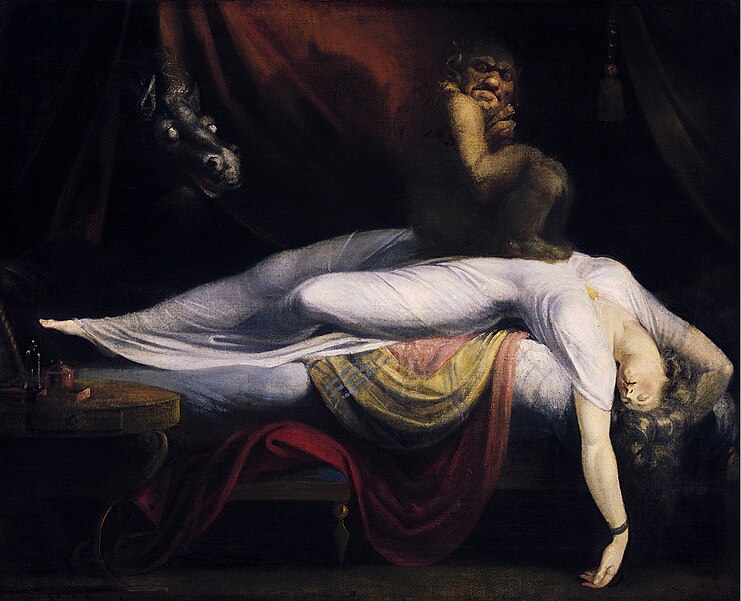
Sometimes just before you fall asleep, or just after you wake up, it is impossible to move any muscles. The panic caused by this sudden paralysis is soon followed by a sense of impending doom and unknown horror. When trying to look around to figure out what is happening, you see a ghost or demon sitting on your chest, pinning you down.
This is a typical scenario of sleep paralysis. It occurs when the mind wakes up before the body (in loose terms) and is experienced by everyone at least once throughout their life. 

Sleep is divided into two phases: REM (rapid eye movement) sleep and non-REM sleep. These two phases cycle to make up sleep at a 1:3 ratio (i.e. about 90 minutes non-REM, 30 minutes REM, repeat). NREM sleep is often thought of as “shallow sleep”, but this is incorrect as the third phase of NREM is literally “deep sleep”. This is followed by REM sleep, characterised by relaxation of muscle tone and the eyes darting in all directions (rapid eye movements). The brain cuts off motor signals to the body during REM sleep to prevent it acting out the movements in a dream (without this, many people would injure themselves or others during sleep). For example, patients suffering from diseases such as Parkinson’s disease with REM sleep disorder show vigorous movements during sleep, often hitting their partners in the process.

The problem occurs when the onset of REM atonia (relaxation) comes before the person fully falls asleep, or fails to disappear after waking up. As the motor system has been shut down, the muscles cannot be moved yet the person has regained consciousness. The more frightening thing is that sleep paralysis is usually accompanied by an intense visual and auditory hallucination, which is almost always related the person’s worst nightmares and fears. This explains why so many cultures associate it with demons and ghosts, and it is also possibly the cause of alien abduction experiences and ghost sightings. Reason being, the hallucination is so vivid the person easily believes that it actually happened.

Sleep paralysis can be caused by excessive drinking, stress or the induction of lucid dreams, but tend to be spontaneous and can happen to you on any day.

Posted in History & Literature

Unicorn

The unicorn is pictured as a white stallion with a single, prominent horn on its forehead. It is still loved and is one of the most well-known mythical creatures. As with any mythical beasts, there are interesting stories related to the unicorn.

The horn is the source of the unicorn’s strength – the infinite fountain of magical power that grants the unicorn unmatched strength and speed. If it meets an enemy it either sprints and disappears, or uses its large weapon to impale even the hardest armour. This makes it extremely hard to capture.

Medieval people believed the horn of the unicorn to be a highly valuable magic ingredient, with extremely potent cleansing properties that could purify even lakes and seas. But as the only way to attain the horn is to capture a unicorn, it was an extremely rare commodity.
To catch a unicorn, one must know its most important (yet not well-known in the modern age) trait. Although they are wild beasts with a savage temper, they calm down like lamb in front of one group of people – virgin maidens. If it detects even the faintest scent of a virgin, it rushes towards her and places its head on her lap, soundly falling asleep. Due to this characteristic, it is often portrayed as a symbol of purity and chastity, and also Jesus Christ and the Virgin Mary.
According to notes written by Leonardo Da Vinci himself, hunters used this trick to capture unicorns that would fall asleep on a virgin’s lap (whom they brought with them to aide in the hunt). Even a mighty beast has a weakness that can be exploited.

On a side note, it is also written that if the unicorn senses that the maiden is not a virgin, it would instantly use its large weapon to impale her until death.

Posted in Philosophy

Two Clocks

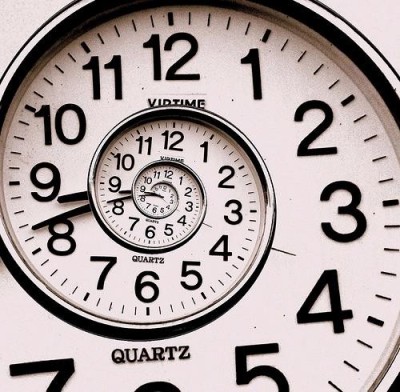
There are two clocks: a still clock and a clock that is always a minute late.
Which clock is more accurate?

The answer is the still clock – it tells the correct time twice every day, but the other clock is always wrong despite the fact that it constantly ticks.
Sometimes when life gets you down, it is better to stop and rest instead of trudging on forever, always out of sync.

Posted in Science & Nature

Trophallaxis

One of the key characteristics of social animals is the act of helping other members of the society. People often think that nature is ruled by “the survival of the fittest” and selfishness for survival, but societies are common in the animal kingdom. For example, even insects, that people consider “inferior”, such as ants build massive empires and cities, forming an unbelievably intricate and efficient society.

In the wild, all animals must find food to live, but due to competition and the environmental conditions, there are days when an animal cannot find enough food. For times like this, ants have a second communal stomach which they fill with leftover food after a meal. They then approach a hungry colony member and offers it a meal. If the other ant accepts, the two ants then lock their mouths together and one ant brings up the food in the communal stomach into the other ant’s mouth. Benefaction such as this allows for a smooth functioning of the society.

There is another role of trophallaxis (the transfer of nutrients via the mouth-to-mouth route described above): communication. Ants rub their antennae together to identify each other’s pheromones, which acts as identification such as what colony they are from and their role in the colony. Some scholars suggest that trophallaxis is the origin of the kiss.

The act of offering pre-stored food to comrades is also found in vertebrates such as birds and bats. For instance, some species of birds feed, return to its nest and then vomits the food for the young to feed on.
Helping those in need to create an efficient and functional society, and reaping the rewards of quid pro quo: that is the way of the philosophy of 1 + 1 = 3.

Posted in Life & Happiness

Eleusis Game

The victory condition for this card game, named after an ancient Greek city, is quite simple: discover the pre-determined law via induction.
This game needs at least four people, with one person acting the position of God. God decides on a certain law (in the form of a single statement) and writes it down on a paper, thus creating the way of the universe
Next, the deck of cards is split evenly between the other players, then one person places a card in the centre. After “the world begins to exist”, God looks at the card and says “This card qualifies” or “This card fails”. The next player also places a card in the centre and the God judges whether it fits the way of the universe.

Players carefully study which cards qualify or fail to try discover the way of the universe. If someone thinks they figured the law out, he or she proclaims themself as the prophet, who begins to take over the role of God to announce whether the cards qualify or not. If at any point the prophet is wrong, he is dismissed. If the prophet correctly judges ten cards in a row, he states his hypothesised law and compares it to the piece of paper. The prophet wins if the two laws coincide, but is dismissed if it is not. When all 52 cards are played without a successful prophet, God becomes victorious.

However, as this is a game, the way of the universe cannot be too complex. To make it fun, the God player must devise a law that is simple yet difficult to discover. For example, the law “Alternate a card higher than 9 and a card lower than 9” is tricky as players tend to focus on picture cards or the colours of the cards. Also, laws such as “Only red cards qualify, except the tenth and thirtieth cards are disqualified” and “Accept all cards that are not the 7 of Hearts” are illegal, as they are too detailed. A God who comes up with such ways of the universe that cannot be found using logic and the scientific method loses his right to play the game. Ergo, the God must seek simplicity that is not easily conceived.

So what is the most successful strategy for this game? Even if there is the risk of being dismissed, proclaim yourself as the prophet as soon as possible for the best chance of winning.

(Sourcehttp://iraka.deviantart.com/art/Playing-his-cards-right-55647521?q=boost%3Apopular%20in%3Aphotography%20playing%20cards&qo=21)

Posted in Psychology & Medicine

Cognitive Dissonance

When two conflicting ideas exist at the same time in the human mind, it causes uneasiness and discomfort. Human beings instinctively tried to reduce the dissonance, most easily achieved by adaptation and blaming. For example, when a person wants something strongly but cannot attain it, they choose to believe that they do not want it any longer, discarding one idea to dissolve the dissonance.

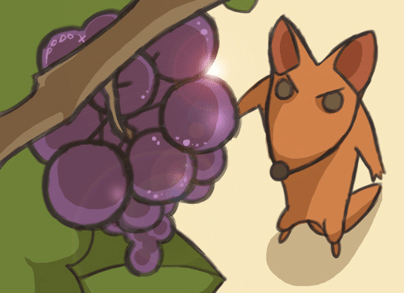
A famous portrayal of this condition is Aesop’s fable The Fox and the Grapes, which goes as following:

A fox sees a grape on a tree and wants to eat it. However, the grape is too high up, so the fox says “That grape is surely sour.” and turns away.

This fable shows the classic pattern of: Wants something -> finds it unattainable
-> criticises it to reduce their want, and ultimately the dissonance caused by it.

This effect is quite powerful and explains many of mankind’s unique behaviours. As stated above, people try to reduce the dissonance by justification, denial and even blaming a third party to ease their mind.
Interestingly, the act of “justification” is brought on by another human feature: arrogance. Most people consider themselves intelligent and always making the right decisions, ergo when they make a mistake it conflicts with their self-image. Instead of accepting that they made a mistake (thus altering their image), they instead believe that they intended that action. This belief is so strong that they do not even know the justification happened subconsciously.

For example, there is a phenomenon called buyer’s remorse, where a buyer finds a flaw or a better product after buying something, feeling remorse (which is due to the discomfort caused by cognitive dissonance). Instead of blaming themselves, people will justify their reasons for buying that product, and paradoxically value that item even more. This shows how cognitive dissonance can be seen everywhere in everyday life.

In short, people cannot accept paradoxes, believe they always make the right decisions, and twist reality and make excuses when it does not fit what they desire. People are fascinating.

Posted in History & Literature

Mayday

Mayday is the universal phrase for requesting emergency assistance in a crisis situation on the sea or in the air. 

It was first created by Frederick Stanley Mockford, who was a senior radio office trying to figure out a simple distress call sign. As he worked at Croydon Airport, London, and dealt with traffic mainly between England and France, he decided on the word mayday, which is derived from the French words venez m’aider, meaning “come help me”.

Another famous distress call is SOS, or  … – – – … in Morse code. It was first used by German radios but then became the worldwide standard in 1906. Although it is often thought to stand for “save our souls”, it is in fact a backronym that was made decades after it came to be. Instead, it was chosen as it is simple to remember (the backronym may have been devised to help people remember the letters) and easy to signal via Morse code. It was most famously used by the RMS Titanic

The reason why mayday was created (and set as a standard in 1927) was due to the need for a spoken word as the audio radio transmitters were developed.

Posted in Life & Happiness

Feynman Problem Solving Algorithm

Richard Feynman is a world-renowned genius physicist, famous for his ability of solving some of the most difficult problems in physics. He said that his intelligence was all thanks to his unique yet “normal” problem solving method, which he used to solve most of his problems. Here is the algorithm:

    1.  Write down the problem.
    2.  Think very deeply.
    3.  Write down the answer.

If that does not yield the answer:

    4.  Sleep.
    5.  Wake up, then think deeply again.
    6.  Write down the answer.

Nothing is impossible.