Posted in History & Literature

Sandwich

Although the concept of eating two pieces of bread with meat and vegetables in between has existed since the invention of bread, the word “sandwich” is a much more recent invention. 

During the 18th century, there was an aristocrat called John Montagu, 4th Earl of Sandwich who loved to gamble. He loved gambling so much that he barely had time to eat a proper meal, so he frequently ordered simple foods from his servants.

His favourite was two pieces of bread with sliced meat in between. Every time he gambled with his friends, he would order this snack from his servants and his friends would say “the same as Sandwich!” when ordering. This playful comment stuck over time and people began officially naming the type of food a “sandwich”.

A sandwich is the perfect snack invented just for those who have no time or are too lazy.

Posted in Science & Nature

Fermat’s Last Theorem

In the 17th century, a lawyer called Pierre de Fermat conjectured many theorems while reading a mathematics textbook called Arithmetica, written by an ancient Greek mathematician called Diophantus. He wrote his theorems on the margins of the books. After his death, a version of the Arithmetica with Fermat’s theorems was published and many mathematicians checked over Fermat’s proofs. However, there was one theorem that could not be solved. Fermat wrote on the theorem: “I found an amazing proof but it is too large to fit in this margin”.

Fermat’s last theorem is as follows:

No three positive integers x, y, and z can satisfy the equation
xⁿ + yⁿ = zⁿ for any integer value of n greater than two.

For example, x² + y² = z² can be solved using Pythaogorean triplets (e.g. 3, 4, 5) but there are no values for x, y and z that solves x³ + y³ = z³. This theorem remained unsolved for 357 years until Andrew Wiles finally found the proof in 1995.

There are many stories surrounding Fermat’s last theorem, but by far the most interesting is related to suicide. In 1908, a German mathematician called Paul Wolfskehl decided to kill himself after being cold-heartedly rejected by the woman he loved so much. He decided to shoot himself at midnight and in the remaining time started reading some mathematics texts until he found a flaw in Kummer’s theory, which disproved Cauchy and Lamé’s solution (the leading solution at the time. After Kummer’s essay, most mathematicians of the time gave up on Fermat’s last theorem). After researching Kummer’s essay, Wolfskehl found that it was far past midnight and he felt great pride in reinforcing Kummer’s solution. His depression was gone and through mathematics he found new meaning in his life. Wolfskehl, who believed that the theorem saved his life, made a resolution to donate his wealth to whoever solved Fermat’s last theorem, putting up 100,000 marks as a prize. This prize was claimed by Wiles in 1996 (then worth $50,000).

image

Posted in History & Literature

Whaling

The Faroe Islands are a group of islands between Scotland and Iceland in the North Atlantic Ocean. Although a small nation, they are known to the outside world for their tradition of whaling – specifically pilot whales that are native to the North Atlantic Ocean. The media often show photos of bloody shorelines with a line of whale carcasses, decrying the so-called “inhumane hunting” of the whales. The dramatic scene and cuteness of the whales seems to appeal to the masses and has caused quite a controversy regarding the Faroese tradition, known as grindadráp. However, the media often tells a misinformed story regarding the whaling. One thing to know is that Faroese whaling is fundamentally different to whaling seen in other parts of the world, such as Japanese whaling. 

The Faroese have been killing pilot whales for food for the past millennium and have done so in the most humane and sustainable way possible. Despite popular belief, the pilot whales are not endangered and in fact overpopulated in the North Atlantic Ocean. As they are carnivorous, an overpopulation of the whales causes a shortage in fish. Fishing is the major industry in the Faroe Islands and constitutes their livelihood; so ironically, the pilot whales can endanger the Faroese people by consuming all the fish in the surrounding sea. Thus, the Faroese kill a small portion of the whale population (roughly 0.1%, a completely sustainable rate) to balance the ecosystem while protecting their most important industry and their livelihood.

Faroese whaling is not commercial and only enough whales are killed to provide enough food for the people (equally distributed to the participating families). The killing is not for fun or money, but simply to support the lives of the people. As such, the Faroese have also come up with the most humane way to kill the animals.

When whaling season starts and the pilot whales come near the shore, “drives” are initiated where a semi-circle of boats herd nearby whales towards the shoreline (only whales near the shoreline are killed). When the whales approach the shore, the people use blunt blowhole hooks that catch the whales without causing wounds (unlike harpoons and spears) and draw them closer to shore. Only adult males are drawn in (no females or babies) and only enough that can be killed swiftly are drawn in.

Once drawn in, the men quickly use their knives to cut the spinal cord and artery supplying the brain, killing the whale within 15 seconds of being beached. It is the quickest and most painless way to kill the whales and only those who have been trained to do it properly are allowed to kill. As a major artery is cut and whales are big mammals, a large volume of blood is released, dying the sea a bloody red colour.
The whales are then divvied up equally, with no part of the whale going to waste. As only nearby whales are killed, sometimes no whales are killed for years.

Unfortunately, due to pollution in the ocean, there have been increasing levels of heavy metals such as mercury found in the whale meat. This is endangering the health of the island population and the deeply engrained tradition of grindadráp. The saddest part is that the pollution is from industrialised countries such as USA and European countries, not the Faroe Islands. Yet the Faroese have to put up with bigotry from those who do not understand the culture, process or the reasoning behind the tradition. If anything, it is by far more humane and sustainable than killing animals after a lifetime of captivity then sending them to a slaughterhouse.

It is extremely important to see the truth behind controversial issues such as this, as more often than not the truth is shrouded by bigotry and subjective comments by people who have only seen the issue through some photographs on the internet.

image

(Notice the single, deep horizontal slash through the dorsal aspect of the spinal cord, just before the brainstem. Such a cut would immediately sever any pain signals and cause almost instant unconsciousness due to ischaemia of the brain.)

Posted in Psychology & Medicine

Emotion

Unless you are a psychopath, as a human being you are bound to feel emotions. Love, happiness, anger, sadness… there are many emotions that range from simple to complex. Emotions are an interesting system as they allow us to respond rapidly to a situation without thinking, while alerting other members of our society to what is happening to us. Essentially, emotions help us in survival and social interactions. 

According to Professor Paul Ekman, emotions are universal from culture to culture, with facial expressions being almost identical from tribal cultures to modern ones. He found that there are six major emotions: anger, fear, disgust, sadness, surprise and happiness. He also pioneered the field of micro-expressions, which studies the flickering change in our facial expressions whenever we feel a certain emotion. As emotions usually occur before the conscious mind thinks, we are often unaware of the expressions we make.

Another psychologist, Dr. Paul Gilbert, divided emotions into three affect systems. They are as follows:

  • Threat/protection system: associated with the fight-or-flight response, activates in response to danger. It causes anger and fear and is related to catecholamines (e.g. adrenaline) and cortisol (stress hormone).
  • Want/desire system: associated with hunting and rewarding behaviour, helps us perform actions that aids survival such as obtaining food and mates. It is related to the emotion of excitement, which is caused by the neurotransmitter dopamine (part of the reward system).
  • Contentment system: associated with met needs and social connection, especially when we feel safe and relaxed. It produces feelings of happiness and peace, linked to the hormone oxytocin (released with human touch, especially during kissing).

Dr. Gilbert also posited that as societies have evolved over time, our affect systems have been altered. For example, despite the lack of natural predators around, urban dwellers are often in a state of high anxiety. This causes a sustained stress response, leading to negative health outcomes. Furthermore, the agitation and the paranoia caused by constant fear leads to crimes such as murder and war. Our want/desire system has also been heightened as we find pleasure in gaining material wealth. This has led to aggressive capitalism, exploiting other people and the environment for selfish gain.

On the other hand, the contentment system has shrunk. People feel less content despite being in a generally healthier and richer world than 100 years ago. The reason being, our brain has evolved to help us survive, not to keep us happy. 

One must learn how to adapt to these changes by finding a way to relieve tension and stress, while finding inner peace and happiness. Whether it be through sports, music, humour or simply talking to another person, finding your own way to deal with anxiety is the best road to being happy and content.

Posted in Science & Nature

Duel

Three gunslingers called Good, Bad and Ugly duel to the death. They each stand an equal distance from each other and shoot at the same time. Good’s accuracy is 30%, Ugly’s accuracy is 70% and Bad’s accuracy is 100%. Who has the highest chance of survival?

Common sense dictates that Bad, with the highest accuracy, will have the highest survival rate. However, when the duel begins, the following scenario will occur.

Good’s most rational decision is to shoot Bad rather than Ugly. Reason being, shooting the person with the higher accuracy improves your survival rate in the next round. Ugly also chooses to shoot Bad instead of Good as it is the best choice. Lastly, Bad shoots Ugly instead of Good. This scenario can be explained by the following diagram:

Thus, the probability of Bad being alive after the first round is (1-0.3)(1-0.7)=0.21, or 21%. This is because Ugly is killed by Bad on the first shot. On the second round, the probability of Good dying is the same as Bad’s survival rate of the first round, which is 21%. Therefore, Good’s survival rate is 79%. On the other hand, Bad’s survival rate becomes 0.21(1-0.3)=0.147, or 14.7%

Ultimately, the survival rate of each shooter is: Ugly 0%, Bad 14.7%, Good 21%, making Good the most likely winner. This illustrates the fundamental principles of game theory – an extremely useful theory that helps predict the many choices we make in life.

Posted in History & Literature

Election

If you think of an election as a game, it is a rather fascinating game. Let us pretend that you are a player participating in a game called Elections. As a player, what is the most rational decision you can make?

The obvious answer is to not vote on the day of the election and do something else instead. As elections tend to be decided by a significant difference in the number of votes between parties, the probability that your single vote will make a difference is near 0. Ergo, instead of wasting your time submitting a vote that will have virtually no effect on the results, you are better off doing something more productive.

However, despite this, there are fools who vote in every election. The fools’ votes pile up and make the world keep on moving forward.

Posted in Life & Happiness

Specialist

In modern ant cities, there can be found many genetic mutations as a result of millennia of division of labour. Thus, ants born with large mandibles that can cut down enemies become soldier ants, while ants born with mandibles that can grind grains become milling ants. Some ants have highly advanced salivary glands and these ants wash and disinfect young larvae.

Here are some examples of the amazing adaptability of ants through the use of mutations:

  • Doorkeeper ants have large, flat heads that can block strategically important entry points to guard the hive. If a worker ant wishes to enter the hive, it must knock on the broad head. If it gives the wrong password, the living door attacks and devours the worker ant.
  • Honeypot ants are found in some tropical ant species. These worker ants are hung upside down on the ceiling and are filled with honey until their abdomens swell up to 20 times the normal size. When another ant comes and strokes the honeypot ant, it releases a few drops of honey it is storing.

However, out of all of these mutations that produce “specialists”, the most noticeable is the mutation that produced specialists of love.
Worker ants are born without the ability to reproduce. This is to prevent these busy worker ants from being distracted from sexual impulses. Reproduction is left to certain ants that do nothing other than reproduce. These ants are the male and female ants – essentially the princes and princesses of the ant kingdom. These ants are born only to make love and have special anatomical features that make the mating process easier. Wings that allow them to fly, antennae that allow the communication of abstract emotions and eyes that can sense infrared light are all examples of this.

How about human beings? We too have “specialists”, but they are not based on features we are born with. Instead, they are a result of the education and upbringing we receive as we grow up – an acquired specialisation rather than a natural one. Then again, it is not as if we are all born equal. Some people are born with a more muscular body that is helpful for labour-intensive work, while others are born with more intelligent brains that are better for jobs that require much thinking. However, our societies have a strange style of oppressing these natural talents and only push study on them. No matter how good a child is at the arts, music or sports, their abilities are ignored and the children are forced to conform into a pre-set path. If a child is introverted and prefer working quietly indoors, they are told off and told to become more extroverted. Ultimately, human societies prefer producing all-round individuals rather than specialists in a certain trade.

But what if we did what ants did and recognise a child’s natural talents and nurture it? The Jewish people have followed a system of education that focusses on helping a child develop their own skill instead of forcing something on them. Considering that 18 of the 40 richest people in USA are Jewish, it could be suggested that this is a very effective form of educating children.

Then why do so many parents want their children to become doctors, lawyers and CEOs? The reason is capitalism. Given the characteristics of the jobs, they are comparatively better paid and more stable than workers and artists. Ergo, parents push children towards such professions “for the sake of their future”. Even though many other professions are required for the smooth functioning of society. If so, could we not equalise the pay of all jobs? Unfortunately, this was tried in communist states but tragically failed as the incentive to study and go into such professions disappeared as the pay was “not worth it”. In fact, the major reason for the downfall of communism was human greed. As ants work for the good of the society rather than the individual, they have the luxury of doing the job they were literally born for and still be well-nourished.

Then what if we paid salaries not equally, but fairly? For example, instead of giving everyone the same pay, we pay people according to the amount of work they do, regardless of the profession. If we distributed the unnecessarily high amounts of wealth of politicians and upper class have to fund the wages of technicians and artists, the income gap between jobs would disappear and children would receive the same reward for whatever profession they chose (given it helps society). If this was implemented, then everyone would be able to bring out their strongest trade and significantly boost productivity. Furthermore, the tragedy of having to give up something you want to do for the sake of money would disappear. If we can find a way to overcome human greed and make equitable distribution of wealth possible, human societies would be able to kill two birds with one stone – progress and happiness.

(first half from the Encyclopaedia of Relative and Absolute Knowledge by Bernard Werber, second half from author’s original thoughts)
(Image Sourcehttp://www.behance.net/gallery/Collages-ABC-of-professions/237797, see source for description of each letter (professions in French))

Posted in Psychology & Medicine

Symptom Reporting

Some people always complain of symptoms, claiming that they are sick, while some people never seem to complain even if they have a whole list of symptoms. Why is there a difference in symptom reporting between people? For example, women are more likely to recognise symptoms and report them compared to men. This is because men are generally under the social pressure of needing to appear strong and healthy, so they become stoic and less sensitive to pain and disease. Women are usually more sensitive to internal bodily changes and worry more about their health.

According to a psychological theory called the competition for cues hypothesis, there are two signals that compete for attention when we recognise symptoms. The first is bodily changes, i.e. internal cues, while the other is external stimuli from what happens around us. Awareness of symptoms follows a ratio between these two signals: if there is a strong internal cue such as severe pain, we notice symptoms more quickly, while if there are many distractions, we may not notice the symptom. For example, according to a study people can run faster when listening to music and running through a forest with plenty to see. This is because music and the scenery distract the runner from internal cues. As we can only process a certain amount of information at a given moment, the more distractions there are the less sensitive we become to signals from inside our body.

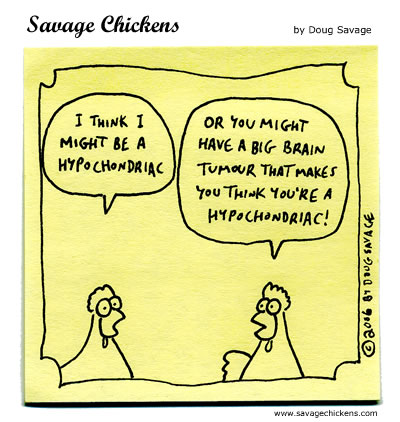
Another factor that affects symptom reporting is illness labelling. The more information we have about a disease, the more we search for those symptoms. For example, if you yawn or scratch yourself, people around you will do the same. This is because they see you yawning and subconsciously believe that they should yawn too. This can be a powerful effect, as seen in mass hysteria. This strange phenomenon occurs when a person observes a sick person and their brain believes they are sick too, beginning to show symptoms despite being healthy. A similar example is seen in medical student disease, where medical students, with their extensive knowledge of diseases, match their own symptoms to symptom lists of rare diseases. For example, they might think that their high blood pressure is due to a phaeochromocytoma or renal artery stenosis, rather than just hypertension.

However, the opposite can occur where people fail to notice important symptoms and suffer serious consequences as a result. For instance, not all cases of heart attacks (myocardial infarction) cause unconsciousness and a patient may believe they are fine when only chest pain occurs. Failure to get treated as soon as possible at a hospital may result in ventricular fibrillation, leading to sudden death.

Posted in History & Literature

The Great Dictator

The following is the final speech given by Charlie Chaplin in the movie The Great Dictator (1940). To this day, it is considered one of the most inspirational speeches in modern history. (NB: video excerpt at the end)

“I’m sorry, but I don’t want to be an emperor. That’s not my business. I don’t want to rule or conquer anyone. I should like to help everyone, if possible, Jew, gentile, black man, white. We all want to help one another. Human beings are like that. We want to live by each other’s happiness – not by each other’s misery. We don’t want to hate and despise one another.

In this world there is room for everyone. And the good earth is rich and can provide for everyone. The way of life can be free and beautiful, but we have lost the way. Greed has poisoned men’s souls, has barricaded the world with hate, has goose-stepped us into misery and bloodshed. We have developed speed, but we have shut ourselves in. Machinery that gives abundance has left us in want. Our knowledge has made us cynical. Our cleverness, hard and unkind. We think too much and feel too little. More than machinery we need humanity. More than cleverness we need kindness and gentleness. Without these qualities, life will be violent and all will be lost.

The aeroplane and the radio have brought us closer together. The very nature of these inventions cries out for the goodness in men, cries out for universal brotherhood, for the unity of us all. Even now my voice is reaching millions throughout the world – millions of despairing men, women and little children – victims of a system that makes men torture and imprison innocent people. To those who can hear me, I say – do not despair. The misery that is now upon us is but the passing of greed – the bitterness of men who fear the way of human progress. The hate of men will pass, and dictators die, and the power they took from the people will return to the people and so long as men die, liberty will never perish.

Soldiers! Don’t give yourselves to brutes – men who despise you – enslave you – who regiment your lives – tell you what to do – what to think or what to feel! Who drill you, diet you, treat you like cattle, use you as cannon fodder. Don’t give yourselves to these unnatural men – machine men with machine minds and machine hearts! You are not machines! You are not cattle! You are men! You have the love of humanity in your hearts. You don’t hate! Only the unloved hate – the unloved and the unnatural!

Soldiers! Don’t fight for slavery! Fight for liberty! In the 17th Chapter of St. Luke it is written: “the Kingdom of God is within man” – not one man nor a group of men, but in all men! In you! You, the people have the power – the power to create machines. The power to create happiness! You, the people, have the power to make this life free and beautiful, to make this life a wonderful adventure.

Then, in the name of democracy, let us use that power! Let us all unite! Let us fight for a new world, a decent world that will give men a chance to work that will give youth the future and old age a security. By the promise of these things, brutes have risen to power, but they lie! They do not fulfil their promise; they never will. Dictators free themselves, but they enslave the people! Now, let us fight to fulfil that promise! Let us fight to free the world, to do away with national barriers, to do away with greed, with hate and intolerance. Let us fight for a world of reason, a world where science and progress will lead to all men’s happiness.

Soldiers! In the name of democracy, let us all unite!“

Posted in Psychology & Medicine

Sudden Death

Unlike diseases such as tuberculosis or cancer, some disease processes are known to kill a human being within an hour of onset. Other than the obvious causes such as decapitation, massive bleeding or any other trauma-related injuries, these diseases tend to be cardiac or respiratory in origin.

A common example is coronary artery disease, where the blood vessel providing blood to an area of the heart becomes completely blocked by stenosis (narrowing, often by atherosclerosis) or a clot. This results in immediate ischaemia (lack of oxygen) to heart muscles, which causes cell death. This produces scar tissue which disrupts the electrical activity of the heart, which may lead to a condition called ventricular fibrillation where the heart beats in an uncontrolled, erratic manner. When in VF, the heart effectively becomes useless as it cannot coordinate proper pumping function. Blood circulation stops and the patient goes in to multiple organ failure (the brain goes first) within a very short time. Although it can kill within a short time, early identification and treatment may be able to prevent VF from occurring and save the patient’s life. If VF does occur, it is crucial to begin CPR or use a defibrillator if available.

VF can also occur in other situations. For example, there is a genetic condition called long QT syndrome which predisposes the patient to spontaneous arrhythmias (electrical abnormalities in the heart). Even becoming too excited can sometimes set off a VF in some LQTS patients, thus they require an implantable cardioverter-defibrillator (ICD) to shock their heart back in to normal rhythm every time they develop an arrhythmia.

Some other causes of sudden death include: aortic dissection (tearing of the aorta that may cause massive internal bleeding), pulmonary embolism (a clot obstructs blood flow in the lung, stopping circulation), commotio cordis (a blow to the heart at a certain moment in the heart rhythm triggers VF), ruptured brain aneurysm (ballooning of an artery in the brain), anaphylaxis (severe allergic reaction that cuts off airflow to the lungs) and poisoning (various mechanisms, mainly related to disrupting cellular function).

Death can strike swiftly, even from within your body.