Posted in Psychology & Medicine

Laughter Epidemic

It is said that laughter is infectious. In 1962, an extreme case of “laughter infection” happened in village in Tanzania. The phenomenon originated in a boarding school for girls. On January 30, three girls spontaneously burst out in laughter and could not stop themselves from laughing. Soon after, the whole class was suffering from fits of uncontrollable laughter. The “infection” then spread throughout the school, claiming 95 of the 159 students over a stretch of two months. This strange symptom of uncontrollable laughter lasted anywhere from a few hours to 16 days. Interestingly, teachers were not affected and only girls between the ages of 12 to 18 were affected. By March 18, the school was forced to close down due to students not being able to focus during class.

The laughter epidemic was not localised to the school. After the school shut down and the girls returned home, fellow villagers were afflicted by the laughing disease, resulting in 217 villagers being “infected” by May (mostly children and teenagers). By June, the laughing epidemic spread to another nearby school, affecting 48 girls. The epidemic then went on to claim two more schools, forcing them to close down. By the time the epidemic died down (6 to 18 months after “patient zero”), it had affected over a 1000 people and shut down 14 schools.

So what was this strange disease? Was it some new viral infection causing neurological symptoms? Was it a toxin in the water supply? The answer was even simpler: mass psychogenic illness, also known as mass hysteria. Mass hysteria is a psychological phenomenon that occurs in groups placed in high-tension situations, such as within an airplane. This setting is perfect for triggering a mass delusion, causing the person to believe they are suffering from a physical disease. The trigger is usually another “patient” and the hysteria spreads like wildfire, usually by people seeing affected victims. Although the above case makes mass hysteria look like a harmless, amusing phenomenon, psychosomatism (when the mind tricks the body into thinking it is sick) can cause symptoms such rashes, fevers, vomiting and even paralysis. In fact, all of these symptoms were also reported during the Tanganyika laughter epidemic.

Posted in Psychology & Medicine

Left-handedness

Phones, golf clubs, scissors, forks and knives, the order of writing… Almost everything in this world is made for the convenience of right-handed people. Because of this, there is a hypothesis that left-handed people have a relatively shorter life expectancy compared to right-handed people.

Dr. Diane F. Halpern of California State University conducted a research comparing the life expectancy of right-handed people versus left-handed people. The results were astounding; the mean life expectancy of right-handed people was 75, while left-handed people only lived 66 years on average. Dr. Halpern posited that this was due to left-handed people becoming stressed living in a right-handed world, shortening their life expectancy. Of course, there were debates about whether the results were reliable or not and there was heavy opposition from the left-handed community. But if the left-handed people are enraged about being discriminated against by society, this would stress them out and actually shorten their life, so it might not be best not to debate about the issue.

Left-handedness has historically been associated with evil. The word right also means “good”, while left-handedness is formally known as sinistrality, which shares its etymological origin with sinister. The word for right is associated with good things throughout the world, while left is associated with bad things. In Korea, 오른 (oreun, right) has the same pronunciation as 옳은 (orlheun, true)“. The Chinese character for left (左) is also used to mean “improper”. In medieval Europe, left-handed people were thought to be associated with the devil or witches and were often executed. Left-handed people have been unjustly hated throughout time and space.

Posted in Psychology & Medicine

Parent

Parents only have one duty: to bring up their children with love. The problem is that so many parents do not know this fact, or have a twisted understanding of the concept of “love”. Some never even hug their child, some abandon their child for their own lives and some even abuse their child. However, that does not mean one should obsess with their child either. Always teaching the child that “they are the best” is not love. Also, trapping a child and preventing them from leaving you is obsession, not love. Some parents tell their children that studying will lead to a happy, successful future, and compare them to other children who get better grades. This is a crucial mistake, as the children will probably live out an unhappy life with a deep wound in their heart for the rest of their lives. This is because the parents’ role is not to secure a successful future and instructing them how to get there, but to allow the child to independently plan their future, taste failure and develop their own values and philosophy, only supporting them from the side. A parent is not a leader who leads a child along a predestined path of life, but an assistant who supports a child while they pave their own path of life and walk down it. To support and respect a child’s decisions, dreams, talents and potential; to teach the wisdom and skills the child will need to follow their dreams; that is true love.

Of course, that is not to say that one should neglect and leave a child without any interventions. If a child clearly makes an objective error or misbehaves, it is a parent’s role to correct it. This kind of home education is not interference like obsessing about the child’s studies, but supportive intervention that helps the child follow their dreams and not be lost on the way. Home education is a very important form of love that imbues a child with skills such as social skills, ethics, morality, philosophy and love that will allow them to lead a happy and wholesome life.

Why is parental love so important to a child? Childhood is a critical period when the child’s brain is rapidly developing and when the child begins to form his or her personality and view of the world. Almost every mental illness (especially personality disorders) can be traced back to a childhood trauma, or at least be affected by it. For example, a child whose parents did not care for them will grow up lacking love and attachment, leading to constantly seeking love and attention from others, which may develop into dependent personality disorder. If a child has to live up to the parents’ great expectations, they will not receive sympathy and fail to develop a self identity. To fill this void, the child will continuously float from one person to another to seek this sympathy. A child with obsessive parents being led to believe that they are the best could develop narcissistic personality disorder, who becomes violent and enraged when someone points out a mistake they made. As one can see, parental love is a crucial nutrient that fosters a healthy personality in a child, helping them become a wholesome, independent “person”.

No matter how poor the parents are, a child who was raised on love is able to construct a plentiful, happy life. Then, when the child becomes a parent, they will know how to raise their own children with love as well. The best parents are those who respect the child’s decisions and allow them to be free when they set out on their pursuit of happiness. All you need is love.

Posted in Psychology & Medicine

Doorway Amnesia

Have you ever experienced the curious phenomenon where you walk into the kitchen and completely forget why you came there? Or why you stepped out of the house? Almost everyone is struck with this bizarre amnesia at some point in their lives. But why does it happen? Do Men in Black come in and wipe your memory because there was an alien in the room or something? The answer lies in the doors.

It has been scientifically proven that doorways have a magical property of causing memory loss. To be exact, doors do not cause amnesia, but the physical act of passing through a doorway causes the brain to lose memories. The reason for the phenomenon is this. The human brain stores information in a very unique way where it compartmentalises information by physical location. Because of this “filing system”, the thought “I really want cake from the kitchen” that you had in the living room is difficult to access when you are in the kitchen. By crossing a doorway, the brain recognises that the physical location has changed and opens a different “folder”, metaphorically speaking. This system allows for smooth mental functioning usually as it lessens the load on the brain, but also creates confusing situations where you just stand in front of the door, questioning whether you are losing your memory.

In an experiment in France, it was found that when students were told to memorise certain objects and then walk into another room, they had much worse recollection of the objects compared to the control group (students who walked the same distance but not through a door). It was even found that a person did not even have to physically walk through a door to lose their memory. When students were made to repeat the experiment in a virtual setting (i.e. moving a computer character through a door in a game), the same thing happened. The effect was so powerful that the researchers dubbed doorways event erasers.

Although it seems like an inconvenient system, the brain’s special way of compartmentalising information according to physical location can be used to harness the power of complete memory. This is done by using the method of loci, also called the memory palace. This is a mnemonic device first devised by ancient Romans to help memorise a large amount of information. To use the memory palace, you must first visualise a certain location – one that you are familiar enough with to recall with great detail. This may be your room, house, the street you live on, or even a fictional palace. The object of the memory palace is to convert a piece of information into an item which you can place in a certain location in the palace. For example, if you have to memorise a shopping list, you can conjure a mental shelf in your mental palace and put all the items in the shelf. To enhance this effect, make the image as bizarre and fancy as possible, as the mind is prone to remembering weird things more (e.g. a massive apple with eyes and a mouth is more memorable than a normal apple). Once your memory palace is complete, you can take a “mental walk” through the palace, go to the room where the memory you need is stored, and just browse the contents to recall the information. With practice and a vivid imagination, this is an infallible method of remembering anything you want, for as long as you want.

Posted in Psychology & Medicine

Lazarus

In the New Testament of the Bible, there is a scene where Jesus resurrects a man by the name of Lazarus back four days after his death. This “miracle” is of course a fictitious event, but nonetheless, the name Lazarus has come to symbolise resurrection after death. For example, there are two actual medical conditions named after Lazarus, both related to death.

The first is called Lazarus phenomenon, where a person who is declared to be clinically dead spontaneously returns to life. This is an extremely rare event that has only been recorded in about 30 cases. In most of these cases, the patients had suffered a cardiac arrest, with all attempts at resuscitation (e.g. CPR, adrenaline) had failed. Sometime after the person was declared clinically dead (usually around 5~10 minutes), the person’s circulatory system would suddenly start on its own and the person would be “resurrected” (quite literally). In one case, a 61 year-old woman was declared officially dead after her heart stopped and her vitals did not return after continuous resuscitation. At the morgue, however, she was found to have a pulse and breathing on her own. She later sued the hospital for the neurological and physical injury caused by oxygen deprivation during her death. There is even a case report of a patient who returned to life two and a half hours after dying (although he died again 3 weeks later).

Of course, the Lazarus phenomenon is not a miracle. In most cases, it is hypothesised that when resuscitation is attempted then stopped, there is a rare chance of the relieving of pressure causing blood to fill the heart, causing a sudden expansion and kickstarting the electrical circuit. Other factors that may influence this is hyperkalaemia resulting from ischaemia and high doses of adrenaline given to the patient during resuscitation having a delayed effect.
Because of this rare “complication” of death, doctors are advised to observe the patient for about 10 minutes after declaring them dead. Just in case.

The second is called Lazarus sign and it occurs not in dead patients, but brain-dead patients. Brain-dead patients are immobile as their higher functions such as cognition and motor functions are destroyed. However, there are rare cases where the brainstem is somehow stimulated, triggering a reflex arc from the spinal cord. This reflex is seen as the patient suddenly raising their arms and dropping them on their chest in a crossed position, much like Egyptian mummies. As the spinal cord is not usually damaged in brain-dead patients, this reflex arc is possible, similar to a knee jerk reflex. The Lazarus sign should not be misinterpreted as a sign that a brain-dead patient is conscious, as it is an involuntary movement. However, it has been mistaken for the resuscitation of a patient, or in some cases, as a miracle.

image

Posted in Psychology & Medicine

Tit For Tat

In human society, there are many ways for a person to interact with others when in a group setting. Some may choose to be selfish and only be out for their best interests, while others may choose altruism and cooperate with each other. The mathematical model that tries to predict human behaviour and outcome in these settings is the Prisoner’s Dilemma – the core of game theory. Tit for tat is one strategy that can be employed in such a setting.

The basis of tit for tat is equivalent exchange. A tit for tat player always chooses to cooperate unless provoked. As seen in the Prisoner’s Dilemma, if both players cooperate, both benefit (let us say 3 points each); if one player defects, that person gains more than from cooperation (5 points) while the tit for tat player gains 0 points.
If a tit for tat player is provoked, that player will retaliate. However, the player is also quick to forgive. Ergo, if the other player chose to cooperate, the tit for tat player (following the principle of equivalent exchange), will also cooperate. If the other player defected, the tit for tat player loses the first round and then chooses to defect from then on.
Note that tit for tat strategy only works when there is more than one game so that the player has a chance to retaliate.

Let us use an example to illustrate why tit for tat strategy works. In this scenario, two tit for tat players and two defectors all play six games each, using the above point system (if both defect, they each receive 1 point). The results are as follows:
  • Tit for tat vs defector: Tit for tat loses first round, both defect for next 5 rounds (5 vs 10)
  • Tit for tat vs tit for tat: Both cooperate on every round (18 vs 18)
  • Defector vs defector: Both defect on every round (6 vs 6)

When the points are added up, a tit for tat player gains 28 points (5 + 5 + 18) while a defector only gains 26 points (6 + 10 + 10). This is a surprising turn of events, as the defectors never lost a round and tit for tat players never “won” a round. This goes to show how cooperation leads to better long-term results while selfishness prevails.

There are shortcomings of this strategy. If there is a failure in communication and one tit for tat player mistakes the other’s actions as an “attack”, they will retaliate. The other player then retaliates to this and a vicious cycle is formed. This is the basis of many conflicts ranging from schoolyard fights to wars (although interestingly, tit for tat strategy is also found during wars in the form of “live and let live”). One way to prevent this is tit for tat with forgiveness, where one player randomly cooperates to try break the cycle (a defector would respond negatively while a tit for tat player will accept the cooperation), or the tit for two tats, where the tit for tat player waits a turn before retaliating, giving the opponent a chance to “make up for their mistake”.

Computer simulations have all proven that tit for tat strategy (especially the other two types mentioned just before) are extremely effective in games. In fact, it is considered one of the most optimal strategies in overcoming the Prisoner’s Dilemma.

In human societies, there is usually a mix of “nice people” and “selfish people”. By cooperating and trusting each other, we can produce a much greater gain over time compared to being selfish. And since society still unfortunately has “defectors”, you can retaliate to those who refuse to cooperate by defecting on them also. Ergo, a good approach to life is to initially reach out your hand to whoever you meet and treat them from there on according to how they respond. If they take your hand and want to cooperate, treat them with altruism and help them out. If they swat your hand away and try to use you for their selfish gain, it is fine to shun them and not help them out.

Through cooperation, understanding and connection, we can build a far more productive and efficient society, just like the ants.

Posted in Psychology & Medicine

Abilene Paradox

On a hot afternoon visiting in Coleman, Texas, the family is comfortably playing dominoes on a porch, until the father-in-law suggests that they take a trip to Abilene (a city 53 miles north of Coleman) for dinner. The wife says, “Sounds like a great idea.” The husband, despite having reservations because the drive is long and hot, thinks that his preferences must be out-of-step with the group and says, “Sounds good to me. I just hope your mother wants to go.” The mother-in-law then says, “Of course I want to go. I haven’t been to Abilene in a long time.”

The drive is hot, dusty, and long. When they arrive at the cafeteria, the food is as bad as the drive. They arrive back home four hours later, exhausted. One of them dishonestly says, “It was a great trip, wasn’t it?” The mother-in-law says that, actually, she would rather have stayed home, but went along since the other three were so enthusiastic. The husband says, “I wasn’t delighted to be doing what we were doing. I only went to satisfy the rest of you.” The wife says, “I just went along to keep you happy. I would have had to be crazy to want to go out in the heat like that.” The father-in-law then says that he only suggested it because he thought the others might be bored.

The group sits back, perplexed that they together decided to take a trip which none of them wanted. They each would have preferred to sit comfortably, but did not admit to it when they still had time to enjoy the afternoon.

This anecdote was written by management expert Jerry B. Harvey to elucidate a paradox found in human nature, where a group of people collectively decide on a course of action that is against the best wishes of any individual in the group. Essentially, the group agrees to do something that would not benefit any one, or the group as a whole. This is the Abilene paradox, colloquially known to us through the idiom: “do not rock the boat”.

As seen in the anecdote, there is a breakdown of communication where each member assumes that the majority of the group will decide to follow the action, pushing them towards conformity. There is a mutual mistaken belief that everyone wants the action when no one does, leading to no one raising objections. This is a type of phenomenon called groupthink (coined by George Orwell in his dystopian novel, Nineteen Eighty-Four), where people do not present alternatives or objections, or even voicing their opinions simply because they believe that will ruin the harmony of the group. They are also under peer-pressure, believing that by being the one voice against the unanimous decision they will become ostracised.

The Abilene paradox explains why poor decisions are made by businesses, especially in committees. Because no one objects to a bad idea (falsely believing that that is what the group wants), even bad ideas are accepted unanimously. This is particularly dangerous when combined with cognitive dissonance, where the group will believe that they chose that decision because it was rational and logical. To prevent this paradox from destroying individual creativity in the group, one should always ask other members if they actually agree with the decision or are merely the victims of groupthink.

Posted in Psychology & Medicine

Learned Helplessness

The following is an incidental finding from an experiment studying conditioning in dogs. In stage 1, a dog was tied on a leash in a room with electrified floors to prevent it from running away and was shocked for a day. Next, the dog from stage 1 and another dog were left in the same room without any leashes, leaving the door opened so that they could run away when they were shocked. Although the dog that did not pass stage 1 (fresh dog) immediately ran to the next room, the dog from stage 1 just helplessly lay down on the floor, receiving the electric shock. In stage 3, the same dog from stage 1 was taught that going to the next room prevents it from getting shocked. However, even after learning this, the dog refused to move and stayed in the room and accepted the shock. It had learned helplessness.

Everyone has depressing moments in their lives, but when these repeat over time it can cause you to feel that life is an inescapable pit of despair. You will learn a sense of helplessness that no matter what you do, the result will be failure and disappointment. But the moment you accept this helplessness, the nightmarish fate that you loathe so much becomes reality. There is no such thing as fate or destiny. If you do not like the fate given to you, free yourself the restraints of life, break away from the fetters and pioneer a new future for yourself. 

Posted in Psychology & Medicine

Laughter

We laugh when we are happy. Laughter provides us with happiness and is the best medicine available to us, relieving the pain and stress of life. In fact, when we laugh we secrete a neurotransmitter called endorphin, which as the name suggests (endo(inside) + morphine), has the same properties as morphine.

What makes us laugh? The best theory to date is that laughter is an instinctive response to the passing of danger (also called the relief theory). For example, if our ancestor came across a predator but it passed by without noticing him, he would have laughed in response to the relief he felt. Others would see from his laugh that the danger had passed and laugh also (possibly explaining why laughter is contagious).

This theory also explains why humour makes us laugh. When you throw a joke, you are essentially giving the other person a “cognitive riddle” with a logical inconsistency. This inconsistency causes the recipient’s subconscious to become confused: “Why is it funny? Why can’t I understand it?”. As jokes are fundamentally a “surprise” to the other person’s mind, they try to solve it and figure it out whether it is a danger or not. If they get the joke, the inconsistency is solved and the person feels relief (as it has been revealed that the confusion brought on by the inconsistency was not dangerous). Once the confusion passes, the person laughs in response. But if the person does not get the joke, the “danger” has not passed and the person does not laugh. This is the basis of one of the laws of comedians: “if the audience is confused, they do not laugh”.

Laughter is beneficial for your health. Frequent laughter lowers the blood pressure, boosts the immune system, relieves pain and lowers the levels of stress hormones such as cortisol. Laughter is especially good for your mental health, therefore having a five-minute laughter yoga session every day where you just laugh as hard as you can will help you lead a happier life. However, ironically laughter can kill you too. Cases of “death from laughter” have been recorded since ancient Greek times to the modern day. The cause has not been identified but it is known that intense laughter can cause cataplexy, which is a paralysis induced by extreme emotions. It is possible that intense laughter overloads the nervous system and causes a heart attack.

Whatever it is, anything is toxic in excess.

Posted in Psychology & Medicine

Trepanation

When and what was the first surgery performed by mankind? Many would believe it to be a simple procedure such as suturing a wound. But would you believe that the earliest surgical procedure was brain surgery in 6500BC? Surprisingly, this is true.

Archaeologists have found a large amount of skulls with a large, round hole in them. Some of the oldest skulls with holes were found in France, where 40 skulls from the Neolithic era were excavated. Archaeologists believed these holes to be from a battle leading to a dent in the skull. However, these holes were actually the results of a surgery (signs of bone recovery can be seen around the edges of the hole, suggesting the patients were alive for some time even after the operation). These skulls all belonged to trepanation patients.

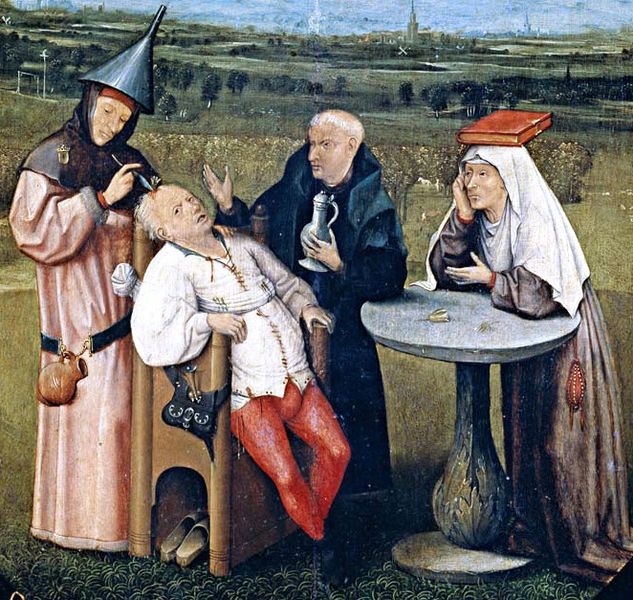
Trepanation is the surgical opening of the skull by drilling a hole in it. This is an ancient surgery that can be found throughout history. Hippocrates and Galen from ancient Greece both recorded detailed instructions on trepanation, ancient Incans performed the surgery and it was also common during the Middle Ages and the Renaissance in Europe. These surgeries were most likely indicated for skull fractures where fragments were embedded in the brain. During the Middle Ages when it was better known that the brain was the seat of the soul, trepanation was used for psychiatric treatments too. For example, in 15th century Netherlands, trepanation was used to excise a so-called stone of madness that was supposedly the cause of insanity. Like this, it was believed that trepanation could release the demons and insanity trapped in the skull.

Although this operation sounds hilariously misled, it is still used in modern medicine. Of course, it is not known to treat insanity, but rather to treat brain bleeds. Extradural and subdural haemorrhages occur when a rupture of an artery in the brain causes a collection of blood in the skull, compressing the brain. This is a dangerous situation which can lead to a stroke or even death. One treatment of this condition is trepanation, or a burr hole, where a small hole is drilled in the skull to relieve the pressure, lowering intracranial pressure and stabilising the patient. Trepanation is an excellent example of how we can learn from the past and how medical knowledge from ancient times is sometimes still valid.