Posted in Science & Nature

Kiss

Kissing is an act of love seen in cultures across the globe, with its history spanning many thousands of years. There are many theories as to how this act – representing love, affection, friendship and even respect – came about. The two most popular theories are the ideas that early humans in the Stone Age licked each other’s faces to obtain salt from sweat, or that it originated from ancient Romans. Roman soldiers kissed their wives as soon as they returned from war, to check whether there was the smell of alcohol (which was banned for women) or another man.
Using historical evidence from ancient texts from India and old paintings from China, it can be deduced that even in Asia the history of kissing is over 2000~4000 years old.

The human lip contains many nerve endings, making it one of the most sensitive part of skin on the body. Also, kissing stimulates the secretion of dopamine and oxytocin, chemicals responsible for invoking the feeling of love and happiness, causing an electric sensation (research states that the brain interprets it in a similar way to using cocaine).
It has already been proven that kissing lowers perceived stress and frequent kissing between couples lowers cholesterol and strengthens the cardiovascular system. Furthermore, it has been discovered that over 295 colonies of bacteria can be transferred per kiss (95% of which are harmless, but diseases such as glandular fever or herpes can be transmitted this way).
Some believe that the act of kissing came about to simulate the feeling of breastfeeding, an act ingrained in the subconscious mind (the same point is made regarding cigarette use).

This romantic behaviour is also seen in nature. Many bird and mammal mothers transfer pre-masticated food to their young this way, and calves kiss each other after drinking milk to prolong the sensation of breastfeeding. Even insects are found to “kiss”, such as ants that bring up food from their second stomach, the “social stomach”, to feed fellow ants that need food.

Posted in Science & Nature

Parkinson’s Law

Parkinson’s Law states that the bigger a company grows, the more inefficient workers it will hire while paying out more wages. The reason for this is simple: those in power like to stay in power, and the best way to ensure this is to eliminate competition.

Hiring skilled workers brings upon the chance of a strong competitor that can over throw the bureaucrats, which is undesirable. Therefore, by hiring useless people, the bureaucrats are able to keep their seat of power.

image

(from The Encyclopaedia of Relative and Absolute Knowledge by Bernard Werber)

Posted in Science & Nature

Echo

Because sound is a wave, it is reflected by a surface. An echo is when this reflection is sufficiently loud and is quite common in everyday life. It is heard especially in places such as a mountain top or in a canyon because the surface needs to be quite far for our ears to detect the echo. If it is too close, as in within 340m – the distance covered by sound within one second – the echo overlaps with the original sound and cannot be heard. However, if a room is lined by a smooth surface, such as a bathroom or opera house, an echo may be heard. In these cases the delay between the sound and its echo is so close that it merely sounds as if the sound is amplified, thus explaining why singing sounds better when in a bath.

An echo can be very powerful, an example being St Paul’s Cathedral in London, England. This building is built with a giant, hemispherical roof that can amplify a whisper from one corner and replay it audibly at a corner on the opposite side of the room.
It is also very useful as it is used in technologies such as sonar and ultrasound machines to see through objects.

The word “echo” originates from a nymph named Echo from Greek mythology. Echo was instructed by Zeus to distract Hera from noticing him having an affair by chatting to her constantly. Hera caught on to this and cursed Echo to only be able to repeat what others say. After that, Echo could not even say “I love you” to the man she loved, and eventually lived in the mountains where she repeated whatever travellers said in an attempt to speak.

An interesting fact about echoes is the common myth that a duck’s quack does not echo. This is incorrect in that it does in fact echo, but since a quack is soft and fades quickly, the echo is usually too faint to be audible.

Posted in History & Literature

Wilhelm Scream

Often while watching a movie, you hear a scream that you feel like you have heard it before. This phenomenon occurs quite commonly, and the reason for it is rather simple. It is not because of some psychological phenomena, but because it is always the same scream. But how is it that the same scream appears in movies spanning over 50 years, with no common actors? 

This is the famous Wilhelm Scream, a pre-recorded sound clip frequently used in movie sound editing. It first appeared in the 1951 film “Distant Drums” (when a villain is snatched away by an alligator), and became famous when it was used again in 1953 in “The Charge at Feather River”, when a soldier named Wilhelm gives off the scream when shot (hence the name).

From then on, this scream has become somewhat a cliché in the film world, with numerous directors humorously sneaking it in their movie. George Lucas is especially well-known for his love with the sound clip, as he used it in every Star Wars and Indiana Jones movie. Including appearances in movies, games and other media, the Wilhelm Scream has been used over 200 times to date. This peculiar scream tends to be used when a nameless villain, such as a stormtrooper or a Nazi soldier, is shot, fell or somehow mortally harmed.

Next time you watch a film, look out for the Wilhelm Scream.

Posted in Science & Nature

Egg

To know whether an egg is raw or boiled, simply spin the egg on its side, put a finger on top of it gently to stop it, then let the finger go.

A raw egg continues to spin because of the inertia of the liquid yolk still spinning within the shell.

Posted in Philosophy

Aliens

People tend to ask “Do aliens exist?”, but a more interesting thought is “What if aliens do not exist?”.

If there are no aliens in this vast universe, then that indicates that we are the only form of intelligent of life. If so, are we not one of nature’s greatest creations and wouldn’t the destruction of such an achievement be foolish? Because if humanity was to become extinct, then that would result in the only species able to think of such a question ceasing to exist.
This theory can further be understood as saying that Earth is the only place in the universe where life can and does exist. Ergo, we (as possibly the last intelligent life) should protect the planet from destruction so that life can continue in the universe.

However, if aliens were to exist, it would be better to ignore them and not search for them. Many dream that they will be benevolent, bringing us advanced technology and knowledge, but in the history of mankind, there is rarely a situation where two worlds meet and the weaker is not looted, enslaved and destroyed.

Posted in Philosophy

Glass Of Water

A pessimist sees a glass as half empty.

An optimist sees a glass as half full.

A wise, happy person drinks the refreshing liquid and then pours another glass.

(also see Points of View)

Posted in Psychology & Medicine

Uncanny Valley

(original article by Kingdom of Discord, summarised and modified with permission)

The Uncanny Valley, a term coined by Japanese roboticist Masahiro Mori, is a theory that the more humanistic a robot (or any object) is, the more humans will feel comfortable with it and show empathy and love towards it. However, there is a point where the robot almost completely resembles a person, yet there is something not quite right. At this point, human response to the robot plummets, even falling below the line of neutrality and instead reaching a point where people become uncomfortable around it, and may even become hostile towards it or be afraid of it.

For example, robots such as C-3PO (from Star Wars) that are humanoid yet obviously robotic are met with love and affection from the audience. This also applies to human characteristics, such as Wall-E who shows human emotions that we can empathise with. 
But when the resemblance becomes too similar, such as a prosthetic limb, computer-generated images (CGI) such as characters from The Polar Express, or zombies, people find that there is something “wrong” and will show negative emotions towards it.
The Uncanny Valley also applies to people, especially those with a physical or mental disability that causes them to slide under the line that society names “the norm”.

There are many theories as to why this phenomenon occurs.
Firstly, the further away from human-likeness an object is, the less likely it will be compared to the “human norm”. But objects in the Uncanny Valley are more likely to be measured against “normal” humans, and thus they will be seen as “inferior”, rather than “superior to normal objects”.
Secondly, using the above theory, it can also be suggested that the primal instinct of avoiding mates with some disfigurement is elicited, causing a natural aversion.
Lastly, it may remind the person of their mortality and the fact that they could become something akin to that, invoking fear. The fear may also originate from the thought that they may become even closer to human beings, thus replacing humanity. This idea is seen in the anime Chobits.

The Uncanny Valley phenomenon is used extensively in the genre of horror movies, as people will relate more closely to human-like monsters such as ghosts and zombies than giant monsters. This will cause them to believe that it is more realistic, resulting in heightened fear. Combined with the uncanny feeling invoked by the closeness to a human, it is a potent method of scaring the audience.
It is also thought that the Uncanny Valley explains certain psychological conditions such as racism and the fear of clowns, as there is a primal aversion to those that are slightly different.

Posted in History & Literature

Hannibal’s Cane

Hannibal was the greatest commander of Carthage, who threatened the Roman Empire and is considered “The Father of Strategy” after his brilliant tactics. He is most famous for the Second Punic War around 200 BC, where Carthage ultimately failed to conquer Rome. However, if it was not for a single cane, Hannibal may have destroyed Rome and Carthage may have dominated the history of Europe.

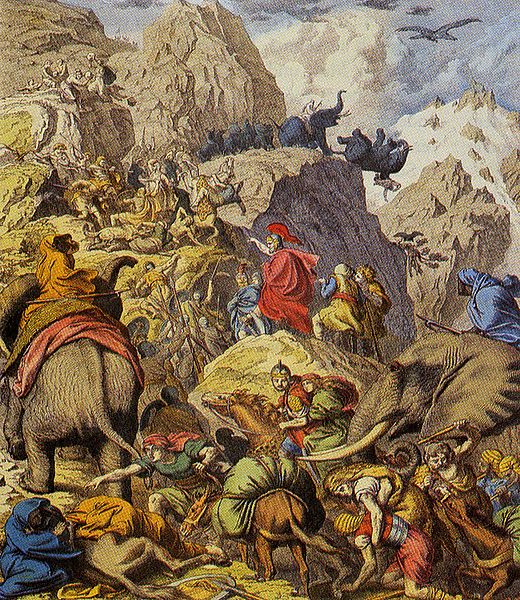
There is a scene in the epic Roman poem, Punica, where Hannibal’s forces are crossing the Alps. This was considered an impossible feat back then and in modern terms, it is as if China was to tunnel below the Pacific Ocean to reach USA soil. This kind of out-of-the-box thinking, charismatic leadership and brilliant military tactics and strategies allowed Hannibal to become one of the greatest threats in Roman history. However, the Alps still proved challenging even for him, and the journey was highly dangerous.

One day, Hannibal’s army reached a valley known as Certain Death, but the soldiers’ morale was too low for them to want to cross it. Hannibal tried to lead them through by using his cane to knock on the snow they stood on, proving that it was solid and safe. But the shock from this action triggered a massive avalanche that struck the army. It devastated the army equipped with advanced weapons and elephants, destroying almost two-thirds of his army (18,000 out of 38,000 soldiers were killed) and a quarter of his cavalry. 

This army that was destroyed so by the Alps managed to fight the war for 16 years, hassling Rome in every way, even producing great outcome such as the infamous Battle of Cannae, considered the greatest tactical feat in military history. One cannot help to wonder whether Hannibal would have completely crushed Rome with a full-size invasion force.

This shows how something as small as a cane can decide the flow of a war.

Posted in Psychology & Medicine

Sensory Illusion

The five senses we use to experience the world are simply wondrous. However, thanks to our not-so-perfect brain, these senses can easily be distorted. Illusions are a very good way to show how the brain processes sensory information and there are many fascinating examples.

Almost everyone has seen an optical illusion before, such as Penrose’s endless stairs or the Muller-Lyer illusion. There are countless more examples such as static pictures that appear to be moving and illusions in colour perception (A and B are the same colour). This is caused by the brain not recording images like a camera, but rather processing visual information and reconstructing an image. There are four main types of optical illusions: ambiguous (e.g. rabbit or duck), distortion (Café wall illusion), paradoxical (Penrose triangle) and fictional (only seen in hallucinations or by schizophrenics).

(Do you see the dolphins? Children cannot see the man and woman because they cannot comprehend it, whilst adults cannot overpower the sexual image)

Like vision, every other sense can be fooled in a similar fashion.
Auditory illusions that distort what we hear are fairly common, a good example being the infinitely ascending Shepard scale (which are just a series of the same ascending octave scale). Also, the McGurk effect shows how the brain uses a multimodal approach where it involves both hearing and vision when listening.

There are also tactile illusions. For example, if you pull your top lip to left and the bottom lip to the right, then prod the middle of the lips with a pencil, it feels like there are two. However, the more famous case is of the Phantom Limb, where an amputee’s brain still believes that the limb is there, causing it to “feel” the limb or even feel pain.

The other two senses aren’t as famous in terms of illusions, but definitely exist.
Smell is easy to fool through chemicals as it is the physiological method of detecting smell. It also exhibits olfactory fatigue where it becomes desensitised to a strong smell.
Taste illusions are more fascinating and easily seen. They are caused by two or more tastes forming a synergy to produce a completely different taste. For instance, mixing barley tea and milk produces a coffee milk taste, while cucumber and honey tastes like melons.
A more fascinating illusion involves Miracle Fruit Berries, which contain a substance called miraculin that distorts the taste of sourness to sweetness.

This shows how we can fool all five senses, and learn more about the mysterious organ that is the brain.