
Posted in Psychology & Medicine

Symptom Reporting

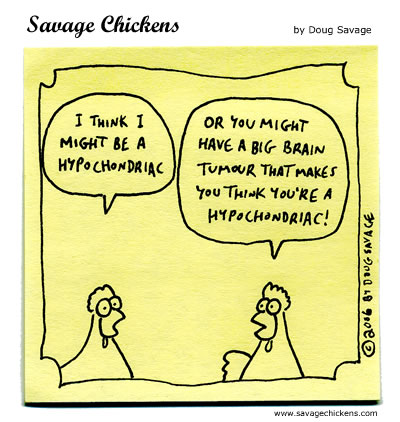
Some people always complain of symptoms, claiming that they are sick, while some people never seem to complain even if they have a whole list of symptoms. Why is there a difference in symptom reporting between people? For example, women are more likely to recognise symptoms and report them compared to men. This is because men are generally under the social pressure of needing to appear strong and healthy, so they become stoic and less sensitive to pain and disease. Women are usually more sensitive to internal bodily changes and worry more about their health.

According to a psychological theory called the competition for cues hypothesis, there are two signals that compete for attention when we recognise symptoms. The first is bodily changes, i.e. internal cues, while the other is external stimuli from what happens around us. Awareness of symptoms follows a ratio between these two signals: if there is a strong internal cue such as severe pain, we notice symptoms more quickly, while if there are many distractions, we may not notice the symptom. For example, according to a study people can run faster when listening to music and running through a forest with plenty to see. This is because music and the scenery distract the runner from internal cues. As we can only process a certain amount of information at a given moment, the more distractions there are the less sensitive we become to signals from inside our body.

Another factor that affects symptom reporting is illness labelling. The more information we have about a disease, the more we search for those symptoms. For example, if you yawn or scratch yourself, people around you will do the same. This is because they see you yawning and subconsciously believe that they should yawn too. This can be a powerful effect, as seen in mass hysteria. This strange phenomenon occurs when a person observes a sick person and their brain believes they are sick too, beginning to show symptoms despite being healthy. A similar example is seen in medical student disease, where medical students, with their extensive knowledge of diseases, match their own symptoms to symptom lists of rare diseases. For example, they might think that their high blood pressure is due to a phaeochromocytoma or renal artery stenosis, rather than just hypertension.

However, the opposite can occur where people fail to notice important symptoms and suffer serious consequences as a result. For instance, not all cases of heart attacks (myocardial infarction) cause unconsciousness and a patient may believe they are fine when only chest pain occurs. Failure to get treated as soon as possible at a hospital may result in ventricular fibrillation, leading to sudden death.
Posted in History & Literature

The Great Dictator

The following is the final speech given by Charlie Chaplin in the movie The Great Dictator (1940). To this day, it is considered one of the most inspirational speeches in modern history. (NB: video excerpt at the end)

“I’m sorry, but I don’t want to be an emperor. That’s not my business. I don’t want to rule or conquer anyone. I should like to help everyone, if possible, Jew, gentile, black man, white. We all want to help one another. Human beings are like that. We want to live by each other’s happiness – not by each other’s misery. We don’t want to hate and despise one another.

In this world there is room for everyone. And the good earth is rich and can provide for everyone. The way of life can be free and beautiful, but we have lost the way. Greed has poisoned men’s souls, has barricaded the world with hate, has goose-stepped us into misery and bloodshed. We have developed speed, but we have shut ourselves in. Machinery that gives abundance has left us in want. Our knowledge has made us cynical. Our cleverness, hard and unkind. We think too much and feel too little. More than machinery we need humanity. More than cleverness we need kindness and gentleness. Without these qualities, life will be violent and all will be lost.

The aeroplane and the radio have brought us closer together. The very nature of these inventions cries out for the goodness in men, cries out for universal brotherhood, for the unity of us all. Even now my voice is reaching millions throughout the world – millions of despairing men, women and little children – victims of a system that makes men torture and imprison innocent people. To those who can hear me, I say – do not despair. The misery that is now upon us is but the passing of greed – the bitterness of men who fear the way of human progress. The hate of men will pass, and dictators die, and the power they took from the people will return to the people and so long as men die, liberty will never perish.

Soldiers! Don’t give yourselves to brutes – men who despise you – enslave you – who regiment your lives – tell you what to do – what to think or what to feel! Who drill you, diet you, treat you like cattle, use you as cannon fodder. Don’t give yourselves to these unnatural men – machine men with machine minds and machine hearts! You are not machines! You are not cattle! You are men! You have the love of humanity in your hearts. You don’t hate! Only the unloved hate – the unloved and the unnatural!

Soldiers! Don’t fight for slavery! Fight for liberty! In the 17th Chapter of St. Luke it is written: “the Kingdom of God is within man” – not one man nor a group of men, but in all men! In you! You, the people have the power – the power to create machines. The power to create happiness! You, the people, have the power to make this life free and beautiful, to make this life a wonderful adventure.

Then, in the name of democracy, let us use that power! Let us all unite! Let us fight for a new world, a decent world that will give men a chance to work that will give youth the future and old age a security. By the promise of these things, brutes have risen to power, but they lie! They do not fulfil their promise; they never will. Dictators free themselves, but they enslave the people! Now, let us fight to fulfil that promise! Let us fight to free the world, to do away with national barriers, to do away with greed, with hate and intolerance. Let us fight for a world of reason, a world where science and progress will lead to all men’s happiness.

Soldiers! In the name of democracy, let us all unite!“

Posted in Psychology & Medicine

Sudden Death

Unlike diseases such as tuberculosis or cancer, some disease processes are known to kill a human being within an hour of onset. Other than the obvious causes such as decapitation, massive bleeding or any other trauma-related injuries, these diseases tend to be cardiac or respiratory in origin.

A common example is coronary artery disease, where the blood vessel providing blood to an area of the heart becomes completely blocked by stenosis (narrowing, often by atherosclerosis) or a clot. This results in immediate ischaemia (lack of oxygen) to heart muscles, which causes cell death. This produces scar tissue which disrupts the electrical activity of the heart, which may lead to a condition called ventricular fibrillation where the heart beats in an uncontrolled, erratic manner. When in VF, the heart effectively becomes useless as it cannot coordinate proper pumping function. Blood circulation stops and the patient goes in to multiple organ failure (the brain goes first) within a very short time. Although it can kill within a short time, early identification and treatment may be able to prevent VF from occurring and save the patient’s life. If VF does occur, it is crucial to begin CPR or use a defibrillator if available.

VF can also occur in other situations. For example, there is a genetic condition called long QT syndrome which predisposes the patient to spontaneous arrhythmias (electrical abnormalities in the heart). Even becoming too excited can sometimes set off a VF in some LQTS patients, thus they require an implantable cardioverter-defibrillator (ICD) to shock their heart back in to normal rhythm every time they develop an arrhythmia.

Some other causes of sudden death include: aortic dissection (tearing of the aorta that may cause massive internal bleeding), pulmonary embolism (a clot obstructs blood flow in the lung, stopping circulation), commotio cordis (a blow to the heart at a certain moment in the heart rhythm triggers VF), ruptured brain aneurysm (ballooning of an artery in the brain), anaphylaxis (severe allergic reaction that cuts off airflow to the lungs) and poisoning (various mechanisms, mainly related to disrupting cellular function).

Death can strike swiftly, even from within your body.

Posted in Science & Nature

Nuclear Explosion

Nuclear weapons are quite possibly the most dangerous weapons mankind has ever developed. Through the use of nuclear fission, atoms are split to release the massive amounts of energy contained within, causing a gargantuan explosion. When a typical nuclear bomb detonates, energy is released in various forms: blast energy (40~50%), heat (30~50%), radiation (5%) and fallout (5~10%). The distribution of the energy varies according to the type of bomb (e.g. neutron bombs produce significantly more radiation than heat and blast energy).

The initial damage that follows a nuclear explosion is from the blast energy, much like a conventional weapon. The sheer amount of kinetic energy creates a shockwave that pulverises everything in its path, travelling at speeds over 1000km/h. In addition, the heat from the explosion, over ten million degrees celsius at one point, causes vaporisation of all matter within a certain radius, causing a massive release of gases, fuelling the shockwave from the expansion. In the case of the bomb that destroyed Hiroshima, all structures within 1.6km were vaporised and those within a 3.2km radius suffered moderate to severe damage. A modern nuclear weapon is at least tens of times more destructive and will affect a significantly larger area.

At the same time, thermal radiation spreads out in all directions much like sunlight. Thermal radiation travels far further than shockwaves and can cause severe burns and eye injuries (flash blindness) to people in the vicinity (if they are close enough, they will spontaneously combust or melt). Near ground zero (point of explosion), a firestorm may erupt from the sheer amount of heat energy, as observed as a fireball. 

Next comes the indirect effects.
Ionising radiation is produced when atoms are split and these have detrimental effects on living organisms. Not only are they responsible for mutations in the genome, leading to deformed offspring, sterility and cancer, but if there is sufficient radiation, a person will immediately die from acute radiation poisoning.
The same radiation, especially gamma rays, creates what is called an electromagnetic pulse (EMP). EMP is caught by metal objects and induces a high voltage surge, destroying unshielded electronic devices. Sometimes, nuclear bombs are detonated at very high altitudes so that only the EMP affects the ground, damaging enemy communications and destroying entire power grids.
Lastly, radioactive material rains from the sky for long periods of time, also known as fallout. Fallout causes continuous radiation damage in affected areas.

A nuclear bomb is truly a weapon of mass destruction as it utilises various forms of destruction to devastate all life forms within an area spanning several kilometres, even killing over the course of time in the form of radiation.

Posted in Psychology & Medicine

Stroke

A stroke is caused by a disruption in the supply of blood to the brain, which leads to cell death as oxygen is required. There are two types: ischaemic (where a clot cuts off blood supply to an area of the brain by blocking an artery) or haemorrhagic (when a blood vessel ruptures and leaks blood instead of delivering it to tissue). The most common cause of a stroke is a clot that made its way up to carotid arteries into the brain until it wedges in small vessel. There are many risk factors for blood clots, such as smoking, high cholesterol levels, atrial fibrillation and long distance flights.

Because the brain is always in high demand of oxygen (taking 20% of the total oxygen available), strokes can produce devastating effects within minutes. 5 minutes of oxygen deprivation can lead to irreversible cell death, a principle that is also used in cases of shock, where the blood pressure is too low to supply organs, or cardiac arrest. Therefore, it is crucial to recognise a stroke early so that an ambulance may arrive and deliver clot-busting medication such as streptokinase.

The FAST mnemonic is an effective way of remembering the common signs of a stroke. It is also useful in reminding people to respond fast.

  • F – Facial weakness: Is the person’s smile crooked? Disrupted brain function causes facial weakness on the opposite side. The weakness is usually seen around the mouth or eyes.
  • A – Arm weakness: Can the person keep both arms outstretched? This is related to motor function of the brain.
  • S – Speech difficulty: Is the person’s speech slurring or are they having problems understanding speech? This is a combined result of impaired motor function and speech centres of the brain.
  • T – Time to act: Call an ambulance. NOW.

Posted in Philosophy

Town Musicians Of Bremen

Once upon a time, a donkey who had worked hard for his master all his life on a farm was about to be sold off simply because he was old. The donkey fled to Bremen where he hoped to be a travelling musician. On his way to Bremen, he met a cat, a dog and a rooster who were all placed in a similar predicament. The four animals decide to form a band of animal musicians. While travelling together, they came across a house full of delicious food and a warm fire. 

However, they soon found out the house was inhabited by robbers. The animals decided they should somehow chase away the robbers and ultimately came up with the plan of the rooster jumping on the cat’s back, who was on the dog’s back who was on the donkey’s back. The quartet began singing at the top of their voice. The robbers were startled by the strange sound and terrifying figure and ran for their lives, thinking the house was haunted. The musicians then feast on the food and spend a warm night in the house.

Later that night, the robbers returned and sent one of their members to scout the house. In the dimly lit room, he sees the cat’s eyes but believes it to be candlelight. At that moment, the cat scratched his face, the dog bit his leg, the donkey kicked the robber and the rooster chased him out the door. The robber then told his companions about how he was scratched by the long nails of a witch (cat), stabbed by an ogre’s blade (dog), hit by the club of a giant (donkey) and worst of all, chased away by the shrieks of a dragon (rooster). The robbers gave up on the house and the animals spent the rest of their lives in that house happily ever after.

The moral of this story is that even after being thrown away, if you stay optimistic and work through the troubles you can still live a happy life. A similar lesson is found in a quote by General Douglas MacArthur: “Old soldiers never die. They just fade away.”. If you have passion, dreams and a friend who has the same mindset, nothing is impossible.

image

Posted in Psychology & Medicine

Hypocrisy

Often in life, we find that other people can be idiots, evil or both. Whether it be the girl working in the cafe that forgot your order, or your girlfriend who says she was late because of traffic, or the bastard that takes the last slice of pizza. But then, when we do that exact same thing that annoyed us so much when someone else did it, we somehow always find an excuse that rationalises our act.

This can be explained by the phenomenon of special pleading. Instead of acknowledging the fact that what you did was incredibly rude or obnoxious, your brain automatically creates an exception to the rule. You forgot that customer’s order because you were having a bad day. You were actually late because of traffic. You took that last slice of pizza because you did not have as much as the others and everyone else looked full. This phenomenon rids us of feeling guilt after an “immoral” act and also enables our hypocrisy.

The best part is that we do not consciously know of our hypocrisy. The brain quickly devises a clever reason to explain why you are the exception to the rule, while everyone else is not. The reason is, as with so many other psychological phenomena, cognitive dissonance. The brain cannot comprehend that you would do something you find so detestable when someone else does it, so it forces itself to believe the reason it pulled out of the air to not feel guilty, as it is the only reason the brain can think of that explains your behaviour. Furthermore, as sometimes the excuses are true, our hypocrisy is reinforced and we continuously disobey the golden rule of “Do unto others as you would have them do unto you”.

Perhaps the more realistic, platinum rule should be: “Do unto others as you would have them do unto you…UNLESS”. It may not be a good moral system, but it sure explains the human condition of being an ass.

(Source: http://this-is-the-life2905.deviantart.com/art/the-only-exception-205009607)

Posted in Science & Nature

Newton’s Apple

Common belief is that Newton discovered gravity after an apple dropped on his head. Although there is no historical evidence to support this myth, it has become a popular story. There are two common responses to this story: the first is “Wow, Newton was a smart cookie” and the second is “Pfft, I could have discovered gravity without an apple, it is such an easy thing.”

The latter group of people are idiots. Newton did not “discover” gravity. Human beings have known that objects fall to the ground since the dawn of time and have utilised it in ways ranging from sports to killing other people by crushing them with giant rocks. Even animals know of the concept as seen by eagles dropping turtles on rocks to crack the shell. In fact, if you could not figure that out, then you would really be an idiot.

The reason why Newton is famous is not because he found that apples fall from trees, it is because he observed the phenomenon, noting that it was always perpendicular to the ground, which in combination with the knowledge that the Earth is round suggests that objects tend to fall towards the centre of the Earth. Again, Newton’s brilliance was not that he simply observed an apple falling, it was that he pondered it and spent years researching it until he discovered the way gravity behaves. He devised formulas to estimate how gravity functions, even applying it to predict how the moon orbits around the Earth. Thanks to Newton, we are able to model the world around us and send rockets to the moon without launching our astronauts in to the depth of space with no hope of recovery. 

Interestingly, physicists still do not know what causes gravity. There are many theories, such as particles called gravitrons attracting two objects to each other. Although the mathematics of two objects attracting each other has been accurately calculated, it is unknown what causes it. Only after you discover the truth behind how gravity functions can you say that “I could have discovered gravity in my sleep” (actually, even then you probably spent decades just trying to grasp the concept).

Before you criticise, know what you are criticising. 


Posted in Life & Happiness

For Them

Eat, for those who are starving.
Run, for those who cannot walk.
Breathe, for those who are suffocating.
Dream, for those who have lost hope.

See, for those who are blind.
Listen, for those who are deaf.
Feel, for those who are numb.
Speak, for those who are voiceless.

Laugh, for those who are crying.
Love, for those who are heartbroken.
Live, for those who are dying.
Be happy, for those who are miserable.

There is no excuse for not doing what you can. 
There is no excuse for trapping yourself in a box.
If it does not harm you or others, then do whatever the hell makes you happy.

Posted in Science & Nature

Fire

Every creature on earth knows the fearful power of fire. Learning how to utilise it is possibly one of man’s greatest achievements, as it allowed science and technology to kickstart in every way. However, we still lose control over it sometimes and suffer the consequences. Fire can develop from a tiny ember to a full-blown firestorm that incinerates everything in its path. The following are the four stages of fire development:

  • Stage 1 – Incipient stage: No visible smoke and very little heat. Small fire.
  • Stage 2 – Build-up stage: More heat causes pyrolysis (decomposition of material due to heat), releasing combustible gases. May cause a flashover (every combustible surface in the room ignites all at once).
  • Stage 3 – Fully-developed stage: Visible flame, massive amounts of heat, smoke and toxic gases. Everything is burning.
  • Stage 4 – Decay stage: Fire is either contained or extinguished. If not, may spread to other areas (e.g. the next room).

After sufficient heat has built up, fire spreads almost explosively (sometimes literally) causing extensive damage. Thus, the most important part is preventing the fire in the first place or extinguishing a small fire still at the incipient stage. As powerful a tool it may be, it can also destroy everything you hold precious within a matter of hours.

An interesting phenomenon related to fire is backdrafts. This is similar to flashovers (described above) except it is triggered by oxygen rather than a build-up of heat. Both cause a sudden transition from a small fire to a full-scale inferno.
A backdraft occurs when a burning room is filled with pyrolysed, combustible gases but lack the oxygen needed to continue burning as it was used up while the fire was building up. When a firefighter or a broken window causes air to rush into the room, the pressure in the room spikes and every combustible material suddenly bursts into flames, exploding out in a ball of fire. Backdrafts are one of the most dangerous fire phenomena that claim the lives of countless firefighters.