The story of the Three Little Pigsis a timeless tale of how important good planning and doing things right is. Also, it serves to remind us that good architecture and engineering is key to one’s survival. A key aspect of the story is how the wolf “huffs and puffs” to blow the straw house and the stick house away. However, he cannot blow the brick house away as it is too well-built. Out of scientific curiosity, how hard does the wolf have to blow to destroy the Little Pigs’ three houses?
An experiment was performed to scientifically test this tale. The researchers built a house out of straw, a house out of sticks and a house out of bricks, then set up a fan to test at what wind speed the house was destroyed. The straw house blew away when the wind speed was 11m/s. The stick house lasted a little longer, up to a wind speed of 21m/s. Then what about the brick house? The brick house withstood winds of 35m/s, whereupon the researchers had to stop as the strong wind nearly blew the people away.
In 1872, a ship by the name of Mary Celeste was spotted off the Azores in the Atlantic Ocean – completely intact and undisturbed aside from its missing crew. Not a single person, alive or dead, could be found, despite everyone’s personal belongings still sitting undisturbed where they had been left. Even little things such as valuables and piano music were right where they should have been. It was as if its crew had simply evaporated. There were no signs of a struggle and no cargo was missing. To this day, the case of the disappearing crew of the merchant ship Mary Celeste is one of the most famous maritime mysteries in history.
So what happened to the ship’s crew? Historians have been trying to figure out their fate for decades, but the question was finally solved by scientists. One fact that is known about the Mary Celeste is that of its cargo of 1701 barrels of alcohol, 9 were empty. Although an obvious answer is that the sailors went overboard with a party, the truth is even more spectacular. In 2006, Dr. Andrea Sella, a professor of chemistry at University College London, created a replica of the Mary Celeste’s hold to find out how to create an explosion without leaving a trace of fire. He simulated a leak of the ship’s nine barrels of alcohol and found that once the vapour was ignited, say by a pipe or a spark, it created a pressure-wave type of explosion. There was a spectacular wave of flame but, behind it was relatively cool air. No soot was left behind and there was no burning or scorching.
Ergo, the mystery of the Mary Celeste is most likely as follows: there was a leak of the alcohol, the vapour of which fuelled a massive ghost explosion that swept through the ship. The sailors, completely unscathed but utterly horrified, would have piled into the ship’s lifeboat without any useful things like food or water, eventually sinking or dying of thirst and exposure. The Mary Celeste would have still looked perfectly fine as it drifted the vast ocean, all by itself.
It is said that laughter is infectious. In 1962, an extreme case of “laughter infection” happened in village in Tanzania. The phenomenon originated in a boarding school for girls. On January 30, three girls spontaneously burst out in laughter and could not stop themselves from laughing. Soon after, the whole class was suffering from fits of uncontrollable laughter. The “infection” then spread throughout the school, claiming 95 of the 159 students over a stretch of two months. This strange symptom of uncontrollable laughter lasted anywhere from a few hours to 16 days. Interestingly, teachers were not affected and only girls between the ages of 12 to 18 were affected. By March 18, the school was forced to close down due to students not being able to focus during class.
The laughter epidemic was not localised to the school. After the school shut down and the girls returned home, fellow villagers were afflicted by the laughing disease, resulting in 217 villagers being “infected” by May (mostly children and teenagers). By June, the laughing epidemic spread to another nearby school, affecting 48 girls. The epidemic then went on to claim two more schools, forcing them to close down. By the time the epidemic died down (6 to 18 months after “patient zero”), it had affected over a 1000 people and shut down 14 schools.
So what was this strange disease? Was it some new viral infection causing neurological symptoms? Was it a toxin in the water supply? The answer was even simpler: mass psychogenic illness, also known as mass hysteria. Mass hysteria is a psychological phenomenon that occurs in groups placed in high-tension situations, such as within an airplane. This setting is perfect for triggering a mass delusion, causing the person to believe they are suffering from a physical disease. The trigger is usually another “patient” and the hysteria spreads like wildfire, usually by people seeing affected victims. Although the above case makes mass hysteria look like a harmless, amusing phenomenon, psychosomatism (when the mind tricks the body into thinking it is sick) can cause symptoms such rashes, fevers, vomiting and even paralysis. In fact, all of these symptoms were also reported during the Tanganyika laughter epidemic.
Han Suk-Bong is a famous writer from the Joseon Dynasty (Korea during 14th to 19th century), who was praised as “the master writer of the East” even in the Ming Dynasty (China during 14th to 17th century). His writing and calligraphy were partly thanks to his inborn talent, but also because of his intense training and practise throughout his life. There is a famous story regarding his training.
Han Suk-Bong practised calligraphy since a young age by himself, practising every day. The villagers all praised his talent and his mother sent him to a famous temple to study. After four years of studying, Han missed his mother so much that he sneaked out during the night and returned home. When he told his mother that he there was nothing more for him to learn, she told him to turn the lights off and said: “I will slice rice cakes while you write, then we will compare our skills”. After the two silently did their best work in the darkness, they turned the light on and it was evident that Han’s letters were all crooked and unsightly while his mother’s rice cakes were perfectly sliced in even thickness. Han deeply repented his arrogance and realised there was so much more to learn. His mother told him off and told him not to set foot in the house again until he could write perfectly even with his eyes closed, just as she could slice rice cakes perfectly. Thanks to his mother’s passion for his education, Han became one of the most well-known masters of calligraphy and literature in the Far East.
The best type of parent is one who identifies a child’s natural talents early on and helps them develop those skills. If the child becomes lost, loses their way or fall into the pit of arrogance believing they are the best, it is the parent’s duty to correct them. The moment you believe that there is nothing more to learn, you become a failure.
Phones, golf clubs, scissors, forks and knives, the order of writing… Almost everything in this world is made for the convenience of right-handed people. Because of this, there is a hypothesis that left-handed people have a relatively shorter life expectancy compared to right-handed people.
Dr. Diane F. Halpern of California State University conducted a research comparing the life expectancy of right-handed people versus left-handed people. The results were astounding; the mean life expectancy of right-handed people was 75, while left-handed people only lived 66 years on average. Dr. Halpern posited that this was due to left-handed people becoming stressed living in a right-handed world, shortening their life expectancy. Of course, there were debates about whether the results were reliable or not and there was heavy opposition from the left-handed community. But if the left-handed people are enraged about being discriminated against by society, this would stress them out and actually shorten their life, so it might not be best not to debate about the issue.
Left-handedness has historically been associated with evil. The word right also means “good”, while left-handedness is formally known as sinistrality, which shares its etymological origin with sinister. The word for right is associated with good things throughout the world, while left is associated with bad things. In Korea, 오른 (oreun, right) has the same pronunciation as 옳은 (orlheun, true)“. The Chinese character for left (左) is also used to mean “improper”. In medieval Europe, left-handed people were thought to be associated with the devil or witches and were often executed. Left-handed people have been unjustly hated throughout time and space.
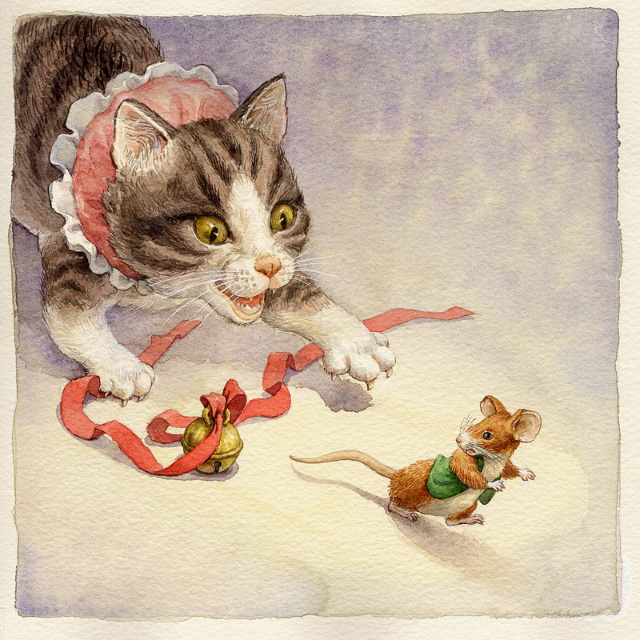
There once lived a community of mice in the attic of a house. The mice would sneak into kitchens, gnaw holes in the walls and run about freely. The owners were so fed up that they brought in a cat, causing the mice to all hide in fear. The terrified mice eventually held a meeting to discuss how they would sneak around the house without getting caught by the cat. One mouse suggested: “What if we put a bell around the neck of the cat? Then we can hear it coming and run away.”. The mice unanimously agreed that it was a brilliant idea. However, when they came to decide who would bell the cat, no mouse was brave enough to step forward and the plan was never carried out.
What would actually happen if a cat was belled? Without a doubt, the cat would take it as a cruel, cruel punishment. Not because it cannot catch mice, but because the sound of the bell ringing every time it moves will be extremely loud for the cat. A cat’s hearing is six times better than a human’s. With this excellent hearing, the constant sound of bells attacking its eardrums would be physical torture for the cat.
Furthermore, a cat can hear frequencies as high as 40,000Hz. A person can only hear up to 20,000Hz, meaning a cat hears over twice the range of sounds we can. This combined with the boosted volume results in the cat living in a very noisy world. Ergo, putting a bell around a cat’s neck is an extremely atrocious thing to do.
For decades, there have been case reports by farmers who found mysteriously dead cattle with strange, surgically precise wounds. Strangely, these corpses were split open and most of their soft organs (e.g. eyes, tongues, intestine, genitals) had been removed. Even stranger, the corpses were completely drained of blood.
The mysterious, mutilated cattle corpses set off a diverse range of conspiracies of what could have caused such a bizarre phenomena. The most popular theories included: alien experimentation (explaining the surgical precision and lack of blood and organs), sacrifice by cults, vampires and the El Chupacabra (a mythological vampiric beast).
Cattle mutilation became so well-known that during the 70’s, it was properly investigated by the FBI. Of course, no evidence was found of aliens and vampires. As with most supernatural phenomena, cattle mutilation could be logically explained by science.
It was found that the cattle had simply died of natural causes, with no foul play involved (other than the occasional psychopaths attacking cattle). But how could natural death cause the surgical wounds, the missing organs and lack of blood? The answer is obvious when one thinks of what happens to animals after they die.
Scavengers such as foxes and buzzards often feast on decomposing corpses, cleanly removing the soft organs before they rot away (organs are the first to spoil). As scavengers usually bite into the corpses, this does not explain the clean wounds. This phenomena is due to insects also feasting on the corpse – a key part in putrefaction. Insects prefer softer tissue such as organs and ragged wounds, so after the insects are finished, wounds often look extremely clean. Also, putrefaction of tissue leads to massive gas production, causing bloating. Once this reaches a peak, the cattle corpse bursts like a balloon, causing clean tears in the abdomen. Lastly, the flies that were involved in cleaning away organs lay eggs, which hatch into maggots. Maggots immediately eat away the dead flesh and organs, even sucking up the blood that pooled at the bottom of the corpse. All of these factors combined results in what appears to be a mysterious alien bovine autopsy.
Although this may sound crazier than Chupacabras, the theory was actually tested in 1979 by a sheriff who kept receiving complaints about cattle mutilation. He took a dead cow, left it on a field and filmed it for 48 hours. The video clearly showed each step described above, proving that cattle mutilation was simply Mother Nature’s cruel, vicious way of returning a corpse back to the soil.
Author Bernard Werber (the inspiration for this Encyclopaedia) posited the following theory: if we could see the future, would we not actively build towards a better future? Imagine a tree soaring high into the sky, stretching countless branches in all directions. The many branches of the tree branch off into smaller branches, which branch into even more smaller branches. At the end of each branch, there hangs a leaf. This tree is not a normal tree; it is a Tree of Possibilities that represents the flow of time from the beginning of the universe to the distant future. Each split in a branch represents the creation of two different futures due to a choice or a change, while a leaf represents the final future created from the cumulative effects of these changes. Thus, the Tree of Possibilities is the ultimate crystal ball showing all the pasts that could have been and all the futures that can happen.
Of course the Tree of Possibilities is a fictional model created in our imaginations. But what if we could actually make this tree? First, we would create an organisation of the greatest scientists, mathematicians, sociologists, psychologists, historians, philosophers, science fiction writers etcetera that represent the many fields of knowledge. These people are gathered in a location far from the reaches of governments and the media, where they can discuss without any interference. These specialists will debate over all sorts of topics, amalgamating their knowledge and intuition to generate a tree diagram as mentioned above. This is a diagram free from ethics, morals, laws, optimism, pessimism and individualism – the ultimate objective view of all possible futures that humanity and the Earth may face. The experts may agree with each other at times and disagree at times. There is ample possibility that their postulations are wrong. But none of these matter. The important point is not that the Tree is “accurate” or not, but that it is an extensive scenario database of all the paths humanity can walk on towards the future.
The Tree of Possibilities will have various conjectures such as: What if nuclear war broke out? What if artificial intelligence is perfected? What if chimpanzees reach the intelligence levels of human beings? What if we build cities on the Moon? However, the future is altered much more easily that you would think. Thus, there will also be branches representing much more trivial and ordinary (even bizarre) postulations as well: What if smoking is banned? What if the average age women gave birth is older? What if rhinoceroses were domesticated pets? What if pianos do not exist?
On analysing these numerous postulations, a branch bearing the leaf with the ideal future will be found. Ergo, we can choose to follow a path of least resistance, where all the choices we make will ultimately lead to that ideal future. Essentially, the Tree of Possibilities is a tool that is used to predict the future. However, it is not “fortune telling” as it is based on logic rather than magic and divinity to see into the future. The future the Tree tells is not a set “destiny”, but rather one “possibility”. Thus, instead of fearing the future like we do with fortunes, we would instead feel excitement over the potential of finding the ideal future. If the path we are currently on is fated to an unhappy ending, then we can simply jump onto a different path with the guidance of the Tree. Unlike fortune telling, which destroys all uncertainty and any other possibilities in the future, the Tree of Possibilities provides humanity with the greatest gift: dreams of a better future.
As you could imagine, the possibilities of the future are infinite so a drawn-out diagram of the Tree of Possibilities would take up extensive amounts of space. Ergo, the ideal form of the Tree of Possibilities would be a computer program. As computer programs only need sufficient storage space, it provides a perfect environment in which the Tree may grow. The program would generate a Tree based on the information provided by the scholars, drawing out each branch and leaf, while also calculating the effects of any action on each of the possible futures. If we further applied the engine used in chess programs to predict the next few moves, then we may be able to create a program that can calculate the ideal future and the path of least resistance for humanity.
My ideal future is this. There is an isolated island, far from any interference, with a large building. At the centre of this building, there lies a supercomputer running The Tree of Possibilities. The computer is surrounded by lecture theatres, conference rooms and residential areas. Thus, specialists of each field may come to stay and use their knowledge to water the Tree and foster it. This island will provide humanity with hopes and dreams, leading them towards the best possible future based on logic and imagination.
The Tree of Possibilities will radically change our day-to-day lives. One of the greatest weaknesses of human beings is the inability to see the long-term happiness and sacrificing it for short-term gain. However, if we were able to see precisely how our actions will affect the future, then would we not act differently? Armed with insight and foresight, people will understand what is best for the future, and instead of the current near-sighted attitude of only seeing the gain right before our eyes, they will act in the best interests of their children and grandchildren. Politicians will see how useless bickering over trifling issues is and instead focus on policies that take a while to show the effects (yet nonetheless important), such as environmental conservation. The Tree of Possibilities will help us make rational decisions to create a world that the future generation will be happy living in, without being swayed by emotions and selfish greed. And so, we will build towards a utopia.
The greatest weapon a person has is imagination that can build the future.
The following are three laws conjectured by acclaimed science fiction author, Arthur C. Clarke, regarding predicting the future.
When a distinguished but elderly scientist states that something is possible, he is almost certainly right. When he states that something is impossible, he is very probably wrong.
The only way of discovering the limits of the possible is to venture a little way past them into the impossible.
Any sufficiently advanced technology is indistinguishable from magic.
A short story of very small word count is known as a flash fiction. However, most flash fictions are between 300 and 1000 words. There are shorter examples such as nanofictions, which are flash fictions exactly 55 words long. But due to the criteria that a story must have a beginning, middle, ending, protagonist etcetera, it is quite difficult to write a story any shorter than that.
Ernest Hemingway once made a bet with a friend that he could write a short story which would have just six words. Of course, Hemingway being Hemingway, he easily completed the challenge. Like any other story, Hemingway’s short story had a beginning, middle and an end. It had a protagonist, a conflict and a resolution. Even within such a small word count, he filled the story with a variety of themes such as hope, joy, tragedy and agony. However, as so much content has been compressed to the extreme, the story may take a few reads to completely understand it. Hemingway’s story is as follows: