Posted in Philosophy

Fundamental Benevolence

Mencius, a leading Chinese Confucian philosopher, proposed a thesis that diametrically opposes Xunzi’s theory of fundamental malevolence. He claimed that human beings are fundamentally good. According to Mencius, people are inherently altruistic and courteous, wanting to help a fellow man. He stated that people are born with all the qualities needed to build virtue: compassion, humility, modesty and ethics. Through mental training and discipline, these traits respectively develop into: humanity (yin, 인, 仁), righteousness (eui, 의, 義), courtesy (ye, 예, 禮) and wisdom (ji, 지, 智). Mencius believed that as every man and woman are born with all the qualities needed to become a saint (seung yin, 성인, 聖人), anyone could become a “good person” through disciplining one’s mind. According to this theory, evil is only a product of bad environments and people inherently act benevolently when matured in a good environment with adequate teaching in etiquettes and social order. Thus, the act of harming others and murdering are because the person’s fundamental nature was corrupted by a harsh life and environment and because they lack virtue and discipline. A person who strives to perfect their morality is a gentleman (gun ja, 군자, 君子), a person who does not is a petty person (so yin, 소인, 小人). In Confucianism, gentlemen are highly respected while petty people are shunned.

Are human beings good-natured? The theory of fundamental malevolence states that human beings, like all other animals, are selfish beings who only care about their own needs and will willingly harm others to fulfil their greed. Contrary to this, the theory of fundamental benevolence (성선설, sung sun sul) teaches that people are altruistic animals who will support and help each other. We proved the validity of fundamental malevolence from an evolutionary perspective with the example of a hungry lion. An animal case scenario that supports the theory of fundamental benevolence is the ant.

By observing an ant colony, we can learn that altruism can assist in survival. An ant by itself is quite powerless, but when millions of ants come together to form a colony, they can build great cities to protect themselves, they can farm to feed everyone and they can easily overcome any foe of all sizes. Ants do not become jealous of another ant who has more food. Instead, when they are full, they will store excess food in a social stomach so that they can share it with another hungry ant they come across. Through cooperation, understanding and connection – that is, the philosophy of 1 + 1 = 3 – ants are able to compete and survive in nature. In fact, ants thrive anywhere in the world and can easily adapt to almost any environmental change. When comparing the two ultimate species that dominated nature, human beings and ants, the commonality is that both build societies. To build a society, individuals must get along with each another, and the key to building relationships is goodwill.

Thus, we have proven that fundamental benevolence can also be supported by evidence from nature. If so, are human beings fundamentally good or evil? The more you study people, the less credibility there is for fundamental benevolence. Of course there are plenty of stories of altruistic people, but “generally” people are still selfish animals who prioritise their own gain. No matter how much you say “I care for other people and wish everyone in the world happiness”, the reality is that you will only really care and love for people within your monkeysphere, while not caring nearly as much for the starving child on the other side of the world.

This is not to say that “good” does not exist on this world. It is just that the fundamental nature of human beings is likely to be evil, as Xunzi posited. However, as we grow, we learn social order, etiquettes and morality and we try to suppress our basal instincts as much as possible. Although our efforts are usually successful, we still slip up every now and then. On the contrary, some people do not even make the effort to hide their true nature and we label these people as “evil”.

Whether we are fundamentally good or evil, the truth is that we have both the potential and ability to develop our own character and sense of morality. Whether you will be an ant, who builds great cities and strive for a society where everyone helps each other stay well-fed, or a lion, who stalks prey all alone to feed itself day-to-day; that is your choice.

Posted in Philosophy

Fundamental Malevolence

Human beings are fundamentally evil. This was a theory concerning human nature put forward by Xunzi – a leading Chinese Confucian philosopher, along with Confucius and Mencius. Xunzi stated that human beings naturally seek out only their own interests and greed, envying and hating each other so much that they are bound to fight if left alone. He suggested that people needed to learn etiquette and culture themselves to correct this.

Xunzi’s philosophies are on a background of the chaotic setting of the Warring States Period. The Warring States Period was a period when China was split into many different countries, all warring with each other to gain dominance over each other’s lands. During these wars, Xunzi saw countless cases of people looting and killing each other, which led him to the conclusion that people are naturally selfish beings. He believed that human beings focus on their greed and self-preservation from the moment of birth. He also believed that leaving people without order would indubitably lead to social chaos. Thus, to effectively rule over the people, a leader must place limits such as laws, ethics, etiquette and culture.

From an evolutionary point of view, the theory of fundamental malevolence (성악설, sung ak sul) makes sense. Would a starving lion mourn the death of a baby zebra? Protecting one’s own interests is a great way to increase your chance of survival and propagating your genes.

The more you carefully observe people’s behaviour, the more credibility the theory seems to gain. Human beings are selfish beings who become jealous of others for having more than themselves, kill someone because they tried to take away their love and engage in fratricidal war because others do not share their beliefs. You as the reader may state that you cannot imagine hurting anyone, let alone taking a life. In that case, let us examine the following thought experiment.

One day, you are kidnapped. When you come about, you find that you are trapped in a pitch-black room, tied to a pole. The room appears to be completely empty and you cannot see or hear anything. Suddenly, you hear a voice coming from the other side of the room. The voice talks about how it will murder you in a violent, excruciating way, over and over. The voice continues to threaten you in a macabre way for three days. Just when you are near your breaking point from the overwhelming fear of imminent death, another voice appears. The voice says: “If you nominate someone you are close to that I can kill in your stead, I will let you go and not harm you in any way”. Would you have the courage to not give a name?

Posted in Science & Nature

Niven’s Laws

Larry Niven is a science fiction author. Like many other science fiction authors, he is responsible for citing many rules regarding the world, humorous or not. Niven took to this another level by publishing a series of laws on “how the universe works” as far as he can tell. The following is the revised list as of January 29, 2002.

  1. Never throw shit at an armed man.
  2. Corollary to #1: Never stand next to someone throwing shit at an armed man. 
  3. Never fire a laser at a mirror.
  4. Mother Nature doesn’t care if you’re having fun.
  5. Giving up freedom for security is beginning to look naive. (or “F x S = k”, meaning that the product of freedom and security is a constant.)
  6. Psi and/or magical powers, if real, are nearly useless.
  7. It is easier to destroy than to create.
  8. Any damn fool can predict the past.
  9. History never repeats itself.
  10. Ethics change with technology.
  11. Anarchy is the least stable of political structures.
  12. There is a time and a place for tact.
  13. The ways of being human are bounded but infinite.
  14. When your life starts to look like a soap opera, it’s time to change the channel.
  15. The only universal message in science fiction: There exist minds that think as well as you do, but differently.
  16. Corollary to #15: The gene-tampered turkey you’re talking to isn’t necessarily one of them.
  17. Never waste calories.
  18. There is no cause so right that one cannot find a fool following it.
  19. No technique works if it isn’t used.
  20. Not responsible for advice not taken.
  21. Think before you make the coward’s choice. Old age is not for sissies.
  22. Never let a waiter escape.

Posted in Psychology & Medicine

Hanging

Hanging is one of the most popular methods of execution and suicide throughout the ages. It is typically performed by fashioning a noose (most commonly with the eponymous hangman’s knot), placing it around the victim’s (or own) neck. The person then falls from a short height (e.g. dropped from a stand or stepping off a stool), upon which the force of the body pulling down causes the noose to tighten. This can kill a person via two ways. Firstly, if the force of the drop and the knot is strong enough, the sheer force of the noose tightening and the person being suspended by their neck will cause their neck to break. This causes spinal cord injury at the cervical level, where the brainstem lies. When the brainstem is damaged, the person loses control of autonomic processes such as breathing, causing instant death. Secondly, if the neck does not break, the person will be strangulated by the noose. This will kill the person through either choking (from airway obstruction) or brain ischaemia (as the carotid arteries are cut off). Pressure on the carotid artery may also cause something called a carotid reflex, where powerful nervous signals cause the heart to beat so slowly that it stops.

It is said that whether a person dies a quick, clean death via neck fracture or a slow, painful death via strangulation depends on how good the knot is. A hangman’s knot is made up of a loop with a series of coils above it. The more coils there are, the more friction it adds to the knot, making the noose harder to pull closed. A true hangman’s knot is defined as thirteen coils, which provides enough resistance to cause a neck fracture when a person falls. If there are fewer knots than that, the knot will tighten too quickly around the neck and not provide enough resistance to cause a neck fracture. This leads to strangulation, which is far more excruciating and a very inhumane way to die. If there are too many knots, there will be too much resistance and there is a risk of decapitation, leading to a very messy situation.

In forensic medicine, there are certain signs that reveal a victim was hung. For example, the C2 spine (second vertebrae in the neck) will exhibit a hangman’s fracture, where there is fractures on both sides. Fracture of the hyoid bone (a small bone below the chin) is also a classic sign of hanging. There will also be bruises along where the noose was and every sphincter would be open (which leads to immediate voiding of the bowels and bladder at the time of death). If the person died of strangulation rather than neck fracture, they will show signs of asphyxiation, such as blue lips (cyanosis). Another interesting result of hanging is something called a death erection. As the name suggests, it is when a corpse is found with an erection, most likely due to hanging. This is probably caused by the noose crushing the cerebellum, causing a reflex erection. The same phenomenon has been observed in women as well.

Posted in Life & Happiness

The Donkey And The Well

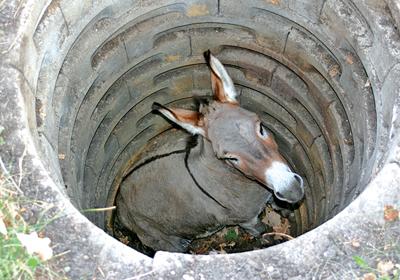
One day, a donkey fell in to a well. It cried piteously for hours while the farmer tried to figure out what to do. Ultimately, the farmer decided that the donkey was old and was nor worth saving. He planned to fill the well, as he had no need for it either. He invited his neighbours to come over and help him. Everyone grabbed a spade and shovelled dirt into the well.

The donkey was terrified; sooner or later he would literally be buried alive, with no food, water or air. It cried even more and begged the farmer to show mercy. The people ignored the animal’s neighing and screeching. The donkey was about to give up. There was no hope of getting out the well and soon it would die a slow, suffocating death. But then, it came up with a cunning plan. As the dirt slowly filled the well, the donkey stepped up on the mound of earth. Eventually, the mound grew high enough for it to jump out of the well. The donkey then kicked the farmer and galloped off into the sunset.

Life is bound to throw all kinds of dirt at you. But just because bad things happen, it does not mean you have to live a miserable life. When life throws a spadeful of dirt at you, brush it off and step over it instead of letting it weigh you down. With a positive mindset and determination to become happy, you can escape even when you fall into the darkest, deepest well of despair.

Posted in Psychology & Medicine

Five Stages Of Grief

Dr. Elisabeth Kübler-Ross was a psychiatrist who was greatly interested in the field of death and dying. She believed that medical students and doctors should be aware of how important the topic was. One of her major contributions to the field of medicine was a theory inspired by her work with terminally ill patients. Dr. Kübler-Ross discovered that patients who were given bad news often reacted in a rather predictable pattern of five “stages”. She also found that these theoretical stages of coping with dying also applied to other grieving processes, such as a child going through a divorce or grieving a break-up. It is important to note that these stages are not absolutely complete or chronological, but only a general theory of how people react to grief.

  1. Denial: A person’s initial response to any bad news or trauma is usually denial. Denial is a hardwired defence mechanism of the brain to protect the mind from trauma. However, it may hinder the process of coping, with some people being perpetually stuck in this stage while never fully coping with their grief. An example thought during this stage is “This can’t be happening to me”.
  2. Anger: Once the person overcomes their denial and recognises reality, they respond with anger. This is an externalisation response where the mind tries to deal with the bad news by lashing out. It can be seen as the mind’s response to the confusion that arises from receiving the bad news, which may be caused by cognitive dissonance arising from the conflict between denial and reality. Because people at this stage often lash out with rage and verbal abuse (sometimes even physical), they may be difficult to deal with. Thus, it is important to recognise that this is a natural response to grief and try to support them even though they are acting abusive. An example thought during this stage is “It’s unfair that this is happening to me”.
  3. Bargaining: When the anger settles down, a person attempts to deal with the grief with logic instead of emotions. They will try to negotiate with a higher power to delay their death, such as through praying. This stage shows how desperate and vulnerable the person is while trying to deal with the bad news. They will try to do anything to make the grief go away, or at least reduce it. However, this stage rarely produces any viable solutions. An example thought during this stage is “If I can have a few more years, I will do anything”.
  4. Depression: With both emotions and logic failing to protect them from the grief, the person will fall into a state of depression. Hope is lost and the person understands that resistance is futile (an example of learned helplessness). By this stage, the person has become quiet and withdrawn, often detaching themselves from family and friends. Ironically, trying to cheer a person up during this stage is ill-advised. It is more beneficial if the person can pull through the depression and process it to make it to the last stage of grief. An example thought during this stage is “Why bother, I’m going to die anyway”.
  5. Acceptance: The last stage of grief is not only accepting that death is unavoidable, but also recognising that there is still time before that. The person reaches a state of clarity and comes to term with the grief, achieving some inner peace. The time taken to reach this state varies and some people may never reach it at all. It is also important to note that just because the person receiving the bad news has accepted it, others around them may not have processed the grief. An example thought during this stage is “Everything is going to be okay”.
Posted in Science & Nature

Seven Bridges Of Konigsberg

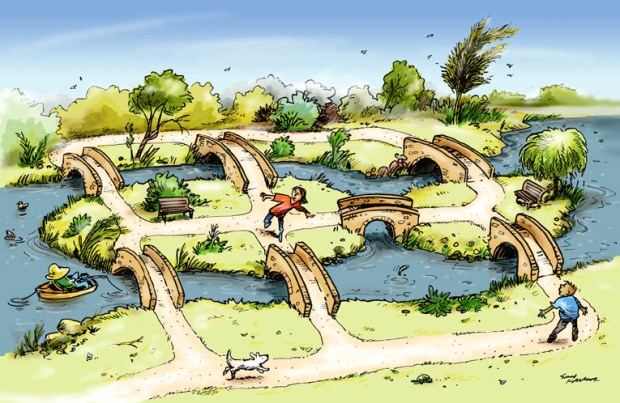
The city of Königsberg (capital of Prussia, now Kaliningrad, Russia) has the Pregel River running through the middle, with islands at the centre of the river connected by seven bridges. Is it possible to cross all of these bridges while only crossing them only once each?

image

If you try to solve this problem, you soon discover that it is incredibly difficult not to cross the same bridge twice. But it is difficult to tackle this problem in a brute force manner. To calculate all of the permutations in the order of bridges, you use 7! = 7 x 6 x 5 x 4 x 3 x 2 x 1 = 5040, meaning that there are 5040 possible arrangements of bridges. Then how can you prove if the problem is solvable or not?

The great mathematician Leonhard Euler, upon being asked to solve the problem, is reported to have said that the problem is impossible to solve on the spot. In 1735, he proved his answer by modelling the seven bridges of Königsberg in a diagram of four dots connected by lines (representing the bridges).

image

By using this model, the problem is converted into a “draw in one stroke” problem, which is also called a Euler walk to honour Euler’s contributions. Euler discovered many properties and laws regarding such problems. If a certain point is the starting point, then the line must first leave the point, then even if it comes back to the point, it must leave again. Ergo, the starting point must have an odd number of lines connected to it. The opposite applies to the ending point, where a line must enter the point, and if it leaves the point it must come back to it. Ergo, the ending point must also have an odd number of lines connected to it. In the case of a Euler walk, the starting and ending points are identical, so the number of lines is the sum of two odd numbers, making it an even number. Thus, to find out whether a picture can be drawn using one line, use the following laws:

  1. If there are no points of odd degree (odd number of lines), the starting and ending points are identical.
  2. If there are two points of odd degree, the starting and ending points are different.
  3. If there are one of more than two points of odd degree, it is impossible to draw using one stroke.

Thus, a Euler walk is only possible if there are 0 or 2 points of odd degree. Looking at the seven bridges of Königsberg problem, we can see that A is connected to 5 lines and B, C and D are connected to 3 lines each. As there are four points of odd degree, we have thus proved that it is impossible to draw a path that crosses all the bridges while not crossing any bridge more than once.

image

Posted in Philosophy

Oil And Water

It is said that oil and water do not mix. This phrase is also used to describe two people who do not get along and cannot even stay near each other. But technically speaking, oil and water can be mixed. When you mix oil and water, you will find that droplets of oil float in the water. If you add an emulsifier (something that helps emulsion – the mixing of oil and water – such as soap or egg white), the oil droplets break down into very fine droplets that spreads through the water to make a stable emulsion fluid. Thus, even something like oil and water that appear to never mix can be mixed using science. Not only that, but some foods that we enjoy so much such as mayonnaise, milk and vinaigrette are all emulsions. Two fluids with different densities and properties, never wanting to be together, can combine to form such a great mixture.

If two people who never get along and refuse to mix were to congeal like mayonnaise, they may form a surprising combination, producing synergy.

1 + 1 = 3

Posted in Philosophy

Bittersweet Dream

One still autumn night, a student woke up in tears. A teacher who found this peculiar asked the student:

“Did you dream a scary dream?”

“No sir.”

“Did you dream a sad dream?”

“No sir. I dreamed a sweet dream.”

“Then why are you crying so?”

As she wiped away her tears, the student said:

Because that dream will never come true.”

(from Bittersweet Life)

Posted in Science & Nature

Mother Horse

Female horses (mares) exhibit a very strange behaviour after they mate with a male. A mare will mate with every other male in the stable, almost immediately after mating with the first one. This strange post-coital promiscuity does not appear to make any sense from an evolutionary perspective, as one would think that pregnancy would lead to a decrease in libido so the mother can focus on caring for her embryo. However, this promiscuity is part of a strategy that helps protect the baby horses.

It is common behaviour in the animal kingdom for a male to kill a female’s young so that he can mate with her and produce babies with his own genetic material. This also happens in horses, where stallions engage in infanticide, kicking a foal to death if it is not his. For a mother horse, this is not only heartbreaking, but also a tremendous waste of the energy she put into pregnancy. So to protect her offspring and conserve energy, she ensures that no male knows who the father of her baby is. It has been shown that males who mated with a female who gave birth will not attack the foal, as there is a chance that it is his. Thus, a mother horse guarantees the protection of her child by prostituting herself to all of the males around.

Although the story of a mother willing to sacrifice everything, even her dignity, for the safety of her offspring may be inspiring, it has also been observed that if a mare cannot mate with all of the males in the stable, she will instead abort the pregnancy. For example, if a new horse is brought into the herd after the mare becomes pregnant, the mare senses the danger to her eventual foal and proceeds to abort it. In a study involving zebras, it was found that bringing in a new male made the foal’s chances of survival fall to less than 5 percent.