Spinach is a vegetable that is excellent for your health as it is rich in nutrients such as vitamins and minerals. If you ask someone the first two things that come to mind regarding spinach, they will most likely reply Popeye and iron. Popeye is a cartoon that began airing in the 1930’s and every child knows that the man gains superhuman powers from eating a can of spinach. In fact, after Popeye began airing, US consumption of spinach grew 33%. Most people believe that Popeye gains powers due to spinach having a high iron content. Thus, adults always tell children that if they want to be as strong as Popeye, they must eat their spinach.
Unfortunately, eating spinach does not make you as strong as Popeye. In fact, it is not even related to iron either. Firstly, the reason why Popeye eats spinach was because the producers wanted to advertise the high vitamin A content in spinach. Furthermore, spinach does not have a high iron content. The spinach iron myth originated from a German scientist named Emil von Wolff. In 1870, von Wolff was analysing the nutrition contents of different foods when he, from severe fatigue, accidentally misplaced a decimal point while recording the iron content of spinach. This led to spinach being known to have ten times the amount iron it actually has (to the level of red meat).
One problem with this is that this story is not true either. There are no detailed records of von Wolff’s experiments and no one knows if he misplaced a decimal point or not. The myth most likely originates from a 1980 article in The British Medical Journal that first brought up the story. Does that mean spinach is actually is a good source of iron? Wrong. Vegetarians often claim that spinach has iron levels close to red meat, but there is something about iron that they do not know. Many plants have a high iron content (it is found in chlorophyll which is used for photosynthesis), but this is mostly non-heme iron. There are two types of iron the human body can absorb: heme and non-heme. Heme iron can be used directly after absorption whereas non-heme iron needs to be metabolised by the liver to be usable. This takes a long time and is inefficient meaning it is far more effective to eat foods rich in heme iron. Plant iron is all non-heme iron while 40% of iron in red meat is heme iron, meaning it is a much better source of iron. Furthermore, spinach has a high oxalate content, which is an iron absorption inhibiting agent, making what little usable iron it has unabsorbable.
In short, it is true that spinach has “iron” but as we cannot absorb it or use it, it practically has no iron content. But if you tell this to your parents and refuse to eat spinach, you may get into a lot of trouble.
How many friends can a person have? Believe it or not, science has solved this question. An anthropologist called Robin Dunbar studied various societies, tribes and primate groups to determine how many members a group can have to maintain stability. He discovered that the ideal size for a group of humans was about 150.
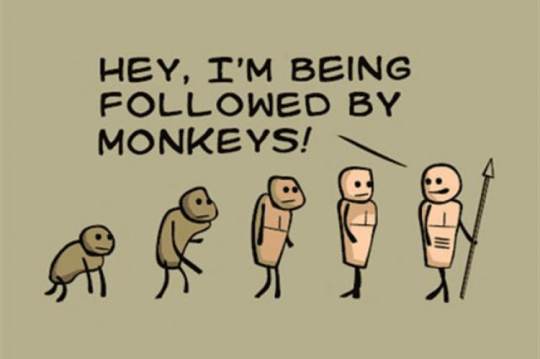
What happens if there are more than 150 people in a group? This is easily explained by the following thought experiment. Imagine that you have a friend called Mr. White. Add a personality to him – flesh him out as a person. Next, you make another friend called Mr. Red. Then Mr. Blue, Mr. Green, Mr. Maroon… At a certain point, you will no longer remember the name or personality of your “friend” and not even care about that person. This is the limit set by our brains – known as Dunbar’s number, or more colloquially the Monkeysphere.
Any person outside of this Monkeysphere is not of your concern. Once you saturate your brain with 150 relationships, the brain ceases to care about other people. Interestingly, the Monkeysphere is directly related to the size of the neocortex (the part of the brain responsible for higher order thinking). For example, most monkeys can only operate in troupes of 50 or so.
The Monkeysphere can be defined as the group of people that you conceptualise as “people”. Because of this limitation, we are physiologically incapable of caring about everyone in the world. For example, we are highly unlikely to be concerned about the welfare of the janitor at work compared to a loved one. As politically incorrect it may be, the brain sees the janitor as “the object that cleans the building” rather than a human being. You may “care” about the janitor in the sense that you greet him in the corridor, but there is a limit to this. This effect actually explains quite well why society is dysfunctional in general.
Because we do not see people outside the Monkeysphere as “people”, they mean less to us. Stalin once said that “one death is a tragedy; a million deaths is a statistic”. Similarly, the death of a family member is devastating but 10,000 people dying in a foreign country from war does not have the same emotional effect. Furthermore, if a stranger was to die in front of your eyes, you would still not be nearly as devastated as the death of someone you are close to.
Also, as we do not feel connected to these “outsiders”, we are much more prone to act rude or aggressively. For example, one may insult other drivers with the most colourful words on the road, but would (hopefully) never say those words to a friend.
This expands to a greater scale in the context of survival. We are wired to put the need of the members of our Monkeysphere ahead of those outside of it. Thus, we would not steal from our friends but openly evade taxes as we see the government and others as a cold, faceless body. It does not occur to us that through our actions, we are harming other human beings. The same applies to our view of corporations; despite being made up of real people, we only see them as heartless machines actively conspiring against us.
What if the scale was then expanded to countries? If we do not see a person on the other side of the road as a human being, it is extremely unlikely we would register a foreigner as one. This explains why racism and stereotyping is so common in human societies. Although liberal-minded people would like to believe that we should treat every human being like we treat our mothers, our brain is incapable of it. In fact, it is much more likely we would see those people as acting against our interests by “stealing jobs” and so forth. Thus, racism is a hard-wired behaviour to protect the best interest of our Monkeysphere.
We have established that it is impossible to worry about the seven billion strangers in this world. This brings us to an important point: it is just as impossible to make “them” interested in “you”. It is a cold, hard fact that if you are outside of their Monkeysphere, people will not care about you. Ergo, they treat you badly, put you down, steal from you and downright ignore you. In fact, cognitive dissonance means you are even less likely to care for people outside the Monkeysphere as your brain actively rejects people from getting closer to your Monkeysphere, exceeding the preset limit of 150 people. This is why propaganda always focusses on dehumanising the enemy and why people seeking votes and attention pull at sympathy strings – to try get as close to your Monkeysphere as possible.
Many people will lament how we are not monkeys and the Monkeysphere does not apply to us. We have laws, ethics and “humanity”. However, we cannot escape our primitive psychological behaviours and this is reflected in societies filled with crime, unhappiness and a general disinterest in people not related to yourself. This is why city-dwellers tend to be less friendly than villagers, as there are too many people to fit in one, happy Monkeysphere. In fact, monkeys may have more functional societies than us because they hardly ever exceed their own Monkeyspheres (which may also explain why they rarely have wars). The same can be said of tribes and villages of the past.
Ironically, the development of society has been based around working around the limitations of the Monkeysphere – a theoretically ideal society. By living in larger groups, humans can achieve greater feats such as industries and large-scale economies. Although we suffer the consequences of racism and crime, we have become very effective in survival.
Economics is based on the Monkeysphere too. As we only care about our Monkeysphere, there is no reason for us to be concerned about the needs of others. So when a system such as communism forces us to share our bananas, we become infuriated that we have to give up our bananas to people we do not know. But in capitalism, every individual can pick bananas for just ourselves and those we care about. The system thrives as each Monkeysphere acts dynamically and everyone is happy. This is the concept of the invisible hand that is the foundation of modern economics.
But still, the concept of countries means that we have to share the burden of millions of people we do not care about in the form of taxes and civil duties. This makes us unhappy. So what can we do?
Firstly, realise that you are to others what others are to you. If you find a certain person on television as annoying and irrational, chances are that someone else sees you in that light. You are limited to your Monkeysphere of 150 people and people outside of it are in their own Monkeyspheres.
Secondly, understand that no one is special. There are no heroes or perfect beings. Everyone is a human being and prone to making mistakes and acting “human”. Therefore, we cannot idolise people and be disappointed by their actions. This also means that you cannot judge another person and consider their words and actions as insignificant, as they are just as human as you.
Lastly, never simplify things. The world is not simple. It cannot be generalised as one happy village with everyone living happily in harmony. It is a composite of a massive number of different Monkeyspheres, all concerned with their own well-being and not caring about anything else.
Remember the words that Charles Darwin spoke to his assistant, Jeje Santiago: “Jeje, we are the monkeys”. As much as we would like to think that we are higher-order beings, we are simple creatures of habit and behaviour limited by our Monkeysphere.
Is time travel possible? In 1943, a science fiction writer called René Barjavel posited the following paradox.
A man travels back to the past and kills his biological grandfather before he meets his grandmother. Thus, his grandparents would not have sired a son (the man’s father) or daughter (mother), which then suggests the man could not have been conceived. If so, who killed the grandfather? As there was no one to kill the grandfather, he would have had a child and the man would ultimately be born, travelling back to the past and killing his grandfather. This paradox suggests that time travel is impossible.
Some people use the parallel universe theory to argue against the paradox. They suggest that as soon as the man travels to the past to kill his grandfather, an alternate universe is created where the grandmother meets a different man and the course of time is changed. This is a valid theory but the grandfather paradox still holds strong in disproving time travel. However, the grandfather paradox only states that travelling back in time is impossible; it says nothing about time travelling to the future.
It is said that through a chain of five people, we can be acquainted to anyone in the world. In other words, an Eskimo man can be no less than six steps away from a Parisian lady. This is the concept of the six degrees of separation.
The concept can be explained mathematically. We all know hundreds of different people each. If we assume that we each have 100 friends, then in the first stage we only know the 100 friends. However, at the second stage we know the 100 friends of each of our friends, meaning we know 10000 people. At the third stage we know 1 million people, fourth stage 100 million and fifth stage 10 billion people. As the world population is 7 billion, by the fifth stage we should theoretically know every person on the world. This means that crossing four metaphorical bridges lets us shake the hands of anyone we want. The concept of the degrees of separation came from the idea of the small world phenomenon.
The first person to properly study the small world phenomenon was Harvard social psychologist Stanley Milgram. In 1967, Milgram asked 296 people in the Midwest (USA) to help him send a package to someone in Boston. To complete the experiment, the participants had to send the package to one of their friends they thought would know this stranger in Boston. Milgram found that in half of the cases, the package was delivered to the target in Boston through five people (5.5 exactly), thus giving birth to the concept that we are at six degrees of separation from another human being.
Of course since 1967 our societies have undergone many changes. One of the most noticeable changes has been the development of technology – specifically the development of the internet and social networking. Nowadays, the younger generations use the internet to communicate with friends and make connections. Knowing this, what degrees of separation exists in modern societies? According to a recently finished study (2011) using data from the social networking site, Facebook, the average number of “bridges” for the world is 4.7. In countries such as the US where there is a bigger proportion of Facebook users, this number fell to 4.4. Ergo, in the past 40 years we have developed more connections to other people, making our world even smaller.
The theory of six degrees of separation reminds us how small a world we live in and how interconnected we are to each other.
Common belief is that Newton discovered gravity after an apple dropped on his head. Although there is no historical evidence to support this myth, it has become a popular story. There are two common responses to this story: the first is “Wow, Newton was a smart cookie” and the second is “Pfft, I could have discovered gravity without an apple, it is such an easy thing.”
The latter group of people are idiots. Newton did not “discover” gravity. Human beings have known that objects fall to the ground since the dawn of time and have utilised it in ways ranging from sports to killing other people by crushing them with giant rocks. Even animals know of the concept as seen by eagles dropping turtles on rocks to crack the shell. In fact, if you could not figure that out, then you would really be an idiot.
The reason why Newton is famous is not because he found that apples fall from trees, it is because he observed the phenomenon, noting that it was always perpendicular to the ground, which in combination with the knowledge that the Earth is round suggests that objects tend to fall towards the centre of the Earth. Again, Newton’s brilliance was not that he simply observed an apple falling, it was that he pondered it and spent years researching it until he discovered the way gravity behaves. He devised formulas to estimate how gravity functions, even applying it to predict how the moon orbits around the Earth. Thanks to Newton, we are able to model the world around us and send rockets to the moon without launching our astronauts in to the depth of space with no hope of recovery.
Interestingly, physicists still do not know what causes gravity. There are many theories, such as particles called gravitrons attracting two objects to each other. Although the mathematics of two objects attracting each other has been accurately calculated, it is unknown what causes it. Only after you discover the truth behind how gravity functions can you say that “I could have discovered gravity in my sleep” (actually, even then you probably spent decades just trying to grasp the concept).
Before you criticise, know what you are criticising.
Every creature on earth knows the fearful power of fire. Learning how to utilise it is possibly one of man’s greatest achievements, as it allowed science and technology to kickstart in every way. However, we still lose control over it sometimes and suffer the consequences. Fire can develop from a tiny ember to a full-blown firestorm that incinerates everything in its path. The following are the four stages of fire development:
Stage 1 – Incipient stage: No visible smoke and very little heat. Small fire.
Stage 2 – Build-up stage: More heat causes pyrolysis (decomposition of material due to heat), releasing combustible gases. May cause a flashover (every combustible surface in the room ignites all at once).
Stage 3 – Fully-developed stage: Visible flame, massive amounts of heat, smoke and toxic gases. Everything is burning.
Stage 4 – Decay stage: Fire is either contained or extinguished. If not, may spread to other areas (e.g. the next room).
After sufficient heat has built up, fire spreads almost explosively (sometimes literally) causing extensive damage. Thus, the most important part is preventing the fire in the first place or extinguishing a small fire still at the incipient stage. As powerful a tool it may be, it can also destroy everything you hold precious within a matter of hours.
An interesting phenomenon related to fire is backdrafts. This is similar to flashovers (described above) except it is triggered by oxygen rather than a build-up of heat. Both cause a sudden transition from a small fire to a full-scale inferno. A backdraft occurs when a burning room is filled with pyrolysed, combustible gases but lack the oxygen needed to continue burning as it was used up while the fire was building up. When a firefighter or a broken window causes air to rush into the room, the pressure in the room spikes and every combustible material suddenly bursts into flames, exploding out in a ball of fire. Backdrafts are one of the most dangerous fire phenomena that claim the lives of countless firefighters.
In 300BC, a Greek mathematician called Euclid wrote a series of texts called Elements. The Elements was a textbook that outlined many principles of mathematics (especially geometry) and it would become one of the most influential works in the history of mathematics. It is composed of a series of axioms (the axiomatic approach) from which many deductions and theorems can be made. Although many of these axioms sound extremely simple and like common sense, the implications are staggering.
The following is Euclid’s Five Postulates of Plane Geometry:
Two points determine a line.
Any line segment can be extended in a straight line as far as desired, in either direction.
Given any length and any point, a circle can be drawn having the length as radius and that point as centre.
All right angles are congruent (can be superimposed).
Parallel postulate: If two lines intersect a third in such a way that the sum of the inner angles on one side is less than two right angles, then the two lines inevitably must intersect each other on that side, if extended far enough.
Using these postulates, mathematicians are able to deduce more advanced theories. For example, the Elements also describes the famous Pythagorean theorem, which states that “in any right triangle, the area of the square of the hypotenuse (the diagonal) is equal to the sum of the areas of the squares of the other two sides” (a² + b² = c²).
Thanks to Euclid’s works, we are now able to accurately model and measure the three-dimensional space around us. Not only did Euclid set the foundations for mathematics, his works were also instrumental in the development of logic and modern science.
The bombardier beetle, or Brachymus creptians, has a “machine gun”. When attacked, it makes an explosive sound and spouts smoke. This beetle combines chemicals from two separate glands to make the smoke. The first gland produces a solution of 25% hydrogen peroxide and 10% hydroquinone, while the second gland produces peroxidase, an enzyme that catalyses the reaction. When these solutions are combined and heated to 100°C, smoke and nitric acid vapour is produced and explosively released.
If you put your hand close to a bombardier beetle, it will rapidly release a scalding, noxious, red vapour. This nitric acid will cause blisters on afflicted skin. Bombardier beetles also know how to aim the tip of its abdomen to target an enemy. Via this method, it can hit a target a few centimetres away. Even if it misses, the explosive sound will scare away any predator. Normally, bombardier beetles store enough chemicals for three or four shots. However, some entomologists have found that some species can fire up to 24 times in rapid succession if provoked.
As these beetles are a bright orange and silver-blue colour, they are very noticeable. They act as if they do not care if they are seen, as they are equipped with an effective cannon. Generally, beetles with a colourful coat have a unique, ingenious defensive mechanism to ward off curious animals and insects. Despite this, rats that know that the beetle loves to use this “ingenious defensive mechanism” quickly grab the beetle and plant its abdomen in the ground. After attacking it continuously while in the ground to exhaust the beetle’s rounds, the rat bites off the head first.
(from the Encyclopaedia of Relative and Absolute Knowledge by Bernard Werber)
Most Westerners are familiar with Johannes Gutenberg, who invented the printing press in 1450 which allowed the mass-production of books, namely the bible. In fact, the printing press is thought of as one of the crucial factors that triggered the Renaissance in Europe.
However, what most people do not know is that the movable type – a printing machine where individual letters can be rearranged and reused – was invented in Korea during the Goryeo Dynastytwo centuries before Gutenberg.
Before the movable type, Buddhist monks would carve out wooden blocks so that they could copy out religious texts with ease. But as this involved the monks having to carve out the entire text (often very long), it was extremely labour-intensive and everyone sought an easier method of mass-producing texts. The concept of the movable type was experimented with throughout the centuries, but it was found that woodblocks would wear out too fast. Although metal was the obvious choice, the technology was not developed enough to produce the fine letters.
In 1234, a Korean man called Choe Yun-ui finally devised the technology to invent the first metal movable type in the world. The process was very complicated, involving the making of durable clay moulds to hold the molten metal without breaking.
This was revolutionary as it meant that texts could easily be printed as all the printers had to do was rearrange pre-made letters in order rather than laboriously carving each one out. Metal movable types are also extremely durable and give a very clean print, unlike the wooden counterpart that tends to wear out or smudge. The metal movable type allowed for the mass-production of books which greatly boosted Goryeo’s culture and education within the poorer classes.
Korea was the leading innovator in the printing industry throughout history, with the earliest woodblock prints dating back to 751. The motivation to develop this technology was partly thanks to Buddhism. To ensure that Buddha’s teachings could be spread far and wide, Buddhist monks worked day and night to produce these texts. This was a critical job during the 13th century when the Mongol Empire was rampaging through the whole of Eurasia. As military force was insufficient to repel the invaders, the people turned to spirituality for power. Furthermore, due to the destructive nature of the Mongols, it was crucial to replace damaged texts to ensure that precious cultural heritages would not be destroyed. This was the main motivation for the creation of the metal movable type and to this day we can see the evidence of the state-of-the-art printing device in books from the 13th and 14th century.
One limitation still remained with the movable type – Chinese characters. At the time, Korea still used Chinese characters to record the Korean language (similar to how Chinese characters can be transcribed in pinyin form). As there are literally tens of thousands of characters, a massive amount of individual types had to be produced.
This problem was solved by King Sejong the Great of the Joseon Dynasty, who invented Hangul – the Korean alphabet. Hangul only contains 24 letters and is extremely logical in its construction, ergo it was a perfect system for recording language. It also meant that much less individual types were needed, making the printing process even more efficient.
Although the 20th and 21st century saw the Western Hemisphere leading science and technology innovations, it is important to remember that the East dominated the field for millennia before.
Cats always fall on their feet. Buttered toast always seems to fall buttered side down. So what would happen if we tied a buttered toast on a cat’s back and then dropped the cat? Would the cat land on its feet or would the toast land on its buttered side? Or would we achieve perpetual motion and anti-gravity simultaneously as they cancel each other and never touch the ground?
Although the paradox is obviously a humorous thought experiment, there is some truth to the separate adages. Cats have a natural righting reflex that allows them to twist their upper body so that they land on their feet. This gracious manoeuvre is developed as a kitten and actually involves quite complex physics where the cat is able to turn around without changing their net angular momentum. Since cats have a small body and very light body weight, their terminal velocity (100km/h compared to a human’s 210km/h) when falling is much less and allows them to absorb the shock easily when landing. Furthermore, when falling cats naturally spread their limbs out to slow their fall as much as possible. All these factors let a cat land safely on its feet even if dropped from a high place. Ironically, the lower they are dropped from, the more likely that the cat would fall on its back.
The other side of the paradox is slightly more complicated. The adage that toast falls buttered side first is actually an example of how if something bad can happen, it will happen. However, physicists have discovered that toast is more likely to fall on its buttered side. When toast falls off a plate, it is highly likely to tip as it hits the edge. This causes it to rotate as it begins to fall. There are two explanations on why the buttered side is more likely to be facing down. Firstly, butter adds weight to one side and heavier objects fall faster in the face of gravity. Secondly, using experimental data it has been found that toast only rotates about 180 degrees by the time it falls the height of the table or person from where it was dropped from.
Despite it only being a tongue-in-cheek thought, one can only wonder how many scientists have made some toast, buttered it, tied it to a cat and dropped the cat off a ladder.