Posted in Life & Happiness

Carriage

There was a disciple who bought an expensive carriage. He did not want to damage it and so never took it out and instead cleaned it every day. One day, his master visited his house and saw his disciple polishing the carriage. He asked:
“Who owns this carriage?”
“I do.”
“It appears to me that the carriage owns you.”
“…What do you mean, master?”
“Are you not treating the carriage as a servant serves its master?”
“…”
“What you do not enjoy cannot be called your possession. Only by enjoying it do you possess it. Not only objects, but the warm sunshine, fresh air, beautiful scenery are all a man’s possessions if he enjoys them. A person who can enjoy many things can be called truly rich. If a person enjoys the world, even without a single penny they are the wealthiest person in the world.”

The foolish disciple was proud of his carriage that he spent so much money on, when he could not even use it. The way people treat the learning of knowledge and skills is similar to how the disciple treated the carriage. People look for all kinds of luxurious carriages that they will not, or cannot even use.

What is infinitely better is to enjoy and indulge in the carriage you already own to move forward in your life, no matter how cheap and ragged it may be. In fact, believing that your carriage is old and worn-out is simply a delusion. Within the most basic carriage lies the secret to enlightenment. However, those who are blinded by delusion that they must seek a fancier, stronger-looking carriage that requires less effort can never see that. The Bluebird of Happiness that you have been seeking forever has been waiting inside you all this time. But how can you learn the ultimate secret if you do not even think about looking deep within your heart?

There is a world of difference between possession and enjoyment. Do not seek the talents of others, cultivate and develop the talents you already own. To be satisfied with what you have and enjoying it – that is the secret to happiness.

Posted in History & Literature

Succubus

A succubus is a demon that takes the form of an attractive human woman to seduce men, tempting them to have sex with her. Through sex, the succubus leeches away the man’s life force until he wilts away. They tend to visit men in their dreams and use their beauty and charm to lure and enchant their victim. A famous example of a succubus is Lilith, the first wife of Adam. There are other similar demons throughout the world, such as the nine-tailed fox in Asia (kumiho in Korea, kitsune in Japan and Hulijing in China). A similar demon is an incubus – the male equivalent of a succubus.

The origin of the succubus may be explained medically. It is well known that sleep paralysis is related to vivid hallucinations in the hypnagogic state, with countless cases of alien abductions and supernatural sightings ascribed to the phenomenon.

However, another explanation may be that the succubus is an allegory of the femme fatale. Femme fatale – French for “deadly woman” – describes a mysterious and seductive woman who uses her womanly charms to ensnare and manipulate men. A femme fatale is highly able in utilising the various tools at her disposal: beauty, charm, sexual allure, music, seductive dancing, persuasive language, deception, coercion, hypnotising and generally toying with a man’s reproductive instincts.

There are many examples of how different femme fatales – ranging from the biblical Eve to the spy Mata Hari – made an impact in history through the elaborate manipulation of men to their advantage. This is reflected in folklore through the concept of witches and enchantresses who use “magic” and sexual charms to have men do their bidding, essentially having them on a leash.

Essentially, the moral of the story of the succubus (that is, to men) that women can be deadly and are completely capable of sapping a man’s life away if she wished so. That is why men should know when they are actively being deceived or being controlled by a woman with (false) promises of love and sex. Perhaps the flipside moral of the story for women is that with the power of sex, a woman can have a man do anything for her – a valid strategy that has proven to be effective for all of recorded history.

Posted in Science & Nature

Euclidean Geometry

In 300BC, a Greek mathematician called Euclid wrote a series of texts called Elements. The Elements was a textbook that outlined many principles of mathematics (especially geometry) and it would become one of the most influential works in the history of mathematics. It is composed of a series of axioms (the axiomatic approach) from which many deductions and theorems can be made. Although many of these axioms sound extremely simple and like common sense, the implications are staggering.

The following is Euclid’s Five Postulates of Plane Geometry:

  1. Two points determine a line. 
  2. Any line segment can be extended in a straight line as far as desired, in either direction. 
  3. Given any length and any point, a circle can be drawn having the length as radius and that point as centre. 
  4. All right angles are congruent (can be superimposed). 
  5. Parallel postulate: If two lines intersect a third in such a way that the sum of the inner angles on one side is less than two right angles, then the two lines inevitably must intersect each other on that side, if extended far enough. 

Using these postulates, mathematicians are able to deduce more advanced theories. For example, the Elements also describes the famous Pythagorean theorem, which states that “in any right triangle, the area of the square of the hypotenuse (the diagonal) is equal to the sum of the areas of the squares of the other two sides” (a² + b² = c²).

Thanks to Euclid’s works, we are now able to accurately model and measure the three-dimensional space around us. Not only did Euclid set the foundations for mathematics, his works were also instrumental in the development of logic and modern science.

Posted in Psychology & Medicine

Alien Hand Syndrome

There is a very rare, disturbing and interesting medical condition called alien hand syndrome (AHS). An individual with this neurological disorder has full sensation in the rogue hand, but is unable to control its movements and does not feel that it is a part of their body. The hand becomes personified, as if it has a will of its own, and its owner will usually deny ownership of the limb.

Though AHS was first identified in 1908, it was not clearly defined until 1972. Depending on the cause of the injury, the movements may be random or purposeful, and may affect the dominant or non-dominant hand. The symptoms are brought on by an injury to the brain, such as head trauma, stroke, tumour, or infection. It can also be a side effect of a certain kind of brain surgery where the patient has the two hemispheres of the brain separated to relieve severe epilepsy.

If the AHS is caused by separation of the corpus callosum (the area of the brain that connects the two halves of the brain) by surgery or injury, the movements are usually complex purposeful behaviour, such as compulsive manipulation of tools, undoing buttons, or tearing clothes. For example, a right-handed person is left-hemisphere-dominant, thus their left hand (controlled by the right hemisphere) will become “alien”. Sometimes the sufferer is completely unaware of what the hand is doing until it is brought to his or her attention, or until they happen to see it themselves. 

Strangely, many of the alien hand’s actions are the complete opposite of what the person is doing with the other hand. For example, if they start packing a suitcase, the alien hand will unpack it. It is believed that one half of the brain (usually the right brain) is unaware of why the other hand is doing something (due to the lack of connection between the two hemispheres) and so proceeds to “correct” it. There are also reports of the alien hand attacking the patient by hitting them or even trying to strangle them in their sleep. 

There is currently no treatment for alien hand syndrome, but the symptoms can often be relieved by giving the rogue hand an object to manipulate, to keep it occupied. One patient whose alien hand had a compulsion of holding on to door handles or other objects to stop the man from walking was given a cane. The alien hand would grab on to the cane and not interfere with the patient’s walking.

There is currently no treatment for alien hand syndrome, but the symptoms can often be relieved by giving the rogue hand an object to manipulate to keep it occupied. One patient whose alien hand had a compulsion of holding on to door handles or other objects to stop the man from walking was given a cane. The alien hand would grab on to the cane and not interfere with the patient’s walking.

Although it is a distressing condition, some patients learn to live with the disease. For instance, when one patient’s alien hand kept throwing away the cigarette her dominant hand put in her mouth, she shrugged and said: “I guess ‘he’ doesn’t want me to smoke that”. Perhaps the alien hand is simply a way for the subconscious mind to physically act on the conscious mind.

Posted in History & Literature

Dragon’s Scale

According to the ancient writings of Chinese author Han Feizi, a dragon is a gentle creature that a man can tame and even ride on the back of. However, one must be extremely cautious of the inverted scale on the neck of the dragon. Touching this scale will cause the dragon to become enraged, immediately killing the person.

Any person has strengths and weaknesses. Some people love to draw out another person’s weakness and are deluded that finding a person’s greatest weakness is a victory. But in human relationships, touching another person’s “inverted scale” can be a critical mistake. Who would want to deal with a person that prods at their weakness? Even during a heated debate, attacking the opponent serves no purpose and is only a destructive act. This kind of dirty move may bring you short-term “victory”, but in the long-term it can cause you to be forever alone. No matter how gentle the person may be, picking on something they are sensitive about may cause them to strike down with great vengeance and furious anger upon you.

The wisdom of the anecdote of the dragon’s scale can also be applied to how people should treat those below them. Whatever your position may be, making fun of your staff’s weaknesses will lead to the loss of trust and respect from them. Sun Tzu’s The Art of War teaches that a general must never attack a soldier’s faults but rather show wisdom in helping the soldier fix the problem on their own.

Lastly, when persuading another person, instead of speaking of their weaknesses, bring up their strengths. Avoiding the “inverted scale” is one of the most important skills in the art of persuasion.

The most important aspect of relationships is following the philosophy of 1 + 1 = 3 by co-operating and having a constructive meeting. A destructive person that attacks others can never progress.

Posted in Life & Happiness

Life And Death

“No one wants to die.
Even people who want to go to heaven don’t want to die to get there.
And yet death is the destination we all share. No one has ever escaped it.
And that is as it should be, because Death is very likely the single best invention of Life. It is Life’s change agent. It clears out the old to make way for the new.
Right now the new is you, but someday not too long from now, you will gradually become the old and be cleared away.
Sorry to be so dramatic, but it is quite true.
Your time is limited, so don’t waste it living someone else’s life.
Don’t be trapped by dogma – which is living with the results of other people’s thinking.
Don’t let the noise of others’ opinions drown out your own inner voice.
And most important, have the courage to follow your heart and intuition. They somehow already know what you truly want to become.
Everything else is secondary.”

~ Steve Jobs, co-founder of Apple Inc.

Posted in History & Literature

Chivalry

Chivalry was a concept developed in medieval times and is defined as the noble qualities a knight was supposed to have, such as courage and a readiness to help the weak. It is characterised by the traits of gallantry, courtesy and honour. Nowadays, the concept of chivalry is largely confined to the mannerisms a gentleman should treat his lady with.

The following is a list of some gentlemanly acts any man should follow to pay due respect to their women:

  • Open doors and pull out chairs.
  • Be punctual, polite, keep calm and collected.
  • Put your coat or jacket around her on a cold day.
  • Be helpful, such as helping fix things and lifting heavy objects.
  • Cover her with your umbrella even if it means you get wetter.
  • Walk on the outside of the sidewalk. (This is derived from the tradition of Victorian England when people would throw excrements out the windows – the male would be more likely to be hit and thus carried an umbrella at all times)
  • Do not be thrift and know how to pay bills discreetly.
  • When conversing, listen to what she says and be attentive.
  • Be romantic, treat her with flowers, gifts and surprises.
  • Compliment her and accept her for the person she is.
  • Never make meaningless promises or go against your word.
  • Respect her.

Although most of this list is part of general etiquette, it is indubitably a crucial part in courting. In fact, as author John Bridges said, being a gentleman requires “a little logic, a bit of forethought and a great deal of consideration for others”. 

However, one cannot help wonder how long chivalry can last in this modern world. As chivalry was based on the idea that the strong should help and protect the weak, it essentially implies that women are weaker and in need of protection by the man. Ideologically speaking, this goes against the arguments of some feminists. Does this mean that those women do not expect chivalry from males?

Regardless, a true gentleman must act chivalrously and treat ladies with proper etiquette if they expect to be respected and loved in return.

Posted in Science & Nature

Badass Weapons Of Nature: Mantis Shrimp

In April 1998, a shrimp by the name of Tyson punched through the quarter-inch-thick glass of his cell and attempted an escape. He was promptly caught and had to be sent to a more secure facility. Unlike his boxing counterpart, Tyson was merely 10 centimetres in length.
Mantis shrimp are well-known for their “fists of fury” – officially the fastest punch in the natural world.

Their weapons of choice are their clubs that can be retracted and folded under their head. Using a remarkable energy-storage system – much like the cocking mechanism of a gun combined with a spring – the mantis shrimp can unleash its rounded, stubby claws at a speed of 80km/h to hit its target in 0.003 seconds. This is an amazing feat given that it happens underwater, where the water puts up a significantly higher resistance compared to air. The acceleration needed to produce this awesome punch is 10,000 times the force of gravity (similar to a bullet). In simpler words, researchers could not film using high-speed cameras and needed to borrow a super high-speed camera just to see the punch happen. 

However, the surprises do not end here. Researchers soon found that each strike by the mantis shrimp not only inflicted heavy physical damage, but the sheer speed of the punch created cavitation (implosion of bubbles). Much like the pistol shrimp, this cavitation releases massive amounts of light and heat energy. This shockwave happens immediately after the punch, essentially resulting in the target receiving a deadly one-two hit combo which instantly knocks it out (or disintegrated). 

The force of the mantis shrimp’s punch can easily penetrate the hard shell of most crustaceans in the ocean, meaning no creature is safe. Mantis shrimps have also been observed beating up fish and octopi – and succeeding.

Not only does the mantis shrimp have the most powerful strike, it also has one of the most sophisticated eyes in nature and is extremely agile. This, combined with the shrimp’s cunning nature makes it the perfect hunter. It tends to ambush prey and swiftly knocks it out before it knows what hit it. If the one-hit KO fails, the mantis shrimp uses its agility to hit the foe and quickly swim away, then hit again from the other side until the foe is crushed.

Lastly, the shrimp described above is actually one type of mantis shrimp called a smasher. There is another subtype called spearer with claws modified into sharp spears that can be thrusted with the same force as the smasher’s clubs.

The only adequate metaphor to describe this awesome creature would be a Mike Tyson punching as hard as he can, in his prime, while his fist is attached to a meteor entering the atmosphere.

(Image source: Cracked.com)

Posted in Science & Nature

Badass Weapons Of Nature: Bombardier Beetle

The bombardier beetle, or Brachymus creptians, has a “machine gun”. When attacked, it makes an explosive sound and spouts smoke.
This beetle combines chemicals from two separate glands to make the smoke. 
The first gland produces a solution of 25% hydrogen peroxide and 10% hydroquinone, while the second gland produces peroxidase, an enzyme that catalyses the reaction. When these solutions are combined and heated to 100°C, smoke and nitric acid vapour is produced and explosively released.

If you put your hand close to a bombardier beetle, it will rapidly release a scalding, noxious, red vapour. This nitric acid will cause blisters on afflicted skin.
Bombardier beetles also know how to aim the tip of its abdomen to target an enemy. Via this method, it can hit a target a few centimetres away. Even if it misses, the explosive sound will scare away any predator. 
Normally, bombardier beetles store enough chemicals for three or four shots. However, some entomologists have found that some species can fire up to 24 times in rapid succession if provoked.

As these beetles are a bright orange and silver-blue colour, they are very noticeable. They act as if they do not care if they are seen, as they are equipped with an effective cannon. Generally, beetles with a colourful coat have a unique, ingenious defensive mechanism to ward off curious animals and insects.
Despite this, rats that know that the beetle loves to use this “ingenious defensive mechanism” quickly grab the beetle and plant its abdomen in the ground. After attacking it continuously while in the ground to exhaust the beetle’s rounds, the rat bites off the head first.

(from the Encyclopaedia of Relative and Absolute Knowledge by Bernard Werber)

Posted in Science & Nature

Badass Weapons Of Nature: Pistol Shrimp

A gun is, without a doubt, a manmade object. It is an invention that has existed less than a thousand years in history. However, there is an animal that has been using firearms to hunt prey for a significantly longer period of time than mankind has.
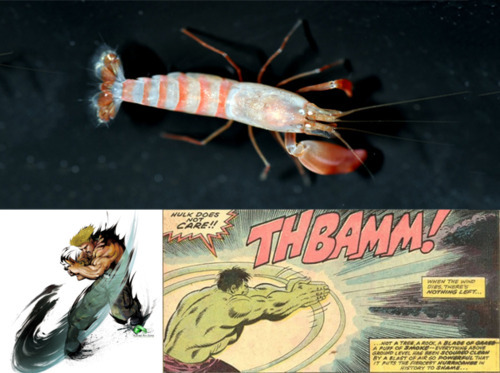
The pistol shrimp is well known for its disproportionately large claw, with the other claw being much smaller like a normal shrimp. The massive claw is what is called the “pistol” and it is the weapon of choice for the shrimp.

When a pistol shrimp identifies a target, it swiftly takes aim with the claw and snaps it shut with enough force to create a bubble jet reaching a speed of almost 100km/h. Not only are bubbles produced, but the pressure wave created by the cavitation (the effect of a bubble imploding and generating energy) reaches a sound level of 218dB – which is about 100,000,000 times larger than a gunshot, or 10,000 times larger than a rocket launch. Furthermore, the energy is also released as light and heat, generating a temperature as hot as 4700°C (for comparison, the surface temperature of the sun is 5500°C).
The combination of the bubble jet, pressure wave and heat energy instantly stuns the target and the pistol shrimp proceeds to devour its prey.

Yes, the pistol shrimp has mastered a skill that humans can only dream of in comics such as the Incredible Hulk’s Thunderclap, or in games such as Guile’s Sonic Boom (from Street Fighter). It has also mastered the skill to the level of an effective ultimate move that is reliable as a hunting tool. In fact, it is quite possibly the closest any animal on Earth has gotten to an actual beam weapon.