
Posted in History & Literature

The Twelve Labours Of Hercules

After killing his children in a psychotic state inflicted by Hera, Hercules was dethroned and was set ten tasks, all deemed impossible, which he had to complete for forgiveness of his sins. Each task required problem-solving and unconventional thinking, which eventually granted Hercules the reward of immortality.

The twelve (including two that were added as he was blamed for cheating in two tasks) labours in order were:

  1. Kill the Nemean Lion, a monster with hide so thick that no arrow can pierce it. Hercules stunned the lion with a club and then strangled it, after which proceeded to skin its hide with its own claws to use as armour.
  2. Kill the Lernean Hydra, a monster with nine heads, which could regrow two heads in the place where one was cut. Hercules instructed his charioteer, Iolaus, to cauterise the necks after cutting the heads to prevent it regenerating, then used the poisonous blood to coat his arrows. This was considered cheating as he used the help of Iolaus.
  3. Capture the Cerynian Hind, Artemis’ beloved deer. Hercules followed the hind for an entire year and then safely carried it away, to avoid harming the frail creature and angering the goddess.
  4. Capture the Erymanthian Boar, a wild beast that intimidated all of the inhabitants of the mountain. Hercules captured the creature using a net.
  5. Clean the Augean Stables, a gigantic stable housing thousands of cows that had not been cleaned in 30 years, Hercules was given one day for the task, so he bent two rivers so they flowed through the stables to clean the filth. He was about to receive payment for his service, which was considered cheating by King Eurystheus (who set the tasks).
  6. Kill the Stymphalian Birds, murderous birds with bronze beaks and claws, and metallic feathers that they could shoot like darts. Hercules killed them with poison arrows tipped with the Hydra’s blood.
  7. Capture the Cretan Bull, a rampant bull capable of breathing fire. Hercules wrestled to control the beast and successfully captured it.
  8. Capture the horses of Diomedes, that were trained to feed on human flesh. Hercules killed King Diomedes who raised them and fed his corpse to the horses, thus taming them.
  9. Take the Girdle of Hippolyte, the queen of the Amazons. Hercules was gifted the girdle by Hippolyte, but Hera spread a rumour that he was there to conquer the Amazons, forcing him to kill the Amazons and steal the belt in the end.
  10. Capture the Cattle of Geryon, a winged monster with three human bodies. Hercules killed Geryon and his guardian dog, and then took his herd of cattle.
  11. Take the Golden Apples of Hesperides, protected by Ladon, a dragon with a hundred heads. Hercules bargained with Atlas to hold the Earth while he retrieved it. Atlas tried to walk away free from his damned task, but Hercules tricked him by asking to hold the Earth while he shifted his cloak.
  12. Capture Cerberus, the three-headed dog who guarded the underworld. Hercules had to wrestle Cerberus into submission as he was not allowed to use his weapons, and Cerberus agreed to be taken to see the king, after which it returned unharmed to the underworld.

This goes to show that any task is possible as long as one has the right mindset, can think outside the square and put in all of his or her strength into it.

Posted in History & Literature

Wilhelm Scream

Often while watching a movie, you hear a scream that you feel like you have heard it before. This phenomenon occurs quite commonly, and the reason for it is rather simple. It is not because of some psychological phenomena, but because it is always the same scream. But how is it that the same scream appears in movies spanning over 50 years, with no common actors? 

This is the famous Wilhelm Scream, a pre-recorded sound clip frequently used in movie sound editing. It first appeared in the 1951 film “Distant Drums” (when a villain is snatched away by an alligator), and became famous when it was used again in 1953 in “The Charge at Feather River”, when a soldier named Wilhelm gives off the scream when shot (hence the name).

From then on, this scream has become somewhat a cliché in the film world, with numerous directors humorously sneaking it in their movie. George Lucas is especially well-known for his love with the sound clip, as he used it in every Star Wars and Indiana Jones movie. Including appearances in movies, games and other media, the Wilhelm Scream has been used over 200 times to date. This peculiar scream tends to be used when a nameless villain, such as a stormtrooper or a Nazi soldier, is shot, fell or somehow mortally harmed.

Next time you watch a film, look out for the Wilhelm Scream.

Posted in History & Literature

Hannibal’s Cane

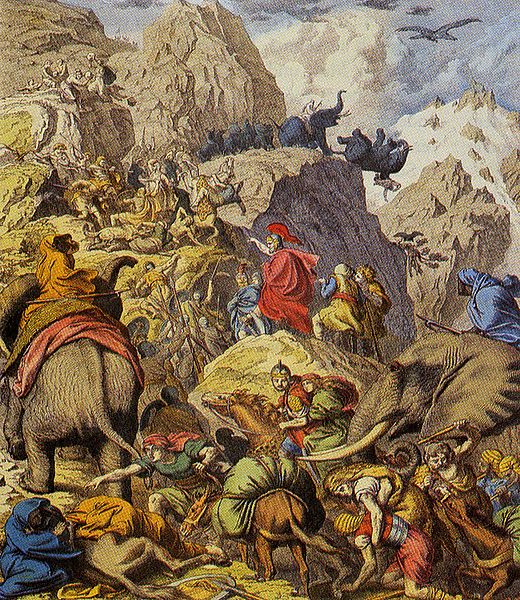
Hannibal was the greatest commander of Carthage, who threatened the Roman Empire and is considered “The Father of Strategy” after his brilliant tactics. He is most famous for the Second Punic War around 200 BC, where Carthage ultimately failed to conquer Rome. However, if it was not for a single cane, Hannibal may have destroyed Rome and Carthage may have dominated the history of Europe.

There is a scene in the epic Roman poem, Punica, where Hannibal’s forces are crossing the Alps. This was considered an impossible feat back then and in modern terms, it is as if China was to tunnel below the Pacific Ocean to reach USA soil. This kind of out-of-the-box thinking, charismatic leadership and brilliant military tactics and strategies allowed Hannibal to become one of the greatest threats in Roman history. However, the Alps still proved challenging even for him, and the journey was highly dangerous.

One day, Hannibal’s army reached a valley known as Certain Death, but the soldiers’ morale was too low for them to want to cross it. Hannibal tried to lead them through by using his cane to knock on the snow they stood on, proving that it was solid and safe. But the shock from this action triggered a massive avalanche that struck the army. It devastated the army equipped with advanced weapons and elephants, destroying almost two-thirds of his army (18,000 out of 38,000 soldiers were killed) and a quarter of his cavalry. 

This army that was destroyed so by the Alps managed to fight the war for 16 years, hassling Rome in every way, even producing great outcome such as the infamous Battle of Cannae, considered the greatest tactical feat in military history. One cannot help to wonder whether Hannibal would have completely crushed Rome with a full-size invasion force.

This shows how something as small as a cane can decide the flow of a war.

Posted in History & Literature

Monet’s Lilies

Monet is the father of impressionism, a style of art that revolutionised the art world in the early 20th century. However, there is a fascinating secret hidden in some of his most famous works, his lilies.

Monet developed cataracts, which is a disease that causes the lens in the eye to become cloudier and cloudier. As it destroys the patient’s vision, it also affects their ability to perceive colour. This changed Monet’s paintings. He always loved painting lilies, but the lush, green lilies turned redder and hazier as his cataracts worsened.

People thought that Monet was intentionally blurring his paintings and using a bold new colour scheme, and impressionists even took after this new “technique”. Monet’s works skyrocketed in price and his fame climbed even more. However, in the 1920’s he received corrective surgery for his cataracts, and thus he could see much more clearly. He saw the red lilies he had painted, and feeling ashamed he destroyed all the red lily paintings in a fit of rage.
Luckily his friends and family saved some of his works so that we could admire the beauty of his red lilies.

image
Posted in History & Literature

Dragon

Dragons are mythical animals that appear in many myths and legends. They are usually portrayed as gigantic reptiles, similar to snakes or lizards, and appear in stories from cultures around the world. Due to this, they can be split into two large groups: Eastern and Western Dragons, which have quite a few differences between them.

  • Western dragons look like dinosaurs or giant lizards, with a large body with bat-like wings and usually able to breathe fire.
    Eastern dragons are sleek like large serpents, with four legs and antlers and the ability to control weather (water-element based).
  • Eastern dragons are wise and benevolent creatures that help people, with omnipotent powers contained in yeouiju (dragon orb).
    Western dragons are violent and evil creatures that harm people, loot gold and jewellery and destroy villages.
  • Western dragons are the greatest enemy the hero has to kill, and is feared by the people.
    Eastern dragons are often teachers to heroes, giving them advice and help, while being worshipped by the people.

Like this the two kinds of dragons are mirror images regarding many characteristics, but the idea of a large reptile being conceived by so many cultures so far apart is quite strange. This leads many to believe that dragons are based on actual animals, and is likely the result of explorers finding dinosaur fossils, wondering what those animals would look like if they were alive.

Posted in History & Literature

10:10

Within a display of watches on sale or a watch advertisement, there lies an easily missed but very interesting fact: that almost all the watches show 10 minutes past 10 o’clock. This “rule” is especially prominent in expensive, famous watch brands.
The reason for this is very simple.

image

In 1926, the Hamilton Watch Company first used 10:10 on their watch advertisement so that the needles did not hide the company logo, found on the upper part of the watch face. Around the 1940’s, other famous brands such as Rolex and Timex began using this as well for the same reason. 10:10 not only allow the company logo to be seen easily, but it also framed it to emphasise the logo.

The industry standard back then was actually 8:20 (for the same reason). However, the companies believed that this looked like a frowning face, :(, and so they flipped it around to 10:10, as this looked more like a :), which customers would feel more encouraged by.

Like this, the second hand also follows a similar rule where it points around 30 seconds (but usually not exactly 30 seconds). This causes all three hands to point away from each other with some asymmetry, giving an aesthetically pleasing appearance. For this reason, Timex uses 10:09:36 while Rolex uses 10:10:31.

Of course this rule does not apply to digital watches, only analogue ones. But some companies still prefer to use a standardised time for all of their products, and Apple is a good example. All iPhone ads show 9:42am, because this is roughly the time the first iPhone was announced to the world.

Posted in History & Literature

Christmas

Christmas (also called X-mas), on the 25th of December, is the religious celebration day of Jesus Christ’s birth. It is a beloved holiday that is usually the biggest in the year for many countries. Every year on Christmas Eve (24th), children put out cookies and milk, and with a resolution that they will not sleep they await Christmas’ undying star, Santa Claus.
But as soon as they fall asleep, Santa arrives in a sleigh pulled by reindeers, comes down the chimney and unloads many presents (only to “nice” kids) under an already-decorated tree. When the 25th comes around, children run to open their presents and celebrate. On this day, most stores close to go into a festive mood. In the evening, the whole family gathers for a feast and celebrates this joyous day.

As with most holidays, Christmas has many interesting stories tied to it.

Firstly, is the 25th of December really Jesus’ birthday? This question has plagued scholars since the 18th century, as the Bible has no record of this. In fact, historic records (old texts, the Bible etc.), scientific data (astronomy etc.) and logic all show that there is a lack of evidence for Christmas actually being the day Jesus was born. Instead, it is suggested that Jesus was born in spring, more specifically the 25th of March. Interestingly, this is celebrated as Annunciation in Christianity, the day when Jesus was allegedly conceived by the Virgin Mary. So which story is correct? This may be linked to the next story.

Secondly, the 25th of December is the Winter Solstice in the Northern Hemisphere. Because of this, many Pagan holidays coincide around this time. For example, ancient Romans celebrated Saturnalia between the 17th and 23rd, to honour the god of agriculture, Saturn (a fun fact is that there is a tradition where they brought a tree inside the house for this day, which is the roots of the modern Christmas tree). Also, later in Rome’s history, the official sun god, Sol Invictus, was honoured on the 25th of December. Many historians hypothesise that when Christianity first developed, it absorbed many of its preceding religions’ holidays, thus giving birth to Christmas.

Lastly, a story about Santa Claus. Santa Claus is based on the Dutch Saint Nicholas, but is also influenced by many other traditional holiday figures, such as Odin from Norse mythologies (who gave gifts to children who put out treats for his eight-legged horse on Christmas day). What is peculiar is the reason Santa wears red. Many people believe that the “red and white outfit” was a product of Coca-Cola’s advertising in the early 20th century, making Santa wear the company colours. However, this theory has some errors. Most importantly, there are many illustrations from before 1925 (when Santa first featured in Coke advertisements) where Santa is portrayed in his plump, bearded form clad in red clothes with a large belt, exactly like the modern Santa. But as there were many other portrayals of Santa back then (e.g. green clothes, skinny etc.), it can be safely said that Coca-Cola’s aggressive advertising and explosive popularity played a vital role in cementing the image of the Santa that we know and love now.

Santa is also known as children’s last innocence. This is because it is something that can only be found in the hearts of children who pray every Christmas to this mythical man to receive a present. Unfortunately, as they grow and learn science and facts (about their parents being the provider) their innocent beliefs turn to ashes. Because of this, some parents like to dress up as Santa to deepen the children’s faith in him, while some never allow the faith to be born in the first place. What is amusing is that in some European countries such as Poland, the idea of Santa Claus is taken quite seriously. Every adult (especially adults and teachers) take strict care not to crush this dream until the age of 4 or 5, almost religiously.

As a final note, some people note that there are some strange connections between Santa and communism: red, large beard, providing only to “nice children”, working the elves in a factory… may whoever reads this decide that fact for themselves.

Posted in History & Literature

The Shortest Letter

The following is the shortest letter ever written in history and its reply:

?“

 “!”

It was written by the author of the famous “Les Miserables”, Victor Hugo, in 1862 to ask his publisher how his book (Les Miserables) was selling. The publisher, amused by Hugo’s creativity, sent back an equally witty reply.

Posted in History & Literature

Alchemy

Alchemy, which is considered the origin of chemistry, is commonly thought to have originated in ancient Egypt, but many scholars in the East studied it also. For example, Chinese alchemists invented black powder, the first gunpowder.
The history of alchemy can be seen from ancient Egyptian books dating to 4000BC.

There were two things that alchemists sought: transmutation of common metals into gold, and the creation of the philosopher’s stone. A philosopher’s stone is a mystical stone believed to drastically boost an alchemist’s abilities and grant immortality. This is similar to Eastern alchemy’s goals of seeking immortality. 
Also, the idea from ancient Greece that all matter is formed from the four elements air, water, fire and earth, is very similar to the Five Element Theory of Eastern philosophy.
However, the major difference between Western and Eastern alchemy is that Western alchemists sought gold for wealth while Eastern alchemists sought medicine for the people.

In the Middle Ages, a “recipe” was invented for transmutation and the creation of the philosopher’s stone, called Magnum Opus, or “The Great Work”. It mentions three steps, which strangely mimics the creation of the world.
Firstly, the Black Step (nigredo) involves mixing Materia Prima (the first matter) in earth and burning it. This causes all the ingredients to become a black, solid mixture, entering a state of chaos.
Secondly, the White Step (albedo) heats this black solid, turning it into a liquid (a property of water). Impurities are washed away by aqua vitae, The Water of Life.
(Some sources suggest that there is another step, the Yellow Step (citrinitas), between the White Step and the Red Step, that involves the “yellowing” of the matter into gold.) 
Lastly, the Red Step (rubedo) continues to add heat until the liquid is totally purified, while obtaining the sediments created from the fusion of matter and spirit, which is gold.

At the end of these three steps, the alchemist gains the philosopher’s stone. Upon closer inspection, one can see how the steps transform simplicity into complexity, bring order to chaos, and develop ignorance into enlightenment.
Therefore, the philosopher’s stone is only the knowledge that we gain, nothing more, nothing less. Although that may not be a simple task.

Posted in History & Literature

Cat

The history of cats is longer than people think. It is known that they have had an intimate relationship with humans for the past 9500 years. The hypothesis is that they were probably domesticated in Egypt and surrounding Middle Eastern countries such as Persia. The reason for this is most likely to eradicate vermin, as they kept stealing the stores of grains that had been produced using developed farming technology.

Cats, with their natural hunting instincts, excelled at this task and people came to love the animals more and more. They became important to the degree that in ancient Egypt, cats were considered sacred animals and worshipped, even being mummified in some cases.

But entering the Middle Ages, the image of cats deteriorated. Europeans considered cats as signs of bad luck and the pet of witches, and proceeded to massacre all cats. As the population shrank, rats thrived with the loss of their predator and began to multiply at a rapid rate. These rats, often carrying fleas, were key players in spreading the deadly Black Plague. In other words, thanks to the massacre of cats, a third of Europe died from the Pest.

Cats are beloved animals in the modern age (dog lovers may disagree), but superstitions linking cats to bad luck still exist. In the West, black cats are believed to be bad luck and have nine lives (most likely originating from a cat’s ability to break its fall).
But their image has much recovered and as it can be seen from characters such as Hello Kitty, they are becoming a symbol of cuteness. However, considering their close relatives such as lions and tigers represent bravery and the king of beasts, a cat’s dignity has surely fallen.