Posted in Science & Nature

Badass Weapons Of Nature: Mantis Shrimp

In April 1998, a shrimp by the name of Tyson punched through the quarter-inch-thick glass of his cell and attempted an escape. He was promptly caught and had to be sent to a more secure facility. Unlike his boxing counterpart, Tyson was merely 10 centimetres in length.
Mantis shrimp are well-known for their “fists of fury” – officially the fastest punch in the natural world.

Their weapons of choice are their clubs that can be retracted and folded under their head. Using a remarkable energy-storage system – much like the cocking mechanism of a gun combined with a spring – the mantis shrimp can unleash its rounded, stubby claws at a speed of 80km/h to hit its target in 0.003 seconds. This is an amazing feat given that it happens underwater, where the water puts up a significantly higher resistance compared to air. The acceleration needed to produce this awesome punch is 10,000 times the force of gravity (similar to a bullet). In simpler words, researchers could not film using high-speed cameras and needed to borrow a super high-speed camera just to see the punch happen. 

However, the surprises do not end here. Researchers soon found that each strike by the mantis shrimp not only inflicted heavy physical damage, but the sheer speed of the punch created cavitation (implosion of bubbles). Much like the pistol shrimp, this cavitation releases massive amounts of light and heat energy. This shockwave happens immediately after the punch, essentially resulting in the target receiving a deadly one-two hit combo which instantly knocks it out (or disintegrated). 

The force of the mantis shrimp’s punch can easily penetrate the hard shell of most crustaceans in the ocean, meaning no creature is safe. Mantis shrimps have also been observed beating up fish and octopi – and succeeding.

Not only does the mantis shrimp have the most powerful strike, it also has one of the most sophisticated eyes in nature and is extremely agile. This, combined with the shrimp’s cunning nature makes it the perfect hunter. It tends to ambush prey and swiftly knocks it out before it knows what hit it. If the one-hit KO fails, the mantis shrimp uses its agility to hit the foe and quickly swim away, then hit again from the other side until the foe is crushed.

Lastly, the shrimp described above is actually one type of mantis shrimp called a smasher. There is another subtype called spearer with claws modified into sharp spears that can be thrusted with the same force as the smasher’s clubs.

The only adequate metaphor to describe this awesome creature would be a Mike Tyson punching as hard as he can, in his prime, while his fist is attached to a meteor entering the atmosphere.

(Image source: Cracked.com)

Posted in Science & Nature

Badass Weapons Of Nature: Bombardier Beetle

The bombardier beetle, or Brachymus creptians, has a “machine gun”. When attacked, it makes an explosive sound and spouts smoke.
This beetle combines chemicals from two separate glands to make the smoke. 
The first gland produces a solution of 25% hydrogen peroxide and 10% hydroquinone, while the second gland produces peroxidase, an enzyme that catalyses the reaction. When these solutions are combined and heated to 100°C, smoke and nitric acid vapour is produced and explosively released.

If you put your hand close to a bombardier beetle, it will rapidly release a scalding, noxious, red vapour. This nitric acid will cause blisters on afflicted skin.
Bombardier beetles also know how to aim the tip of its abdomen to target an enemy. Via this method, it can hit a target a few centimetres away. Even if it misses, the explosive sound will scare away any predator. 
Normally, bombardier beetles store enough chemicals for three or four shots. However, some entomologists have found that some species can fire up to 24 times in rapid succession if provoked.

As these beetles are a bright orange and silver-blue colour, they are very noticeable. They act as if they do not care if they are seen, as they are equipped with an effective cannon. Generally, beetles with a colourful coat have a unique, ingenious defensive mechanism to ward off curious animals and insects.
Despite this, rats that know that the beetle loves to use this “ingenious defensive mechanism” quickly grab the beetle and plant its abdomen in the ground. After attacking it continuously while in the ground to exhaust the beetle’s rounds, the rat bites off the head first.

(from the Encyclopaedia of Relative and Absolute Knowledge by Bernard Werber)

Posted in Science & Nature

Badass Weapons Of Nature: Pistol Shrimp

A gun is, without a doubt, a manmade object. It is an invention that has existed less than a thousand years in history. However, there is an animal that has been using firearms to hunt prey for a significantly longer period of time than mankind has.
The pistol shrimp is well known for its disproportionately large claw, with the other claw being much smaller like a normal shrimp. The massive claw is what is called the “pistol” and it is the weapon of choice for the shrimp.

When a pistol shrimp identifies a target, it swiftly takes aim with the claw and snaps it shut with enough force to create a bubble jet reaching a speed of almost 100km/h. Not only are bubbles produced, but the pressure wave created by the cavitation (the effect of a bubble imploding and generating energy) reaches a sound level of 218dB – which is about 100,000,000 times larger than a gunshot, or 10,000 times larger than a rocket launch. Furthermore, the energy is also released as light and heat, generating a temperature as hot as 4700°C (for comparison, the surface temperature of the sun is 5500°C).
The combination of the bubble jet, pressure wave and heat energy instantly stuns the target and the pistol shrimp proceeds to devour its prey.

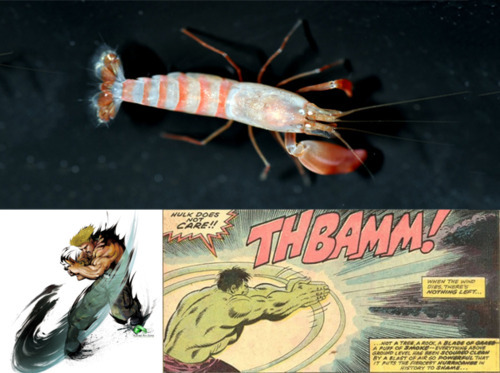
Yes, the pistol shrimp has mastered a skill that humans can only dream of in comics such as the Incredible Hulk’s Thunderclap, or in games such as Guile’s Sonic Boom (from Street Fighter). It has also mastered the skill to the level of an effective ultimate move that is reliable as a hunting tool. In fact, it is quite possibly the closest any animal on Earth has gotten to an actual beam weapon.

Posted in Science & Nature

Badass Weapons Of Nature: Carpenter Ant

There is an extreme number of ant species, each with a unique characteristic. In the case of carpenter ants, they are famous for their strange defence mechanism.

Some species of carpenter ants, such as the Camponotus saundersi, have warrior ants with very large mandibular glands (many times greater than normal ants). When in a battle it judges that it has no chance of winning, the ant rapidly contracts its abdominal muscles to build pressure. When sufficient pressure is reached within the mandibular glands, it explodes violently, shattering the ant in the process. The glands are filled with a sticky, toxic fluid, which is spread all around where the ant used to be, ensnaring the foes. The inflicted enemies are killed by the poison. 
This is the reason why they are sometimes referred to as exploding ants.

It is a bold, yet fearsome sacrifice for the greater good.

Posted in Science & Nature

Badass Weapons Of Nature: Long-tailed Weasel

Long-tailed weasels are ferocious predators found in North America that likes to stalk its prey and pounce it with lightning speed. With small prey such as mice, the weasel will wrap its long body around the prey and then crush the head with a strong bite. As the weasel is very slender and sleek, it can easily dig into burrows to hunt hiding animals by crushing its skull, or to add variety, ripping out the windpipe.

Although it usually preys on small rodents, the long-tailed weasel is also known to fearlessly attack much larger animals such as birds and rabbits. As wild rabbits tend to be bulkier (sometimes even ten times larger) than the weasel, it cannot use its characteristic hunting style. To overcome this difficulty, these weasels have developed a strange behaviour that zoologists have labelled the Weasel War Dance. The War Dance (NB: two videos on what it looks like) is a chaotic set of movements where the weasel runs left and right frantically, jumping and flipping upside-down and almost appearing insane. This type of behaviour is observed in other species of weasels and ferrets when they are excited, but few use it as a hunting tool.

It has been observed that when the long-tailed weasel performs a War Dance in front of a rabbit, the rabbit becomes dazed and enters a trance-like state. It is possible that the chaotic and confusing movements disorient the rabbit. Once the rabbit has been disabled, the weasel promptly jumps on the rabbit’s back and delivers a powerful bite to the back of the neck, instantly killing the rabbit.
Wild weasels and stoats practise this skill by playfully ambushing each other when they are young.

Long-tailed weasels, despite their cute appearance, are notorious for their vicious temper. Being a carnivore that prefers fresh meat, it actively hunts and collects food. Despite seeking fresh food, the weasel also exhibits a curious behaviour of storing carrions, which is often only eaten in times of food shortages. This behaviour leads to the weasel going on killing sprees just because they can. Long-tailed weasels have also been observed lapping up blood from the wounds they inflict, and enjoys making their nest from the fur of their victims.

Posted in Science & Nature

Badass Weapons Of Nature: Roadrunner

Roadrunners are medium-sized birds that grow to about 60cm and found in desert environments. They prefer walking or running (top speed 27km/h) to flying and have been portrayed as Road Runner in Looney Toons. In the cartoon, the bird is shown as a witty, intelligent bird that easily runs away from its predator. In real life, the roadrunner is a much more formidable animal.

Although it usually feeds on lizards and insects, roadrunners also enjoy feasting on rattlesnakes. Thanks to its quick speed, the thin bird can swiftly dig its beak into the rattlesnake before it can retaliate with its venomous bite. What happens next is quite surprising.
With its prey secured on its beak, the roadrunner promptly begins whipping its head around, bashing the snake to the ground in a circular motion. This whip-like attack causes the snake to lose consciousness or even die from the sheer impact and rotational force, essentially becoming tenderised. This deadly move has been named by ornithologists as the Centrifugal Slam. The roadrunner does this until it is certain the snake cannot attack back, then swallows it whole. As snakes tend to be longer than the bird, roadrunners are often found running around the desert with a long piece of tail dangling from its beak, the head being slowly digested in the bird’s stomach. 

Roadrunners are also known to eat horned lizards (spiked lizard that shoots blood from its eyes to deter predators), tarantula hawk wasps (giant wasp that defeats tarantulas to lay eggs inside it, with no other known predators) and even flying birds. As mentioned before, roadrunners do not fly unless in an emergency. So to hunt flying birds, they simply run, jump and Centrifugal Slam the living daylight out of the unfortunate prey.

image

Posted in History & Literature

Printing

Most Westerners are familiar with Johannes Gutenberg, who invented the printing press in 1450 which allowed the mass-production of books, namely the bible. In fact, the printing press is thought of as one of the crucial factors that triggered the Renaissance in Europe.
However, what most people do not know is that the movable type – a printing machine where individual letters can be rearranged and reused – was invented in Korea during the Goryeo Dynasty two centuries before Gutenberg.

Before the movable type, Buddhist monks would carve out wooden blocks so that they could copy out religious texts with ease. But as this involved the monks having to carve out the entire text (often very long), it was extremely labour-intensive and everyone sought an easier method of mass-producing texts. The concept of the movable type was experimented with throughout the centuries, but it was found that woodblocks would wear out too fast. Although metal was the obvious choice, the technology was not developed enough to produce the fine letters.

In 1234, a Korean man called Choe Yun-ui finally devised the technology to invent the first metal movable type in the world. The process was very complicated, involving the making of durable clay moulds to hold the molten metal without breaking.
This was revolutionary as it meant that texts could easily be printed as all the printers had to do was rearrange pre-made letters in order rather than laboriously carving each one out. Metal movable types are also extremely durable and give a very clean print, unlike the wooden counterpart that tends to wear out or smudge. The metal movable type allowed for the mass-production of books which greatly boosted Goryeo’s culture and education within the poorer classes.

Korea was the leading innovator in the printing industry throughout history, with the earliest woodblock prints dating back to 751. The motivation to develop this technology was partly thanks to Buddhism. To ensure that Buddha’s teachings could be spread far and wide, Buddhist monks worked day and night to produce these texts. This was a critical job during the 13th century when the Mongol Empire was rampaging through the whole of Eurasia. As military force was insufficient to repel the invaders, the people turned to spirituality for power. Furthermore, due to the destructive nature of the Mongols, it was crucial to replace damaged texts to ensure that precious cultural heritages would not be destroyed. This was the main motivation for the creation of the metal movable type and to this day we can see the evidence of the state-of-the-art printing device in books from the 13th and 14th century.

One limitation still remained with the movable type – Chinese characters. At the time, Korea still used Chinese characters to record the Korean language (similar to how Chinese characters can be transcribed in pinyin form). As there are literally tens of thousands of characters, a massive amount of individual types had to be produced.
This problem was solved by King Sejong the Great of the Joseon Dynasty, who invented Hangul – the Korean alphabet. Hangul only contains 24 letters and is extremely logical in its construction, ergo it was a perfect system for recording language. It also meant that much less individual types were needed, making the printing process even more efficient.

Although the 20th and 21st century saw the Western Hemisphere leading science and technology innovations, it is important to remember that the East dominated the field for millennia before.

Posted in Philosophy

Spoon

In the film Matrix, a scene shows the protagonist, Neo, talking to a bald child in the Matrix who can bend spoons. The child can bend and straighten the spoon at will just by looking at it. He then passes the spoon to Neo and asks him to try. Neo stares and stares but nothing changes. The child then says:

Child: “Do not try to bend the spoon, that’s impossible. Instead only try to realise the truth.”
Neo: “What truth?”
Child: “There is no spoon.”
Neo: “There is no spoon?”
Child: “Then you will see that it is not the spoon that bends, it is only yourself.”

This philosophy, while sounding rather simple and nonsensical, can be applied to modern day life in so many ways.

For example, as people mature, they have a tendency to lose the creativity and innocence of their inner child. They find that reality is too harsh and cruel and one must follow the strict rules of society to survive. They feel as if they are trapped in a box, unable to escape forever. This pessimistic view of life and the world restricts their ability to be happy. These people have not yet realised the truth.

There is no box

Free your mind and the rest will follow.

Posted in History & Literature

Land

The following is the synopsis of a short story called How Much Land Does a Man Need?, written by the famous Russian author Leo Tolstoy.

A peasant man called Pahom was complaining of how he did not possess enough land to satisfy him. He lamented: “If I had plenty of land, I should not fear the Devil himself”. The Devil, hiding behind the stove and listening to this, decided to have a tussle with Pahom to teach him a lesson.

The next day, a lady in the village sold her estate, which was bought up by the peasants. Pahom too tried to buy as much land as possible and by utilising the land he pays off his debts and he leads a happier life. But despite having his wish granted, he was still not satisfied and desired more land. His obsession with his land began to cause troubles with his neighbours and he eventually moved to a larger area of land at another village.

However, he was annoyed that he was growing crop on rented land and wanted more land for himself. He found out that the Bashkirs in the village were simple-minded people with large amounts of land. Pahom decided to exploit the Bashkirs and went to them to negotiate the lowest price possible for their land. The Bashkirs counteroffered with a very strange deal: for a thousand rubles, they would let Pahom take a spade to mark out an area of land and claim it for himself. The only condition was that he had to come back to where he started to close the loop by sunset. Pahom joyfully took up the offer, thinking how stupid these people were.

That night, Pahom had a surreal dream where he saw himself lying at the feet of the Devil. The Devil was laughing maniacally over Pahom’s cold, dead body. After jerking awake from this nightmare, Pahom sets out to start marking out as much land as possible. He decides to travel as far as he can to maximise his gain. However, he forgets to take into account the time needed to come back to where he started and hurries back. Although he manages to close the loop by sunset, the exhaustion causes him to drop dead on the spot. He is buried in a hole measuring 6 feet long.

How much more land does a man need than a place where he can rest in peace?


Posted in History & Literature

Laconic Phrase

The Spartans are well-known to us as some of the bravest and toughest soldiers in Western history, with a culture completely focussed on breeding the best of the best warriors. However, during ancient times they were famous for another trait.
Spartans were famous for stating their arguments in concise statements, able to express their ideas with just a few words. This type of speech was known as laconic phrase, named after the region of Laconia where Sparta was located. Laconic phrases are not only short, but extremely efficient and often witty. In fact, another trait that Spartans shared was a sense of dry wit known as laconic humour.

There are plenty of records, such as Socrates’, that describe the Spartan’s ability to effortlessly throw off pithy comments in retaliation. Ergo, the Spartans did not use little words because they were illiterate or did not value education and culture; they used as little words as possible to conceal their wisdom in a concentrated phrase. The Spartans deemed this a valuable skill as a true professional is efficient in whatever he does, including language.

Many examples of laconic phrase can be drawn from the historic Battle of Thermopylae – the battle portrayed by the movie 300 (which, despite a rather dramatic presentation, quite accurately portrays many aspects of the battle).

  • Before the war, a Persian envoy came to Sparta demanding an offering of soil and water – a traditional symbol of surrender. The Spartans threw them in a well and said “Dig it out for yourselves”.
  • This infuriated the Persian Empire and war broke out. As King Leonidas departed for the Battle of Thermopylae, he advised her wife: “Marry a good man and bear good children”.
  • When Xerxes of Persia offered to spare the Spartan army in exchange for their surrender and giving up their weapons, Leonidas simply retorted: “Molon labe”, which translates to “Come and take them”.
  • On the morning of the last day of the battle, Leonidas knew that defeat was inevitable. To boost his troop’s morale, he spoke the famous line: “Eat well, for tonight we dine in Hades”.

The Spartans’ efficiency with words and wit inspired many famous words over history. These range from responding to the enemy’s demand for surrender (at the end of the Battle of Waterloo, British forces demand the French surrender, to which General Cambronne replied: “Merde” or “Go to hell”), a pithy description of a disastrous situation (during the Battle of Imjin River of the Korean War, Lieutenant Colonel Carne – surrounded by the Chinese and his forces utterly destroyed – described the situation as “A bit sticky”), to the modern day epic burn.

image