Posted in Science & Nature

Typical Person

What is the typical look of a human being? The following is a character bio using data of the most common traits and average statistics from the world population.

The typical model of Earth is a 28 year old Han Chinese male called Mohammed Lee. His height is 1.75m, weight 80kg, he has black hair and brown eyes and he is right-handed. He speaks Mandarin Chinese and his religion is Christianity. He works in a factory earning less than USD$12,000. He owns a cellphone but not a bank account. The following is the most typical face constructed using a composite of 190,000 faces of people fitting the above description.

Posted in History & Literature

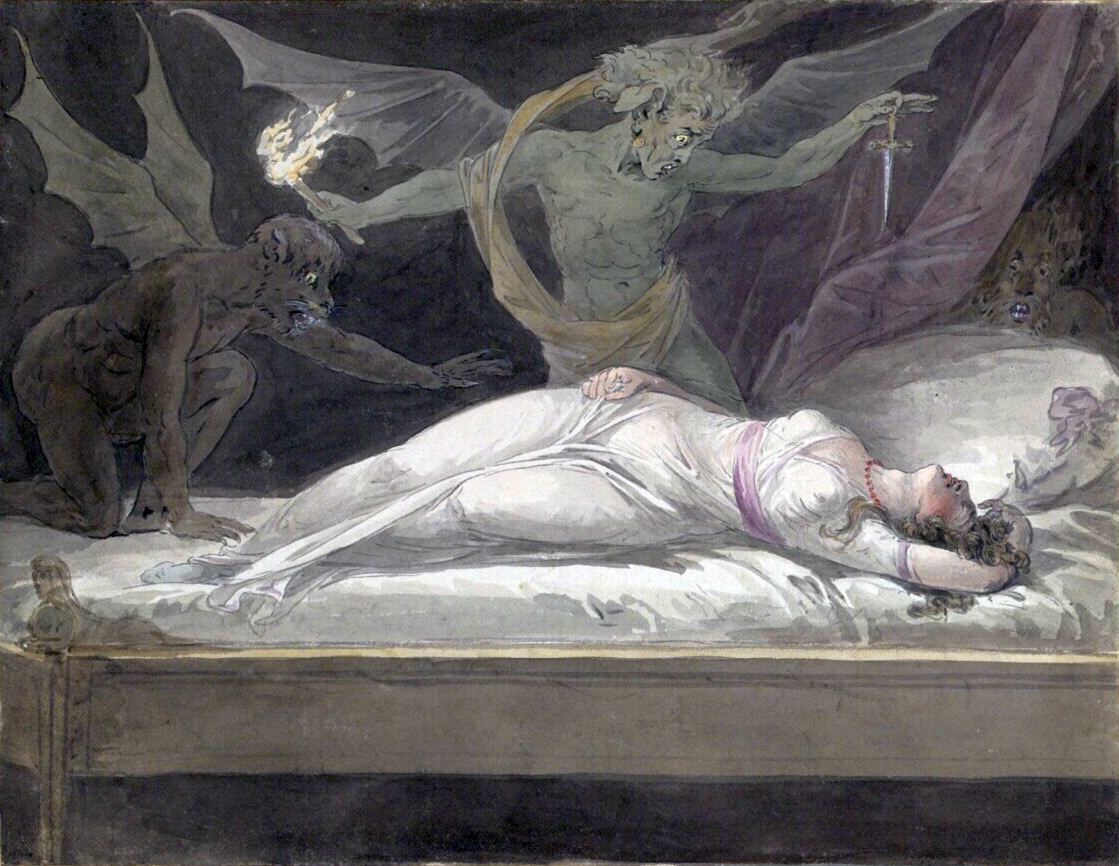
Incubus

An incubus, much like a succubus, is a demon that visits in a dream or while a person is sleeping. An incubus is the male counterpart to the succubus and shares many of its characteristics, such as visiting a person to have sex with them (since it is male, it only attacks women). According to legends, a woman pregnant after having sex with an incubus gives birth to a stillborn or a deformed child. The legend of the incubus most likely arose to explain the hallucinations seen with sleep paralysis and a pregnancy out of wedlock or from a shameful relationship. During the Renaissance when the culture was less restrained around sex than the Middle ages, there was a rise in cases of young girls giving birth to stillborns without knowing who the father was, resulting in debates to whether an incubus could really impregnate a woman.

The most famous “child” of an incubus is Merlin from the King Arthur legends. Merlin’s mother was a woman of high class but gave birth to Merlin after being attacked by an incubus. She was afraid that Merlin would turn out to be an evil person so she took him to the church to cleanse his body. This left Merlin with only mysterious powers, allowing him to be one of the most famous wizards in fiction.

Posted in Psychology & Medicine

Time Perception

What exactly is the present? The present is the middle point between the past and future, the world that we experience and perceive on a real-time basis. But would you believe it if the world you perceive is not the true “present”? To experience the world, we use our five senses. The brain collates all these sensory information and processes it to construct “the present”. This process takes about 80 milliseconds. Ergo, the world we experience is actually the world as it was 80 milliseconds ago. For a similar phenomenon, consider the stars. The stars we observe are not what they look like now, but what the stars looked liked when they emitted the light that we see. Thus, the star you are looking at may not even exist anymore.

But 80 milliseconds is a very short time; surely it has no impact on our everyday life? To prove that this delay has a critical impact on our understanding of cause and effect, neuroscientists designed the following experiment. The researchers would ask the participant to press a button that caused a light to blink after a short delay. After about ten tries, the participants reported that the delay had disappeared and the light flashed immediately after they pressed the button. This was due to their brain editing out the time delay and directly connecting the cause (button) and the effect (flash). But a much more peculiar phenomenon was seen when the researches removed the delay between the button press and the flash. Participants reported that they saw the light flash before they even pressed the button. The participant’s brain had become so used to the editing process that it was confusing the order of the cause and the effect.

The brain’s time-editing ability can be seen in the following simple experiment. If you touch your nose and toe at the same time, logic dictates that as the toe is further from your brain, the signal will have to travel further and it will be felt later. But in reality, you feel both at the exact same time. This is because your brain uses a map of the body to edit the relative time the signal takes to reach the brain to better construct a “real-time present”.

Posted in History & Literature

Valentine’s Day

Valentine’s day is the one day put aside every year, on the 14th of February, to celebrate the love between a couple. It is a rather controversial(?) holiday with many people contesting that it is the result of chocolate and flower companies conspiring to increase sales and that people should love equally on every day. The day is full of hearts and cupids and chocolate, making it the perfect day for couples to show off to the world just how much they adore each other, while single people put up a nonchalant face while desperately trying to distract themselves from the fact that they alone (there is also a statistic that states suicide rates peak during Valentine’s day).

February 14th was not always associated with romantic love. Originally it was a day honouring Saint Valentine of Rome (it is debated whether day honours him or another Saint Valentine – Valentine of Terni). In 1st century Rome, it was illegal for Christians to marry. Saint Valentine secretly performed weddings for Christians under threat of death (helping Christians was illegal too). He was eventually caught, imprisoned, tortured and killed.

As one can see, the story (and its ending) is not the most romantic one and Valentine was honoured for helping Christians rather than being involved in marrying people. It appears that the romantic association started around the 14th century in Parlement of Foules by Chaucer. Up until the 19th century, the only custom for Valentine’s Day was the giving of cards (or “valentines”) between loved ones. It was in the mid-1900’s when the practice of giving roses and chocolates arose (most likely due to advertising campaigns by companies for the commercialisation of the day), with the diamond industry promoting a custom of giving jewellery on Valentine’s Day.

Another not-so-lovely story related to Valentine’s Day is the infamous Saint Valentine’s Day Massacre of Chicago in 1929. In a conflict related to gangs and bootlegging, the South Side Italian gang led by Al Capone initiated a deadly attack resulting in the death of seven deaths.

Posted in Science & Nature

Diamond

The hardest object on the Earth is diamond. A diamond is famous not only for its hardness but also its luxuriousness and unique lustre. One might call it the king of all jewels. Would you believe then that such a beautiful, tough gemstone is made of the same thing as charcoal and graphite? Diamond is crystallised carbon where the carbon atoms are neatly arranged in a pyramid lattice. Charcoal and graphite are also made of carbon but the carbon atoms are placed in a different configuration, giving them a different look and characteristics. This unique lattice shape can only be achieved under extreme pressure (such as in the mantle of the Earth or in a meteorite). Thus, a diamond is just carbon that has endured stress well.

If diamond is the hardest material, then how can one cut it? The answer is simple – use a diamond. As it is near impossible to polish or cut without knowing this, diamonds were only used in the form of ores until the modern age. In 1919, a mathematician named Marcel Tolkowsky calculated the optimum proportions of a diamond cut to obtain the best lustre. The first time he struck the diamond with a nail, he fainted from the shock. He succeeded the second time and devised the round brilliant cut used most popularly nowadays.

Diamond is especially used in engagement rings. About 80% of all engagement rings sold in the United States are diamond rings. This may be because the toughness of diamond symbolises undying love, but another key reason is due to diamond syndicates and their marketing campaign. Even until the 1930’s, there was a tradition of women keeping their virginity until their engagement. Thus, if a man proposed to a woman, took her virginity and broke off the engagement, the woman had a legal right to sue the man. Diamond syndicate De Beers thought that this tradition was an excellent money-making scheme. They planted the idea that offering a diamond ring when proposing put a price on the woman’s virginity and encouraged men to buy more expensive rings to show their love and respect for the woman. This manipulative advertising campaign was a great success and the price of diamond skyrocketed very quickly. Now, a diamond ring is almost an essential item when proposing. Thanks to these companies, there are still many African children who are being slaved in diamond mines.

Posted in History & Literature

Dystopia

The following is an excerpt from the book Amusing Ourselves To Death by Neil Postman, where the author compares and contrasts two famous books depicting a dystopian society: Nineteen Eighty-Four by George Orwell and Brave New World by Aldous Huxley.

What Orwell feared were those who would ban books.
What Huxley feared was that there would be no reason to ban a book, for there would be no one who would want to read one.

Orwell feared those who would deprive us of information.
Huxley feared those who would give us so much that we would be reduced to passivity and egotism

Orwell feared the truth would be concealed from us.
Huxley feared the truth would be drowned in a sea of irrelevance.

Orwell feared we would become a captive culture.
Huxley feared we would become a trivial culture, preoccupied with some equivalent of the Feelies, the orgy porgy and the Centrifugal Bumble-puppy.

As Huxley remarked in Brave New World Revisited, the civil libertarians and rationalists who are ever on the alert to oppose tyranny “failed to take into account man’s almost infinite appetite for distractions”.

In Nineteen Eighty-Four, people are controlled by inflicting pain.
In Brave New World, people are controlled by inflicting pleasure.

In short, Orwell feared that what we hate will ruin us. 
Huxley feared that what we love will ruin us.

(Source: http://www.totalitariers.nl/wp-content/uploads/2011/08/Brave-New-World-vs.-1984.jpg)

Posted in Psychology & Medicine

How To Feign Death

Usually to check if a person is dead, one checks their pulse and breathing. If you want to fake your death properly, you must be able to stop both of these. You can easily hold your breath, but how can one stop their own heart? The answer lies in a ball.

If you wedge a tennis ball, squash ball, baseball or any small but firm ball in each of your armpits and squeeze tightly, the pulse at your wrist will disappear. This pulse is the radial pulse, and the radial artery is a branch of the brachial artery further up the arm. If a ball is squeezed in the armpit, it compresses the brachial artery, stopping the blood flow to the radial artery and obliterating the radial pulse. Most people who are not medical professionals tend to use the radial pulse for taking a pulse, so this method can be used to make it look like you do not have a pulse. But as this trick only causes the radial pulse to disappear, it is ineffective if the other person takes the pulse at another site such as the carotid artery or femoral artery. However, if you can control the situation and the person checking to see if you are alive is not a doctor or nurse, then it is quite a useful trick to use.

Posted in Psychology & Medicine

Nostril

What would happen if your nostrils were facing up instead of down? Rain would fall into your nose and when you were sad or with a cold, mucus would fill up in the nose instead of draining, creating quite a problem. Then why do we have two nostrils? The reason being, if one is blocked, we can breathe through the other (unless you have bad hay fever or a cold and both are blocked). This shows how (almost) every part of the human body has a purpose, including its shape and characteristics.

Another fun fact about nostrils is that at one moment, only one nostril is used for breathing. In other words, you can breathe easily through one side of your nose but the other side will feel stuffy and blocked. This phenomenon alternates sides on a periodic cycle (where the blocked side becomes clear and vice versa). This mechanism is most likely to protect the inside of your nose (nasal cavity) from drying out.

Posted in Psychology & Medicine

Muslin Disease

The French Revolution that occurred in the late 18th century had a significant impact on not only politics, but French society as a whole. Even after the revolution, there was much hatred against the nobility and especially the luxurious and extravagant lifestyle they lead. Men and women wearing too much clothes and jewellery were punished heavily. There was even a law stating that the weight of your clothes and accessories combined must not exceed 3.5kg. In the early 19th century, the fashion trend changed from the fancy dresses of the past with many decorations to a much more simple, clean and frugal type of dress. A point of interest is that women wearing petticoats (an undergarment worn to puff out skirts) – a key point of the Rococo style – were executed on the guillotine, causing women to quickly throw away their petticoats and try to look as slim as possible. To look thin, women did not even wear underwear. There was a fabric that suited this new fashion trend very well and that was the extremely thin cloth, muslin.

But to follow the fashion of then, it is not enough to simply wear a muslin dress. In early 19th century France, the trend was to douse your dress in water. Why did the women drench themselves in water? The reason being, muslin is a very thin and light cloth that becomes half transparent when wet, while clinging to your body. Women dampened their muslin dress to prove that they were wearing nothing underneath. Also, the ideal, beautiful woman of the time was an intellectual woman who looked fatigued from reading books all night long. Drenching yourself in water adds to this gaunt image, accentuating your fatigue and by extension, your beauty. The woman probably also intended to make the clothing cling to their body to show off their figure (much like the modern day wet t-shirt contests).

The problem was that muslin is an extremely thin material that is unsuitable in the winter or in Northern regions. Considering that women were wearing such a thin dress and even pouring water on themselves, one can imagine how cold they must have been. In fact, France suffered a heavy epidemic of pneumonia in the early 19th century with as much as 60,000 patients turning up with pneumonia every day. A high proportion of these patients were women who liked to wear wet muslin dresses. Thus, the pneumonia was nicknamed muslin disease.

Posted in Science & Nature

Alex The Parrot

Alex (Avian Language EXperiment) was the name of an animal psychology experiment that ran for 30 years starting from 1977. The experiment was designed to see if birds could undertake complex problem solving and learn languages like primates. For this, Dr Irene Pepperberg bough an African grey parrot, named him Alex and started teaching him how to speak. Before Alex, scientists believed that animals needed a large enough brain like a primate to handle the complex problems related to language. But Alex proved otherwise.

Before Dr Pepperberg, scientists failed to establish any two-way communication with parrots. She used a new training technique called the model/rival technique, where two trainers act in front of the parrot to teach it things. The method is as follows. One trainer (the rival) shows the other trainer the desired student behaviour they want the parrot to learn. The other trainer then compliments the trainer and shows attention. The parrot sees that the behaviour gets the trainer’s attention and learns it to compete with the rival. This technique was extremely successful and Alex began picking up words at a very fast rate (technically it was more of a two-way communications code than “language”).

Once communication was possible, Dr Pepperberg taught Alex many different concepts. Over the course of his life, Alex learnt 150 words, how to differentiate between seven colours and five shapes and also understood the concept of numbers and sizes. If you showed Alex two objects, he could answer many questions regarding one object (thus showing that his response was not a conditioned one). For example, if you showed him a small blue key and a large green key, he could answer what colour the larger key was, or which one was the green key. Furthermore, if a plate full of objects of different colours and shapes was presented to him, he could correctly count how many green blocks (or any other shape or colour) there was among the objects. The important point here is that he could pick out just the green blocks, excluding green balls or blue blocks from his answers (showing he fully understood the question and could attribute more than one characteristic to one object). He knew how to express himself, such as saying “Wanna go back” when he was tired, and would give playful, incorrect answers when bored of the repetitious experiments. According to Dr Pepperberg, Alex had the intelligence equal to a dolphin, a great ape or a five year-old child. He also knew how to attain knowledge by asking questions, such as when he asked what colour he was to learn the word “grey”.

Alex, who told us so much about the intelligence of a parrot, unfortunately died in 2007. The night before he died, he said the following last words to Dr Pepperberg: “You be good. I love you”.