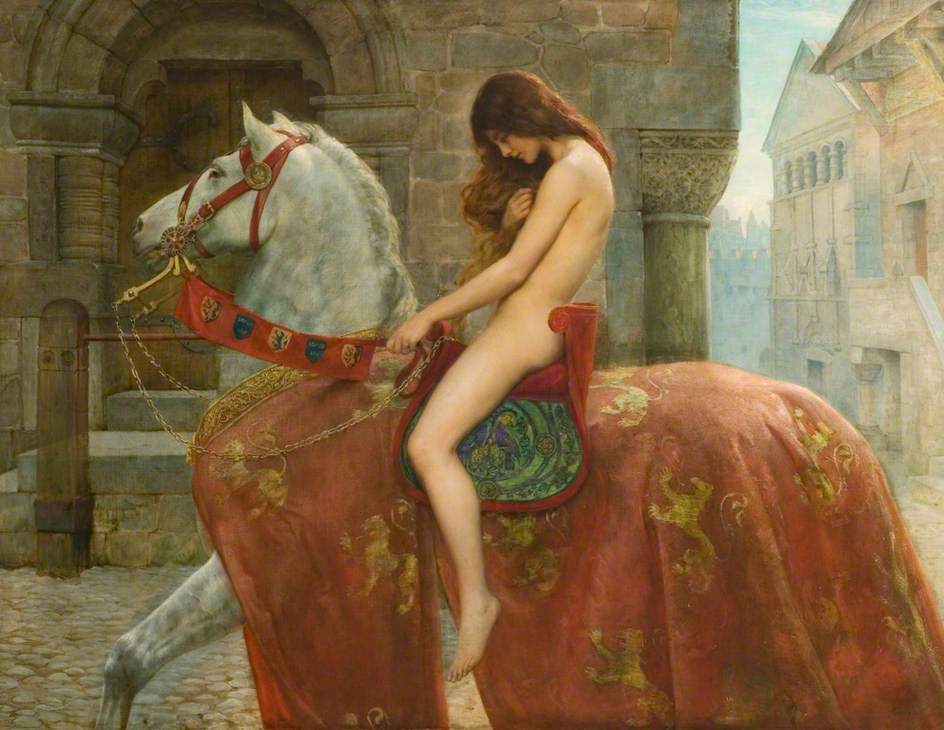
During the 11th century, the town of Coventry was suffering grievously under the earl’s oppressive taxation scheme. The earl’s wife, Lady Godiva, took pity on the people and pleaded her husband to lift the heavy taxes. The husband refused over and over, until one day in exasperation he made a wager: if she would ride through the streets of Coventry naked, he would grant her request. The earl believed that she would never undertake such a shameful, scandalous act. Lady Godiva pondered on the decision for a while, but then agreed on the condition that her husband keep his word.
Rumour quickly spread of what Lady Godiva was willing to do for the sake of her people. Out of respect and appreciation, the people of Coventry mutually agreed to stay indoors behind shuttered windows to preserve her dignity as she passed. On the fateful day, Lady Godiva set out on her white horse, stark naked and only draped by her long luscious hair. The entire town was silent, with every person in their home with the windows closed shut so that the Lady was the only one passing by, with no one to see her. However, one man, a tailor by the name of Tom, could not overcome his curiosity and lust and decided to peep through a hole in his shutter to gaze at her nude body. At that moment, he was struck blind, being punished for his voyeurism (this is the origin of the term “peeping tom”). In the end, the earl reluctantly abolished the onerous taxes, admiring his wife’s bravery and the respect the people had for her.
In human society, there are many ways for a person to interact with others when in a group setting. Some may choose to be selfish and only be out for their best interests, while others may choose altruism and cooperate with each other. The mathematical model that tries to predict human behaviour and outcome in these settings is the Prisoner’s Dilemma – the core of game theory. Tit for tat is one strategy that can be employed in such a setting.
The basis of tit for tat is equivalent exchange. A tit for tat player always chooses to cooperate unless provoked. As seen in the Prisoner’s Dilemma, if both players cooperate, both benefit (let us say 3 points each); if one player defects, that person gains more than from cooperation (5 points) while the tit for tat player gains 0 points.
If a tit for tat player is provoked, that player will retaliate. However, the player is also quick to forgive. Ergo, if the other player chose to cooperate, the tit for tat player (following the principle of equivalent exchange), will also cooperate. If the other player defected, the tit for tat player loses the first round and then chooses to defect from then on.
Note that tit for tat strategy only works when there is more than one game so that the player has a chance to retaliate.
Let us use an example to illustrate why tit for tat strategy works. In this scenario, two tit for tat players and two defectors all play six games each, using the above point system (if both defect, they each receive 1 point). The results are as follows:
Tit for tat vs defector: Tit for tat loses first round, both defect for next 5 rounds (5 vs 10)
Tit for tat vs tit for tat: Both cooperate on every round (18 vs 18)
Defector vs defector: Both defect on every round (6 vs 6)
When the points are added up, a tit for tat player gains 28 points (5 + 5 + 18) while a defector only gains 26 points (6 + 10 + 10). This is a surprising turn of events, as the defectors never lost a round and tit for tat players never “won” a round. This goes to show how cooperation leads to better long-term results while selfishness prevails.
There are shortcomings of this strategy. If there is a failure in communication and one tit for tat player mistakes the other’s actions as an “attack”, they will retaliate. The other player then retaliates to this and a vicious cycle is formed. This is the basis of many conflicts ranging from schoolyard fights to wars (although interestingly, tit for tat strategy is also found during wars in the form of “live and let live”). One way to prevent this is tit for tat with forgiveness, where one player randomly cooperates to try break the cycle (a defector would respond negatively while a tit for tat player will accept the cooperation), or the tit for two tats, where the tit for tat player waits a turn before retaliating, giving the opponent a chance to “make up for their mistake”.
Computer simulations have all proven that tit for tat strategy (especially the other two types mentioned just before) are extremely effective in games. In fact, it is considered one of the most optimal strategies in overcoming the Prisoner’s Dilemma.
In human societies, there is usually a mix of “nice people” and “selfish people”. By cooperating and trusting each other, we can produce a much greater gain over time compared to being selfish. And since society still unfortunately has “defectors”, you can retaliate to those who refuse to cooperate by defecting on them also. Ergo, a good approach to life is to initially reach out your hand to whoever you meet and treat them from there on according to how they respond. If they take your hand and want to cooperate, treat them with altruism and help them out. If they swat your hand away and try to use you for their selfish gain, it is fine to shun them and not help them out.
Through cooperation, understanding and connection, we can build a far more productive and efficient society, just like the ants.
On a hot afternoon visiting in Coleman, Texas, the family is comfortably playing dominoes on a porch, until the father-in-law suggests that they take a trip to Abilene (a city 53 miles north of Coleman) for dinner. The wife says, “Sounds like a great idea.” The husband, despite having reservations because the drive is long and hot, thinks that his preferences must be out-of-step with the group and says, “Sounds good to me. I just hope your mother wants to go.” The mother-in-law then says, “Of course I want to go. I haven’t been to Abilene in a long time.”
The drive is hot, dusty, and long. When they arrive at the cafeteria, the food is as bad as the drive. They arrive back home four hours later, exhausted. One of them dishonestly says, “It was a great trip, wasn’t it?” The mother-in-law says that, actually, she would rather have stayed home, but went along since the other three were so enthusiastic. The husband says, “I wasn’t delighted to be doing what we were doing. I only went to satisfy the rest of you.” The wife says, “I just went along to keep you happy. I would have had to be crazy to want to go out in the heat like that.” The father-in-law then says that he only suggested it because he thought the others might be bored.
The group sits back, perplexed that they together decided to take a trip which none of them wanted. They each would have preferred to sit comfortably, but did not admit to it when they still had time to enjoy the afternoon.
This anecdote was written by management expert Jerry B. Harvey to elucidate a paradox found in human nature, where a group of people collectively decide on a course of action that is against the best wishes of any individual in the group. Essentially, the group agrees to do something that would not benefit any one, or the group as a whole. This is the Abilene paradox, colloquially known to us through the idiom: “do not rock the boat”.
As seen in the anecdote, there is a breakdown of communication where each member assumes that the majority of the group will decide to follow the action, pushing them towards conformity. There is a mutual mistaken belief that everyone wants the action when no one does, leading to no one raising objections. This is a type of phenomenon called groupthink (coined by George Orwell in his dystopian novel, Nineteen Eighty-Four), where people do not present alternatives or objections, or even voicing their opinions simply because they believe that will ruin the harmony of the group. They are also under peer-pressure, believing that by being the one voice against the unanimous decision they will become ostracised.
The Abilene paradox explains why poor decisions are made by businesses, especially in committees. Because no one objects to a bad idea (falsely believing that that is what the group wants), even bad ideas are accepted unanimously. This is particularly dangerous when combined with cognitive dissonance, where the group will believe that they chose that decision because it was rational and logical. To prevent this paradox from destroying individual creativity in the group, one should always ask other members if they actually agree with the decision or are merely the victims of groupthink.
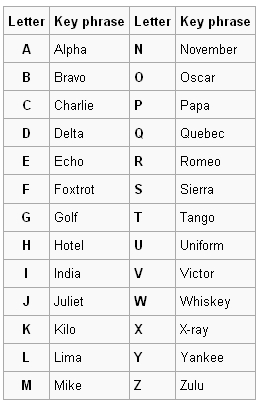
One weakness with the English alphabet is that when they are spelt out aloud, some letters are too similar and end up being confused. For example, B sounds like D and M sounds like N. Although this is not too major an issue in normal life, it becomes very problematic when giving important information over the phone, such as an identification number. The same problem applies in the military where precise orders are required. To overcome the issue of similar-sounding letters, many systems have been developed to replace the letters with words when spelling words aloud over the phone or radio. For example, if the ID number EFS9201 has to be told to the other person, it can be read as “echo-foxtrot-sierra-nine-two-zero-one”. It is also used in the military to say abbreviations, such as “oscar mike” for “on the move”. As the spelling alphabet system is designed so that no two words sound similar, it is a very effective way of accurately transmitting information over the phone.
The spelling alphabet (NATO phonetic alphabet) is as follows:
Travelling is fun. But strangely, the etymology of the word travel is the Latin word tripalium, which means “torture instrument”. This is most likely because in the old days before airplanes and trains were invented, travelling was often long, arduous and painful. Travelling is probably the least terrifying form of torture. Let us explore the various methods of torture used throughout human history. There are many types of tortures, but they can be largely divided into physical and psychological torture. The main goal of torture is to induce maximum pain to extract information from, punish or to execute a person.
Physical torture is very simple: inflict as much pain as you can. For example, you can simply tie the person to a chair and beat them senselessly, or apply pressure to a wound to cause intense pain. A useful tip for beating someone is to place a phonebook on their stomach or hand and hitting the book, which transfers pains while not leaving a bruise or any marks. A simple way to cause extreme pain is the use of fingers. Finger tips are extremely sensitive and contain many nerve endings, meaning sticking needles under the nail bed or ripping the fingernails off causes extreme pain. Like this, medical knowledge has often been used to develop new ways to torture people. For instance, heating the sole of the feet with fire causes severe pain, electricity used in the right amount can keep the person alive while causing pain and seizures, and if you lie a person flat and on a slight decline (so the head is lower than the body), put a cloth over their face and pour over it, you can induce a sensation of drowning (this is called waterboarding and is used by the CIA). Another simple, effective torture method is the joori-teulgi(주리 틀기) from Korea, where a person is tied to a chair with the feet bound, with two long sticks inserted between the thighs, crossed, then pulled down to streth the thighs apart. This causes extreme pain and suffering.
As mentioned above, torture can be used to kill a person too. The famous hanged, drawn and quartered torture was used in the Middle Ages to punish treasonists. The convict was drawn behind a horse for a while and then hanged until just before death, when they were disembowelled, beheaded and quartered. Another strange, complicated method of torture can be found in China, where slow slicing was used. Slow slicing involves tying a convict to a post and cutting slices of flesh off him until he dies. Executioners often had an art of slicing in such a way to prolong the suffering for as long as possible without killing the person. Another execution method found in both Western and Eastern history is dismemberment by horses, where the person’s four limbs and head are tied to individual horses (or cows), which are then made to run in different directions to violently rip the person up.
Animals were used in various forms of torture throughout history around the world. Tying the prisoner to an elephant’s feet to crush them to death, putting a rat on the person’s stomach then putting a pot over it and heating it with fire to make the rat burrow into the person’s guts, feeding them to lions or vicious dogs, coating them in honey and leaving them in the path of fire ants to make them get slowly eaten… Out of all of these, the most bizarre method is the goat torture used in ancient Rome. This torture involved tying the prisoner to a chair and securing their feet, which were coated with salt water. Next, goats were released around the prisoner. The goats would lick the sole of the feet to cause tickling, which over a prolonged period is interpreted as pain by the body. This eventually drives the person insane from pain.
Unlike physical torture, psychological torture induces shame and fear rather than pain. Threatening, solitary confinement, sleep deprivation, rape and sexual torture, sensory deprivation, exploitation of phobias, loud noises (such as banging on a door constantly), blindfolding the person and rubbing a balloon on their cheeks, placing foreign objects or snakes in the anus or vagina, leaving them in a container full of insects… Psychological torture has just as much a variety as physical torture and can have longer lasting effects on the person. Furthermore, as it leaves no external marks, it is still frequently used in the modern day.
No matter what the method, inducing extreme pain to control people, extract information and cause suffering is an inhumane act that cannot be tolerated. If mankind had focussed their creativity and effort into more constructive and altruistic things rather than discovering various ways to cause pain, we would probably be living in a much better world.
The following is an incidental finding from an experiment studying conditioning in dogs. In stage 1, a dog was tied on a leash in a room with electrified floors to prevent it from running away and was shocked for a day. Next, the dog from stage 1 and another dog were left in the same room without any leashes, leaving the door opened so that they could run away when they were shocked. Although the dog that did not pass stage 1 (fresh dog) immediately ran to the next room, the dog from stage 1 just helplessly lay down on the floor, receiving the electric shock. In stage 3, the same dog from stage 1 was taught that going to the next room prevents it from getting shocked. However, even after learning this, the dog refused to move and stayed in the room and accepted the shock. It had learned helplessness.
Everyone has depressing moments in their lives, but when these repeat over time it can cause you to feel that life is an inescapable pit of despair. You will learn a sense of helplessness that no matter what you do, the result will be failure and disappointment. But the moment you accept this helplessness, the nightmarish fate that you loathe so much becomes reality. There is no such thing as fate or destiny. If you do not like the fate given to you, free yourself the restraints of life, break away from the fetters and pioneer a new future for yourself.
In the children’s story Goldilocks and the Three Bears, the protagonist is found trying out various porridges, chairs and beds until she finds the one that is just right for her. Because of this, the name “Goldilocks” has become a symbol for something that is “just right”. A Goldilocks economy is one where there is high growth but no inflation; a Goldilocks planet is one which is not too hot or too cold, making it an ideal planet for life; the Goldilocks effect is when success is achieved because something was not too great or too little.
The Goldilocks effect is a law of nature that is far more important than you would think. Nature always seeks consistency, as shown in the human body. For something as complex as life to exist, a cell must maintain its internal environment in a perfect, ideal state. French physiologist Claude Bernard observed that a cell’s internal environment does not change even with changes in the external environment, and commented that “The stability of the internal environment is the condition for the free and independent life”. This is the basis for homeostasis. Without homeostasis, life cannot exist and all living things put in all their effort in keeping homeostasis. Our body constantly strives to keep various factors such as pulse, blood pressure, oxygen saturation, temperature, blood glucose, electrolytes and numerous hormones etcetera in a stable range. One could possibly argue that the meaning of life is “to maintain homeostasis” – a rather cyclical argument.
To understand the importance of homeostasis, let us look at how changes in the external environment affect us. Our core temperature is maintained in a tight range around 36.5 degrees. If it is altered even a couple of degrees, we exhibit symptoms of hypothermia or hyperthermia. If the weather is too hot, we sweat to cool ourselves; if the weather is too cold, we shiver to raise our temperature. After a meal, we secrete insulin to lower our blood glucose, while we secrete glucagon when starving to raise our blood glucose. Failure of either system leads to either diabetes or hypoglycaemic shock respectively. Homeostasis is an extremely complicated and intricate self-repair system that cannot be imitated.
The Goldilocks effect can be applied beyond physiology to our lives. Everything in moderation; to go beyond is as wrong as to fall short. If we have too little money, it is a problem. If we have too much money, it causes other problems. Whether we work or play, doing too much or too little of either can be bad for us. Medicines become poison in excess and even love in excess becomes obsession. In the marathon that is life, if you run too fast you end up collapsing from exhaustion, while running too slow will mean you never get anywhere.
The secret to happiness lies in understanding what is “just right”.
We laugh when we are happy. Laughter provides us with happiness and is the best medicine available to us, relieving the pain and stress of life. In fact, when we laugh we secrete a neurotransmitter called endorphin, which as the name suggests (endo(inside) + morphine), has the same properties as morphine.
What makes us laugh? The best theory to date is that laughter is an instinctive response to the passing of danger (also called the relief theory). For example, if our ancestor came across a predator but it passed by without noticing him, he would have laughed in response to the relief he felt. Others would see from his laugh that the danger had passed and laugh also (possibly explaining why laughter is contagious).
This theory also explains why humour makes us laugh. When you throw a joke, you are essentially giving the other person a “cognitive riddle” with a logical inconsistency. This inconsistency causes the recipient’s subconscious to become confused: “Why is it funny? Why can’t I understand it?”. As jokes are fundamentally a “surprise” to the other person’s mind, they try to solve it and figure it out whether it is a danger or not. If they get the joke, the inconsistency is solved and the person feels relief (as it has been revealed that the confusion brought on by the inconsistency was not dangerous). Once the confusion passes, the person laughs in response. But if the person does not get the joke, the “danger” has not passed and the person does not laugh. This is the basis of one of the laws of comedians: “if the audience is confused, they do not laugh”.
Laughter is beneficial for your health. Frequent laughter lowers the blood pressure, boosts the immune system, relieves pain and lowers the levels of stress hormones such as cortisol. Laughter is especially good for your mental health, therefore having a five-minute laughter yoga session every day where you just laugh as hard as you can will help you lead a happier life. However, ironically laughter can kill you too. Cases of “death from laughter” have been recorded since ancient Greek times to the modern day. The cause has not been identified but it is known that intense laughter can cause cataplexy, which is a paralysis induced by extreme emotions. It is possible that intense laughter overloads the nervous system and causes a heart attack.
When and what was the first surgery performed by mankind? Many would believe it to be a simple procedure such as suturing a wound. But would you believe that the earliest surgical procedure was brain surgery in 6500BC? Surprisingly, this is true.
Archaeologists have found a large amount of skulls with a large, round hole in them. Some of the oldest skulls with holes were found in France, where 40 skulls from the Neolithic era were excavated. Archaeologists believed these holes to be from a battle leading to a dent in the skull. However, these holes were actually the results of a surgery (signs of bone recovery can be seen around the edges of the hole, suggesting the patients were alive for some time even after the operation). These skulls all belonged to trepanation patients.
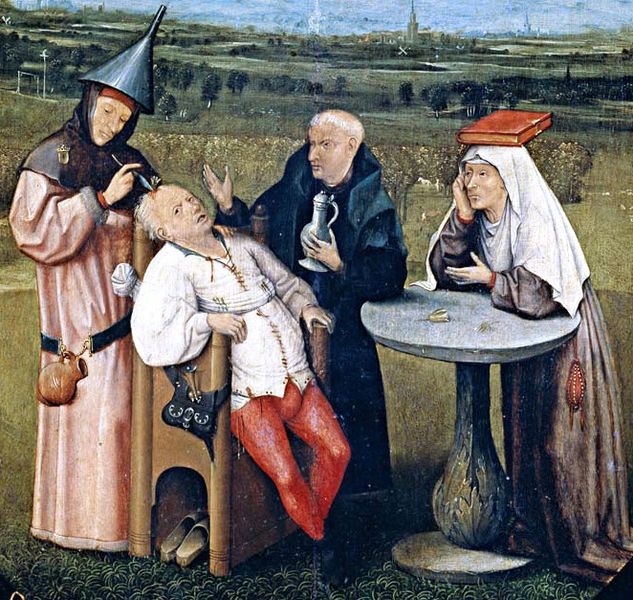
Trepanation is the surgical opening of the skull by drilling a hole in it. This is an ancient surgery that can be found throughout history. Hippocrates and Galen from ancient Greece both recorded detailed instructions on trepanation, ancient Incans performed the surgery and it was also common during the Middle Ages and the Renaissance in Europe. These surgeries were most likely indicated for skull fractures where fragments were embedded in the brain. During the Middle Ages when it was better known that the brain was the seat of the soul, trepanation was used for psychiatric treatments too. For example, in 15th century Netherlands, trepanation was used to excise a so-called stone of madness that was supposedly the cause of insanity. Like this, it was believed that trepanation could release the demons and insanity trapped in the skull.
Although this operation sounds hilariously misled, it is still used in modern medicine. Of course, it is not known to treat insanity, but rather to treat brain bleeds. Extradural and subdural haemorrhages occur when a rupture of an artery in the brain causes a collection of blood in the skull, compressing the brain. This is a dangerous situation which can lead to a stroke or even death. One treatment of this condition is trepanation, or a burr hole, where a small hole is drilled in the skull to relieve the pressure, lowering intracranial pressure and stabilising the patient. Trepanation is an excellent example of how we can learn from the past and how medical knowledge from ancient times is sometimes still valid.
An airplane flying across the sky faces many dangers. But a very common yet not well-known type of accident is the bird strike. Just as the name suggests, a bird strike is when a plane collides with a flying bird. This may not sound so dangerous, but considering a plane typically flies at 800~900km/h, the energy from the collision is quite significant. If a plane flying at 800km/h collides with a 5kg bird, the energy generated is 92 tonnes. This is not only enough to instantly kill the bird, but also enough to damage the plane.
The most common type of bird strikes is when a bird collides head-on with the windshield or gets sucked into the engine. The latter can cause severe damage to the engine and even cause it to fail. For example, in 1960 a plane flying above Boston collided with a flock of starlings, leading to all four of its engines failing and causing it to crash, killing 62 passengers. Since birds typically fly below an altitude of 9000m, bird strikes most often occur during take-off and landing. However, there are case reports of much higher altitude crashes, with the record being held at 11300m.
According to statistics, the most common type of bird involved are waterfowls and gulls, with 15% of bird strikes being severe. Bird strikes cause $1.2 billion worth of damage annually worldwide and has cost 200 lives since 1988. The first bird strike occurred with the invention of the airplane, as recorded by the Wright brothers (inventors of the modern airplane). As bird strikes cause so much damage, airports place many countermeasures to prevent them. The most frequently used methods are driving away birds from runways by using scarecrows and other methods, or modifying the plane and engines to be more bird-resistant.