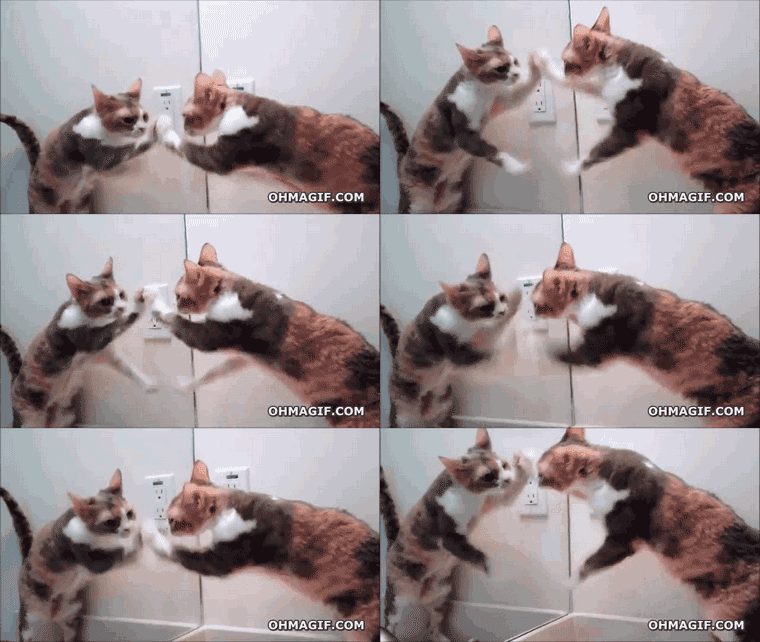
We look around the world we live in and marvel in all its complexity and grandeur. But Mother Nature focusses on one thing when it comes to design: efficiency. That is to say, that nature strives to design things that will do the job best. For example, stars and planets are always round because a sphere is the most effective way to get all the mass as close to the planet’s centre of gravity as possible (a process known as isostatic adjustment). The wings of a bird have evolved to maximise the thrust generated at the least energy cost, while the sleek, teardrop body shape of fish allow for them to slip through water with minimal resistance. One of the best examples of nature coming up with the best design solution is beehives.
If you look closely at a beehive, you will find that it is made up of tiny hexagons. Each hexagon is a room that a bee can fit in and the walls are made from wax. The interesting thing about hexagons is that it has many properties that make it the ideal shape in construction.
Firstly, hexagons can fit together perfectly to tile a plane, meaning that bees can tile thousands of columns without wasting any space. The little columns even end in a unique pyramidal shape that allows them to tile up nicely with each other at the centre.
Secondly, a hexagon has 6 rotational symmetries and 6 reflection symmetries, making it very easy to tile as every bee will know what orientation to build their cell in using the side of any cell as a reference.
Lastly, in a hexagonal grid each line is as short as it can possibly be when tiling an area with the smallest number of hexagons. Therefore, bees can use much less wax when constructing hives, while achieving remarkable strength as hexagons gain lots of strength under compression. This design also allows for the maximum amount of honey stored in each cell.
Bees have mastered this architectural feat not through physics and mathematics, but through evolution – the driving force of nature. Over millions and millions of years, various types of bees will have experimented with square-celled hives or triangular-celled hives, but they could not survive as long as the hexagonal-celled bees because their hives were less efficient. This is exactly why nature is so good at coming up with the best solution to a problem. Because in nature, the best solution to the problem an environment offers is rewarded with survival.
There is a farmer who is unhappy with the milk production from his dairy farm. To rectify this, he writes to the local university asking for advice. A theoretical physicist responds to the request and visits the farm. He then takes many measurements such as the size of the cow and proceeds to do some calculations. After finishing all of this, he tells the farmer: “I have a solution, but it only works for spherical cows in a vacuum.”
The point of the joke is that in science, models are frequently used to simplify reality. Because there are infinite amounts of variables, it is impossible to predict anything unless the scenario is simplified through certain assumptions and removal of factors. For example, many physics principles make assumptions such as not accounting for air resistance. Occam’s razor states that if you shave away all the complex details, the simplest answer remains. But perhaps we oversimplify some things?
Money is a human invention that acts as a medium of exchange and a store of value. It lets us easily carry around our assets in the form of paper, or nowadays, on a card. But because of its characteristics, money allows for some very intricate, complicated con schemes. One famous example is the Ponzi scheme – a type of investment scam.
In 1920, Charles Ponzi had a great idea. Back then, people would send an international reply coupon along with international mail so the receiver could send a reply using the coupon. Ponzi noted that since the value of these coupons were constant across nations, buying it cheap in one country then selling them in the United States would lead to profit. To kickstart his business idea, he began gathering investors, to whom he promised large returns that the investors could not refuse. However, when Ponzi began trading the coupons, he quickly found that it was not effective and he did not make the profit he expected. But instead of telling the investors that his plan failed and that they would not get the returns he promised, he decided to try something different.
Having not heard of Ponzi’s failure, new excited investors asked Ponzi to invest their savings too. Ponzi used the invested funds to pay off the original investors by redistributing the money. Happy that they got their promised returns, the original investors told their friends and family about the incredible opportunity. This brought more new investors to Ponzi, whose money he used to pay off the previous investors. Because Ponzi took a commission from each investment, he quickly raked in a massive amount of money – just by redistributing money around and not actually investing a single cent.
But Ponzi schemes do not last. Eventually, the amount of new investments were not enough to pay off the previous investors and people began investigating, only to discover that Ponzi was scamming them all along.
The Ponzi scheme relies on three things: enticing investors with the promise of high returns, intricate redistribution of money to feed the previous group of investors and the good reputation built through word of mouth. Because the scheme relies on paying old investors with money taken from new investors, a larger number of new investors is needed compared to the old investors. This leads to the formation of a pyramid. When the number of new investors is not enough, for example during a recession, the pyramid’s base becomes weak and the whole scheme collapses, with everyone losing money except for the schemer and the few original investors.
(Click Read More for diagram explaining a Ponzi scheme)
When a person is on the verge of death, they may show a very strange pattern of breathing. They will begin gasping for breath, take deep laboured breaths, begin to make strange noises and possibly have some muscle jerks (which may look like a seizure). The breathing makes it look as if the person is taking a deep breath and sighing, while gasping every now and then irregularly. This is called agonal breathing and it is most likely caused by an oxygen-starved brain sending weak signals to try kick up the respiratory drive for more oxygen.
Agonal breathing is not uncommon in cases of cardiac arrest. It is important to note that agonal breathing is not an efficient form of breathing and thus it cannot be said that the victim is “breathing” when this occurs. Because it looks like the patient is taking deep breaths, bystanders may be fooled into thinking that they have been resuscitated and have begun breathing again. But this is not the case and the patient is still clinically dead. Ergo, one should not stop CPR even if the patient begins taking deep breaths and sighs. The presence of agonal breaths usually indicate a better outcome for the patient.
Have you ever noticed that when a car or train speed past you, the sound it makes changes in pitch depending on where it is? For example, imagine a train loaded with a marching band. You watch the train come closer and closer to the station where you wait, while the band plays a single note. As the train approaches, the pitch of the note gets higher and higher. The train does not see you and races past the station. As it gets further from you, the note played by the band becomes lower and lower in pitch again. If you cannot imagine this, the next time you see a police car or ambulance racing past you, carefully listen to the sound of the siren.
This change in pitch is called the Doppler effect. The Doppler effect is defined as the change in frequency of a wave (such as sound) for an observer moving relative to the source. It occurs because of the nature of waves. When the source of the sound is still, sound waves ripple out in all directions at a uniform speed. But when the source begins to move, the waves in front of the source begins to bunch up as the source moves with the wave, shortening the distance between each successive wave. As the waves bunch up, the frequency of the sound wave increases, causing a stationary observer to hear it as a higher pitch. This is essentially the same as the waves in the front of a moving boat being bunched up.
The Doppler effect is very useful as it lets the observer measure the speed of the moving object from the amount of “shift” that occurred in the measured wave. This is how speed guns work. Astronomists can use the shift in colour of a star to measure the speed at which it is moving away from or towards us (known as a blue or red shift respectively). In medicine, the Doppler effect is used to visualise the flow of blood in the heart or through vessels on an ultrasound.
In modern society, life gets extremely busy and we have to move quite fast to catch up with it. But like with the Doppler effect, sometimes moving too fast can distort things. You might lose track of what your hopes, dreams and priorities are. People might see a distorted version of who you really are and say that you have “changed”. So no matter how busy you are and how fast the world spins on, remember that it is okay to slow down every now and then just to get a clear picture of where you are, who you are or what you are doing. For in the wise words of Ferris Bueller: “Life moves pretty fast. If you don’t stop and look around once in a while, you could miss it”.
Biologists state that the driving force behind evolution can simply be summarised as four forces: fight, flight, feed and mate (“fuck”). These are known as the Four Fs. Evolution is described as the process by which species adapt to an environment through modifications in the genomes of successive generations. The Four Fs describe the adaptations most commonly seen in evolution; that is, the four things that species evolve in order to better adapt and survive their environment. For example, carnivores developed sharp teeth and claws to hunt better and herbivores developed faster legs to flee from their predators better. Nature is a vicious battleground where different species compete with each other for survival, and the Four Fs are the most powerful weapons of survival.
As much as we’d like to think that we are higher-order, civilised beings, human beings are still driven by the basic four forces that drive every other species in the world. Obviously, our bodies are well-adapted to these forces, such as our fight-or-flight drive activating in the face of danger to let us fight harder or run faster through adrenaline. Anyone can see that nature has done her job well by bestowing us the gift of satiety and orgasm to promote our feeding and mating. But what is interesting that the Four Fs go beyond our “natural evolution” to affect the evolution of our civilisation.
Consider this: what is the purpose of war? Since the dawn of time, mankind has spent a considerable amount of resources figuring how to most efficiently kill another group of people, or live in fear that other people will kill us. If we study the behaviour of chimpanzees (one of the few species other than us that wage warfare), we can see that their motivation is for food and sex (i.e. mating partners). This also applies to mankind and it is not a story of ancient times. It is well-known that raping and pillaging runs rampant during wars. Less than 800 years ago, a man named Genghis Khan was so successful in waging war that DNA evidence suggests that 0.5% of the world population are descended from him. Even in the present, countries wage war to secure natural resources to ensure that their people can eat, as the health of the economy directly correlates with the ability of people to put food on their plates. Almost every war essentially boils down to a fight for food.
Then what about sex? Like it or not, sex has been a tremendously influential force in history. From Cleopatra’s seduction of Caesar preventing Rome’s invasion of Egypt, to Henry VIII turning against the Catholic Church to marry Anne Boleyn, sex has been a timeless motivator for humanity. Although the consequences would not be as dramatic as those described, a significant proportion of our actions are also based on our primal desire to reproduce.
Of course, this is not always the truth and human beings are capable of acting on less wild motivators such as happiness and altruism. However, the next time you make a decision or see a conflict on the news, question this: how much of an impact did food and sex have to motivate that?
In 1990 when the internet was still in its infancy, Mike Godwin observed something while browsing through internet forums. From his observations, he humorously coined the following adage: “As an online discussion grows longer, the probability of a comparison involving Nazis or Hitler approaches 1”. This essentially means that no matter what the topic of the online discussion may be, given enough time, someone will eventually make a comparison to Adolf Hitler or the Nazis.
For example, during a discussion about animal rights, someone may decide to post: “You know who else loved animals? Hitler.” No matter how unrelated the topic may be, someone will inevitably make a hyperbolic comparison to Hitler. It is also widely accepted that the moment this happens to a discussion, it is considered dead and the one who made the comparison loses the discussion. It should be noted that this law only applies to discussions not originally related to Hitler, the Nazis or totalitarian regimes and ideologies where the comparison to Hitler may be appropriate.
This law is closely related to a logical fallacy known as reductio ad Hitlerum, where someone tries to refute an opponent’s argument by comparing it to something Hitler would think or say. It is a crude, classless form of the ad hominem fallacy, where someone attacks the opponent personally rather than the argument itself. The reductio ad Hitlerum is extremely ineffective as in an intelligent discussion, such an effort would simply be considered childish and moronic.
Mirrors are perhaps one of the most useful yet underrated inventions that we use every day. From shaving in the morning to fixing make-up during lunch, the modern man or woman will use a mirror (or some other reflective surface) at least once a day. Mirrors show us an accurate reflection of the world that we cannot see. We can only look forwards and need a mirror to reflect light going the opposite way to see behind us or – more importantly – ourselves. To do this, a mirror must directly reflect every photon (particles that make up light) at exactly the right angle so the image is not distorted. If the mirror is not completely flat or perfectly polished, light will not be reflected at the exact angle and we will see a distorted image – much like looking into a mirror at the circus. Therefore, one could say that a perfectly flat, clean mirror is absolutely honest, as it will reflect exactly as it sees.
However, this statement is not entirely true as what you see in the mirror is a mirror image of reality. This may seem trivial, but it has significant consequences. This is most obvious when you hold a book up to a mirror. Without training, it is very difficult to read something that is mirrored. This is why Leonardo da Vinci wrote his notes in mirror image. This phenomenon of something becoming completely different is also seen in chemistry. Because of the way molecules are arranged, it is possible to have a property called chirality – where two molecules with the same elemental composition are built in the mirror image of one another. Essentially, it is as if the molecule can be either left- or right-handed. It turns out that even if the composition is the same, two molecules of different chirality (called enantiomers) can act completely differently. This effect may be as simple as changing the way a liquid polarises light to making a drug completely inert or even toxic. For example, the amino acid carvone that gives the spearmint taste only tastes like spearmint if it is L-carvone (“left-handed”), whereas D-carvone (“right-handed”) is tasteless despite having the same molecular formula.
Since the topic of chirality is rather technical and hard to understand, let us move on to the field of literature. One of the best examples of how mirrors can completely change something is seen in Lewis Carroll’s novel Through the Looking-Glass and What Alice Found There. Lewis Carroll understood the significance of mirror images in chemistry and wrote this novel to portray how quirky and strange a “mirror world” may be. Through the Looking Glass is a sequel to the famous book Alice in Wonderland and describes a world that is the mirror image of Wonderland. Carroll cleverly wrote the first book so that it would be the opposite of the first book. The first book starts outdoors, is set in the summer, uses changes in size as a plot device and focuses on the theme of trump cards. The second book starts indoors, is set in the winter, uses changes in direction as a plot device and draws on the theme of chess. There are even characters such as Hatta and Haigha who are the mirror images of the Mad Hatter and the March Hare from the previous book. Although they are very similar, they are just not the same and hence Alice does not recognise them. Perhaps the line that best shows Carroll’s understanding of the dangers of mirror worlds is this: “Perhaps Looking-glass milk isn’t good to drink”.
The field of psychology is also heavily interested in mirrors. It is a well-known fact that our brains recognise the purpose of mirrors. If you put a mirror in front of someone, you know that the person will examine themselves, groom themselves or simply make funny poses. A simple experiment shows how used to mirrors we are. If you angle two mirrors at right angles and fit a transparent sheet of glass in front of the two to make a prism shape, the image you see through the glass is a reflection that is not mirrored. Because it is not mirrored, you can hold up a book to it and still read it fine. This is known as a non-reflecting mirror. An interesting experiment shows that if you make people use this kind of mirror, they become incredibly confused as they are too used to using a mirror image to see themselves. Even though the reflection they see is a “truer” image, because their brain automatically flips the mirrored image, they become uncoordinated and keep moving their hands in the opposite direction.
As mentioned at the start, mirrors are a human invention. Although reflection occurs in nature, such as on a clear surface of water, animals generally are incapable of using mirrors. This is such a universal fact that animal psychologists use a mirror test to determine whether a specie of animal is self-aware or not. The test is done by showing an animal a mirror. Most animals will see their reflection and automatically believe that it is another animal, as they are incapable of thinking that it is a reflection of themselves. Hence, they will try to threaten, attack or flee from the image they see. But if you show a higher-order animal such as an ape or dolphin a mirror, they will start to groom themselves as they realize that the mirror is simply showing themselves.
This is what sets us apart from animals. Not only are we capable of recognizing ourselves in a mirror, but we have the ability to go one step further and reflect on ourselves using the mirror of our minds. Some people may take a look at the person in this mirror and be content with who they are. But some will gaze into the mirror and, much like the animals in the mirror test experiments, see a completely different person they do not recognise. This may cause disappointment, frustration or even disgust as we realize that we are not who we think we are or aspire to be. Then again, sometimes you will gaze into the mirror and see a person that has strengths such as courage – a person you could be if you realized your true potential. The most frightening realisation would be to discover that there is no one in the mirror.
Lastly, we could consider the mirror of behaviour. Goethe said that “behaviour is a mirror in which everyone displays his own image”. The corollary to this is that human beings read behaviour to try and interpret another person’s character. One can use this to greatly improve the relationship and connection with another person. Mirroring is the act of subtly copying the other person’s behaviour to build rapport– where an empathic bridge is constructed between two people. Rapport is particularly useful in jobs that involve earning the trust of strangers in a short time, such as in healthcare or business. By matching the other person’s body language, such as posture or actions like taking a sip of water, the other person will open up more easily to you. The same applies to verbal and emotional mirroring where you subtly reuse the words the other person spoke and reflect their emotions such as excitement. Obviously, one must be subtle with mirroring as a direct imitation will appear mocking and strange. If you are able to subtly copy their behaviour, the other person’s subconscious mind will be tricked into thinking that you are similar in character and trust you more. This skill is extremely useful in improving your interpersonal and social skills.
A mirror is a paradoxical object that is absolutely honest yet relatively deceitful. Reflections in the mirror are true yet completely different. If you take a peek into the mirror of your mind, perhaps you will see the person you think you are now or the person you could be in a mirror world. If you are happy with what you see, then cherish that and be proud of who you are. Otherwise, you can always do what Alice did and jump through the looking-glass to find an alternate you – the best you that you can be.
“Listen to the sound of silence.” ~ Buddhist saying
The anechoic chamber at Orfield Labs in Minneapolis is the quietest room in the world. It records a staggering sound level of -9.4 decibels (humans can only detect sound levels above 0dB), thanks to its special walls, floor and ceiling design that absorbs all sound instead of echoing it. The room is so quiet that the only sound you will hear inside is the sound of your own organs: the sound of air drifting in and out of your lungs, the blood being thumped out of your heart, the digested food gurgling in your stomach… Even your ears generate a tiny amount of noise from the tiny blood vessels in its walls. The absolute silence is so disturbing that the longest anyone has ever spent alone in the room is merely 45 minutes.
The disturbing power of silence is also demonstrated in the infamous musical piece 4’33” (4 minutes 33 seconds) by John Cage. When it was first premiered in 1952, the audience watched in anticipation as the pianist David Tudor entered the stage. Tudor calmly approached the piano and sat down with a graceful demeanour. Then, he closed the piano lid. For 4 minutes and 33 seconds, the pianist did not play a single note. His only actions were opening and closing the lid to mark the end of one movement and the start of the next one. After the 4 minutes and 33 seconds, he stood up, bowed to the (stunned) audience and exited.
The audience was confused, bewildered and angry. How dare they be mocked with such an outrageous performance? By definition, silence is the absence of music, meaning that the audience were not given the musical performance they expected. However, the audience simply did not understand the “sound of silence”. Outside of the anechoic chamber mentioned above, there is no such thing as absolute silence on Earth. For example, that concert room would have been filled with the noise of the unsettled audience shifting in their seats, the raindrops pattering on the roof and the sound of the footsteps of those who walked out in rage.
It is common to see creatures in mythology that are a combination of different animals. The unicorn, griffin, chimera, basilisk, hippocampus… The list goes on and on. But perhaps the more interesting combinations are those between humans and animals. Centaurs are a cross between man and horse, harpies are a cross between woman and bird while mermaids and mermen are half-human, half-fish. Although these examples are all from ancient mythologies, there are more recent examples such as the merlion.
The merlion – top-half lion, bottom-half fish – is the national symbol of Singapore. This symbol was designed by Alec Fraser-Brunner in 1964 to promote the name of Singapore. Since then, the merlion has been used frequently in Singaporean art such as in statues and souvenirs. Although the concept of merlions have been found in certain ancient Indian and Hellenistic cultures (not to mention the “sea lion” which is an actual animal), it is almost synonymous with Singapore in modern times.
How did this bizarre combination of a lion and fish come to be? The union of the lion and fish is a symbol for Singapore’s history. Singapore originates from a small fishing village called Temasek – which means sea town in Javanese. This is symbolised by the fish tail, which forms the “root” of the icon. The lion symbolises modern Singapore, which gains its name from Singapura, which means lion city. Furthermore, Singapore is an island nation – a combination of land and water. The core culture of Singapore is descended from Asia via the land mass of South-East Asia, while its affluence and modernisation came from the sea via trade routes. Singapore is one of the most famous and important trade ports in modern history as it controls the passage from the Indian Ocean to the Pacific Ocean. This allowed the country to thrive economically from the flourishing trade, being dubbed one of the Four Asian Tigers (along with South Korea, Hong Kong and Taiwan – all four countries achieved exceptionally high growth rates from the 1960s to the 1990s).