Posted in History & Literature

Tic Tac Toe

Tic Tac Toe is a simple game where you and an opponent make a mark (X or O) on a 3×3 grid once per turn, until one person has made a line of three marks in a row (horizontal, vertical or diagonal).

However, it is so simple that there are only a certain number of permutations, meaning that if you know the algorithm, you can win most of your games (assuming your opponent does not also know the algorithm). This is called a solved game – unlike chess, where there is a near infinite number of ways the game can play out.

First, let’s take the case of you starting first. Put a X in a corner. If your opponent does not put an O in the centre, you automatically win. Your next move is to put an X in any corner away from the O. Your opponent will have to put an O between the two X’s to prevent a loss. Once they do this, you can either put an X in the centre or another corner to create two possible winning moves and your opponent can only block one. You win.

image

If your opponent puts their O in the centre, things get more complicated. Now you can only win if your opponent makes a mistake – otherwise the game is guaranteed to end in a draw. You can take one of two options:

– Place an X in the corner diagonally opposite to your first X. If your opponent puts an O in a corner, you win by putting an X on the last corner to block their attack and create your own double-attack.
– Place an X on an edge square that is not next to your X. You can win if your opponent puts an O in a corner not next to an X by blocking their attack and creating a double-attack.

image

If your opponent plays first, then you can never lose. If an opponent starts in the corner, put your X in the centre. All you have to do now is block your opponent’s attacks and you will force a draw.
The same strategy applies if your opponent starts in the centre – put an X in any corner then block every attack. The game will end in a draw unless your opponent slips up.

As you can see, there are only so many ways a game can play out, meaning it is very easy to force a draw.
A more interesting game is omok (오목 in Korean, gomoku in Japanese) – where you put white or black stones on a 15×15 board to try and connect five stones in a row.

Posted in Philosophy

Heroes And Villains

A nearly universal belief most people seem to share is that we all like to think that we are the “good guy” in the story of our lives. We like to think that we are doing our best in life to be a positive influence in the world. No one likes to think that they are a villain; all our actions – even the questionable, harmful ones – are justifiable by our intent. Even Hitler thought that his massacre of the Jewish people and other horrible deeds were simply a means to an end to provide an environment where his own people could flourish.

But there comes a point in our lives where we are faced by a situation that challenges this belief. More often than not, it is when someone close to us, such as a friend or partner who we trust in to know us well, criticises us. Not superficial things such as critiquing your fashion sense or correcting your grammar, but digging deep and shining a bright spotlight on a flaw in your person, pointing out how much you have hurt them because of what you said or how you acted.

Such an event typically shocks us to the core. Because of the invisible social contract, we rarely point out people’s character flaws out of politeness and to avoid hurting them. This means we do not always know our own deepest flaws. However, sometimes enough is enough and people will explode in a fit of rage to let you know that you have hurt them through your behaviour. You have not been the good guy. You have been a villain.

Our response to this type of situation defines who we really are. An appropriate response is to listen to this criticism, have a period of introspection to understand your flaw and make an effort to try and correct this and improve yourself. This is a display of maturity. But if you become defensive, reject all criticism and continue to act in a way that hurts those around you, then how could you call yourself a hero?

Remember that life is not a story revolving only around you. You are simply one of many characters, like other people, in the grand, unifying story we call life. Whether you develop your character to be a mature hero willing to accept and improve on their flaws, or an immature villain deluded that they are always good, is up to you.

Posted in History & Literature

Keys To Music

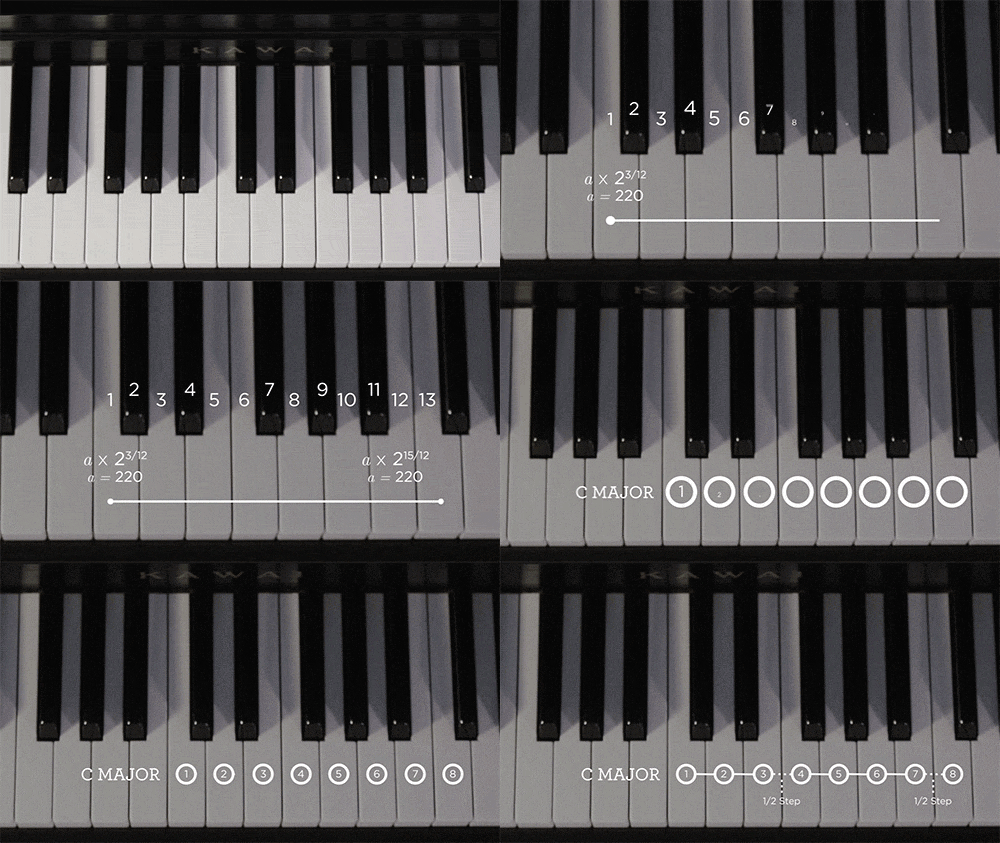
On a piano, the simplest key is the C major key. The C major scale starts from the middle C key, then the seven white keys to the right are pressed in order. The notes are named as follows: C-D-E-F-G-A-B-C. This is known as the diatonic order of the piano. There are various other keys, but every one involves the black keys as sharp and flat notes are used.

Why does the diatonic order – the simplest scale – start at C instead of A?

When the modern system of written music came to be, the lowest available note was named “A” for simplicity, then each note above it was named alphabetically. However, at the time the notes were not matched to any specific scales. Furthermore, they started by only using seven letters, but later agreed on a 12-note octave. To make room for the extra five notes, they invented accidentals – the flats (b) and sharps (#). When the piano keyboard was invented, they made the white keys play natural notes and black keys play accidentals (flats and sharps).

As Western music developed, people became fonder and fonder of major keys (the “happier” sounding keys, to simplify things). This created a problem, as the simplest major key to only use natural notes was the C major key, which starts at C. The notes return to alphabetical order in the natural minor key, as the A minor scale plays as A-B-C-D-E-F-G-A.

Posted in Science & Nature

Newton’s Flaming Laser Sword

If an irresistible force was to act on an immovable object, what would happen?

A mathematician named Mike Alder decided to approach this philosophical paradox from a scientific perspective. He proposed a simple answer to the paradox – it is not worth discussing.

Alder argued that for an object to be immovable, all known forces must be acted upon it with no effect. Similarly, an irresistible force can only be called that if literally no object could ignore its effects. Therefore, the two cannot possibly exist in the same universe, meaning that the paradox is pointless. As Alder would put it – “Language is bigger than the universe”, as it allows us to formulate impossible scenarios that ignore the rules of science.

The implication of this line of thought is that if you cannot tangibly test an idea, then there is no point in arguing it as it would not add to scientific knowledge. This is a purist view of the fundamental principle of science that is falsifiability.

Sir Isaac Newton was one of the earliest pioneers of this philosophy. He wrote: “hypotheses non fingo”, or “I do not engage in untestable speculation”. Newton challenged the classical school of philosophy, where one would challenge and develop an idea through thought, discussion and argument. When faced with philosophical questions such as whether animals had rights, he would ask: “What set of observations do you consider would establish the truth of your claim?”.

Alder named his principle – that one should only discuss matters that can be tested and verified – Newton’s Flaming Laser Sword (as he believed all good principles should have sexy names). This is a play on Occam’s razor, the philosophical principle that once you shave away the complexities, the simplest truth remains. Alder believed that Newton’s Flaming Laser Sword was a much sharper and more dangerous tool than Occam’s Razor, meaning that as useful as it is, it should be used with care.

Of course, this is an extreme school of philosophy that is only upheld by a group of philosophers who we now call “scientists”. There are still many intangible issues that could only be solved through thinking, such as ethics. Thus, the battle between scientists and philosophers continue.

image
Posted in Life & Happiness

Trademark

What makes us “us”? This is a question that every person on Earth would have asked (or constantly asking) themselves at some point in their lives. We seem to be gripped by an instinct to be unique – to not only discover our identity but to express it to the world.

Our identity is manifested through how we interact with the world. Some people express themselves visually – colourful hair, a token accessory they always wear or a general “look”. Some people opt to express their uniqueness through what they say – such as having catch-phrases or being the witty, funny guy. 

However, by far the most common way people show their identity is through their mannerisms – specifically those we display consciously. For example, some common traits people openly show are “being a hugger”, “always smiling” or “never swearing”. It is almost as if we set up intricate sets of rules for ourselves so that we act in a way that is predictable by people who know us well – a persona code, if you will.

This becomes interesting when the expected behaviour is not necessarily positive, such as when your friend is acting in a way that irks you, like saying something stupid or being overly affectionate. Well, it could be that they are purposefully doing it as per their persona code, knowing that it may not be received well. This seems illogical – why would you act in a way that hurts your image?

This is because our “trademark” – what makes us “us” – is a complex combination of our past experiences, present behaviour and our choices for the future. Due to this complexity, it is impossible to be a “perfect person”. So perhaps the reason that we cling to our mannerisms – whether they are good or bad – is that we would rather be a perfect “me” than a perfect person.

Others may mock us for doing something “that’s so Raven” or “that’s so Jin”. But we would rather show the world our imperfections and be loved for them, than forcing ourselves to be something that we are notperfect.

Posted in History & Literature

Shibboleth

We are often corrected by others (as much as we correct others) on the proper pronunciation of words. Luckily, improper pronunciation is rarely consequential (other than sparking debates such as how to pronounce the word “gif”). However, on numerous occasions throughout history, this was not the case.

During World War 2, American soldiers in the Pacific Theatre came up with a questionable way of detecting enemy soldiers pretending to be allies to sneak in to bases. If a suspicious person was to approach a checkpoint claiming that they were an American or Filipino soldier, the sentry would ask them to say a certain word. The word was “lollapalooza” – an American colloquialism for something that is exceptional and extraordinary. The basis for this test was that Japanese people tend to pronounce the English letter “l” as “r” due to the difference in the two languages. Therefore, if the person was to repeat back “rorra-” they would be immediately shot.

This seems like a highly inaccurate method. What if they were an American soldier who had a bad head cold, or a lisp? But this type of racial profiling by the way someone pronounces a certain word has been commonly used throughout history to filter out people of certain races. Lollapalooza is an example of a shibboleth – a word that can distinguish people of a certain race by their inability to properly pronounce it.

The word comes from the Biblical story of the Ephraimites. When the Gileadites were invaded by the Ephraimites, they fought back and repelled the Ephraimites, who tried to retreat by crossing the River Jordan. The Gileadites planned ahead by securing the river so that they could capture the Ephraimites. They ordered each person crossing the river to say the word “shibboleth”. Because the Ephraimite’s dialect did not include a way to pronounce the “sh” sound, they would repeat back “sibboleth” and were killed on the spot.

Unfortunately, shibboleths have typically been used to identify members of a certain race so that they could be massacred. Nowadays, shibboleths are used in a more light-hearted manner. For example, New Zealanders and Australians mock each other on how each pronounce the words fish and chips. Because New Zealanders pronounce the “i” with a shorter sound, Australians tease that they say “fush and chups”. On the other hand, New Zealanders mock Australians on their long “i” sounds that make it sound as if they are saying “feesh and cheeps”.

Posted in Psychology & Medicine

Pepsi Challenge

The “Pepsi challenge” was a marketing campaign by Pepsi, where a person blindly takes sips from two different cups – one of Coke, one of Pepsi – and states which tastes better. The Pepsi challenge showed that people tended to prefer Pepsi to Coke in a blind sip test. This caused significant controversy and even led Coca-Cola to trial a change in their classic recipe, which failed disastrously.

Of course, there are many reasons why the results of this challenge may be invalid, as Malcolm Gladwell explored in his book Blink. The challenge is designed to isolate just a snapshot experience of each drink. Ergo, people tend to prefer a single sip of the sweeter, more citreous drink that is Pepsi, when they may not have enjoyed it as much if they had to drink an entire bottle.

Furthermore, multiple studies and experiments in the marketing field show a psychological phenomenon called sensation transference. This is when our perception of a sense is affected by other information such as the brand name, packaging or even the colour of the food or drink. For example, margarine was originally white but yellow colour was added to make it look more “butter-like”, greatly increasing sales.

This shows how little things that we may find insignificant can affect our decisions and first impressions. Our subconscious mind is a powerful processor that makes rapid assessments from a sea of information, while not bothering the conscious mind. We might buy a certain wine because the bottle looks more premium than another bottle. We may fall in love with someone because of a small detail like the way their nose looks. But at the same time, it can be just as easily misled as it uses only the information given to it at the time.

So the question is not how powerful your gut instinct is, but if you know yourself well enough to trust it.

Posted in Philosophy

Zugzwang

Chess is a game of choice. Each move sets in motion a myriad of possible games and a single misplay can drastically turn the tables. A skilled chess player will deliberate on each move as they try to predict how the game will flow on from the decision they make, but in an infinite sea of possibilities, choosing the best outcome is extremely difficult.

However, there is one situation that is the direct opposite. Zugzwang is a state in which the most viable, ideal move is an impossible one – to not move. In zugzwang, whatever decision you make will reduce your odds of winning compared to skipping your turn. In some cases, you are even forced to make a choice that will spell your inevitable doom.

Life is similar to chess in that we are always faced with choices. What outfit will you wear today? Will you sit in the front seat or the back? Who will you ask to be your date for the ball? Should I take this job offer to change my career path, or stay in my current, stable job? Some choices are simple and appear inconsequential, yet others make us feel stressed even considering the implications. We often regret choices we made, looking back and wondering “What if?”. How would my life be different had I chosen differently?

But in the grand scheme of things, how important is it that we make “the best choice” each time? A majority of the time, it is highly unlikely that a single poor decision will completely ruin your life. Sure, your life may turn out different for better or for worse in a certain way, but we neglect to account for all of the other ways our life may change. Chaos theory teaches us that even a small change like a butterfly flapping its wings can wildly and unpredictably affect the future. For example, it could be that changing jobs results in your career progress being delayed by five years. However, by changing jobs you may meet the woman or man of your dreams, when you would have not met them had you not changed jobs.

We often trap ourselves in a state of zugzwang – pondering all the horrible ways our decisions may cause regrets in the future. Our fear of the unknown causes us to be paralysed by these choices. But as discussed above, our choices do not cause purely good or bad outcomes, but instead result in a simply different future due to the sheer number of variables that can change.

Ergo, there is no point stressing about each and every choice you make – you might as well pick one, see how it plays out and learn from the experience.

image
Posted in Life & Happiness

The Secret Of Happiness

A merchant sent his son to learn the Secret of Happiness from the wisest of men. The young man wandered through the desert for forty days until he reached a beautiful castle at the top of a mountain. There lived the sage that the young man was looking for.

However, instead of finding a holy man, our hero entered a room and saw a great deal of activity; merchants coming and going, people chatting in the corners, a small orchestra playing sweet melodies, and there was a table laden with the most delectable dishes of that part of the world.

The wise man talked to everybody, and the young man had to wait for two hours until it was time for his audience.

With considerable patience, he listened attentively to the reason for the boy’s visit, but told him that at that moment he did not have the time to explain to him the Secret of Happiness. He suggested that the young man take a stroll around his palace and come back in two hours’ time.

“However, I want to ask you a favour,” he added, handing the boy a teaspoon, in which he poured two drops of oil. “While you walk, carry this spoon and don’t let the oil spill.”

The young man began to climb up and down the palace staircases, always keeping his eyes fixed on the spoon. At the end of two hours he returned to the presence of the wise man.

“So,” asked the sage, “did you see the Persian tapestries hanging in my dining room? Did you see the garden that the Master of Gardeners took ten years to create? Did you notice the beautiful parchments in my library?”

Embarrassed, the young man confessed that he had seen nothing. His only concern was not to spill the drops of oil that the wise man had entrusted to him.

“So, go back and see the wonders of my world,” said the wise man. “You can’t trust a man if you don’t know his house.”

Now more at ease, the young man took the spoon and strolled again through the palace, this time paying attention to all the works of art that hung from the ceiling and walls. He saw the gardens, the mountains all around the palace, the delicacy of the flowers, the taste with which each work of art was placed in its niche. Returning to the sage, he reported in detail all that he had seen.

“But where are the two drops of oil that I entrusted to you?” asked the sage.

Looking down at the spoon, the young man realized that he had spilled the oil.

“Well, that is the only advice I have to give you,” said the sage of sages. 

The Secret of Happiness lies in looking at all the wonders of the world and never forgetting the two drops of oil in the spoon.

(from The Alchemist by Paulo Coelho)
(Image source: http://paper-hero.deviantart.com/art/The-Alchemist-2-254695701)

Posted in Psychology & Medicine

Rat Park

In the mid-20th century, rat models were used by psychologists to study the science of drug addiction. Rats would be placed into cages, connected to a pump that would deliver a dose of morphine when a switch was pressed. These rats would press the switch to get more “hits”, with some rats pressing the button in preference to food and water, eventually dying from dehydration.

In the 1970’s, Professor Bruce Alexander questioned whether this was an accurate description of the nature of drug addiction in humans. He posited that given that rats are social animals, placing them in isolation would put them in an environment where the drugs were the only “escape”. To study this, his team designed a large enclosure that they nicknamed “Rat Park”.

image

Rat Park was designed to be a utopia for rats. It was 200 times the size of a standard cage, filled with comfortable cedar shaving floors, plenty of nesting areas, toys and abundant food. Most importantly, the enclosure had all 16 rats living in the same enclosure, so that they could interact with each other. The control group were placed individually in 16 separate isolated cages.

The researchers gave the rats a choice of two fluids to drink from – water and water laced with morphine. Although the rats initially stayed away from the morphine due to the bitterness, they eventually started drinking from it when they realised the euphoric sensation they got from drinking it. Interestingly, rats in cages would follow the traditionally predicted path of drinking more and more morphine, becoming addicted. However, rats living in Rat Park would barely touch the morphine water. Even when the morphine was sweetened with sugar, the rats would still not drink much of it.

image

Through rigorous experiments, the researchers deduced that the Rat Park residents preferred social interaction over the drug-induced haze from drinking morphine. Rats under the effects of morphine were less able to socialise and in an environment with adequate social stimulus, this was a good enough reason to avoid drugs.

In a different experiment, Professor Alexander’s team put rats already dependent on morphine into Rat Park. They found that despite withdrawal symptoms, rats would prefer staying away from morphine and would attempt to socialise.

Although it remains controversial, Alexander’s research into Rat Park offered new insights into the study of drug addiction. It raised the question of whether drug addiction was purely an issue of biochemistry and how much effect our social environment has on our life choices.

image